
Zebra Danio
Danio rerio
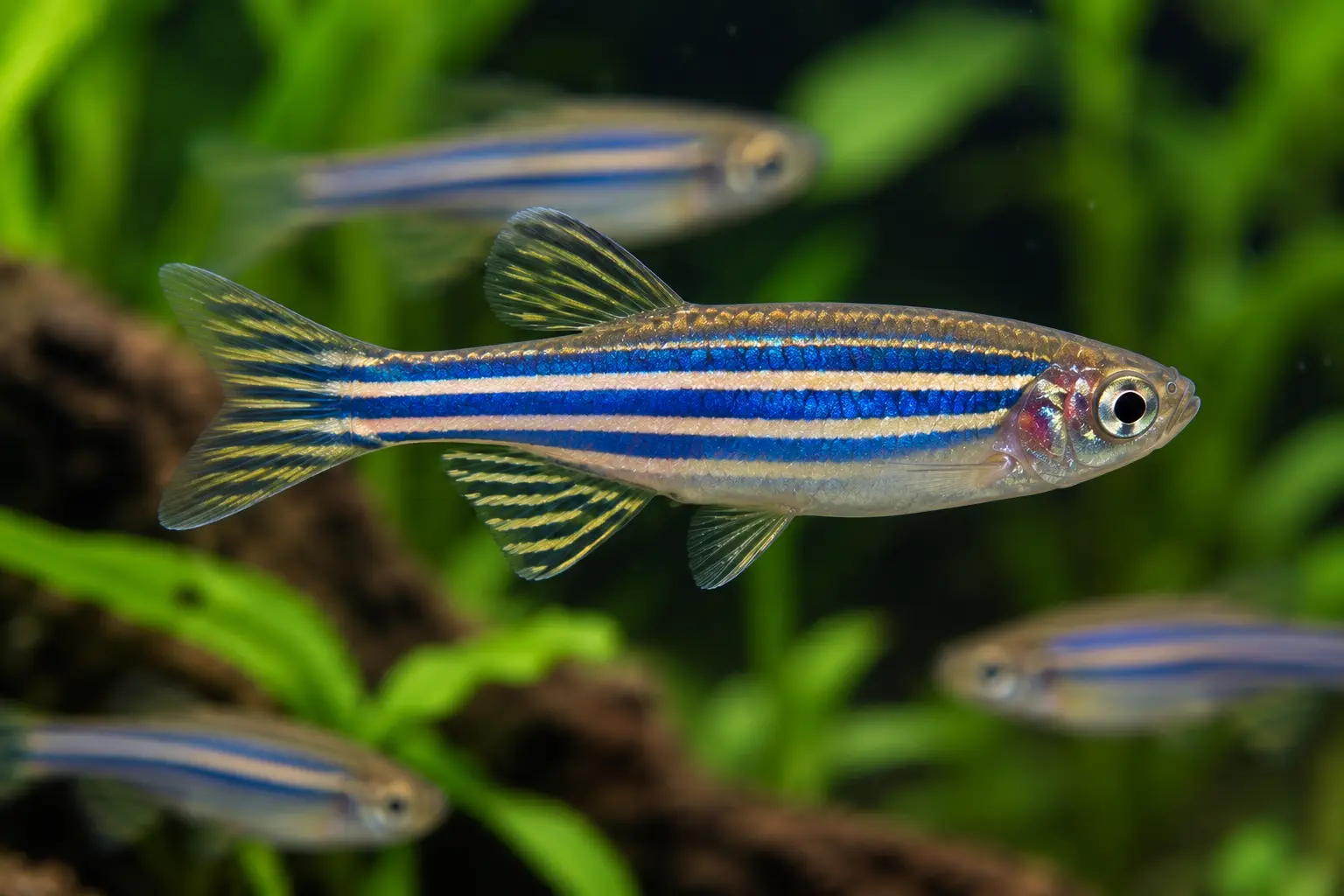
The hardy, striped schooling fish that makes an excellent first aquarium species — active, adaptable and always on the move.
Difficulty
Beginner
Min tank size
38 L / 10 gal
Temperament
Peaceful, active
Diet type
Omnivore
Adult size
4–5 cm / 1.5–2 in
Lifespan
3–5 years
Water type
Freshwater
Zebra danio at a glance
| Scientific name | Danio rerio (Hamilton, 1822) |
|---|---|
| Family | Danionidae (danios) |
| Origin | South Asia — Ganges, Brahmaputra and surrounding drainage systems |
| Adult size | 4–5 cm (1.5–2 in) |
| Tank size (min) | 38 L / 10 gal — 75 L / 20 gal long for a school |
| Temperature | 18–24 °C (65–75 °F) |
| pH range | 6.0–8.0 |
| Water hardness | 5–19 dGH |
| Diet | Omnivore — flakes, micro-pellets, live and frozen foods |
| Temperament | Peaceful, active shoaling fish |
| Lifespan | 3–5 years |
| Care level | Beginner |
Overview
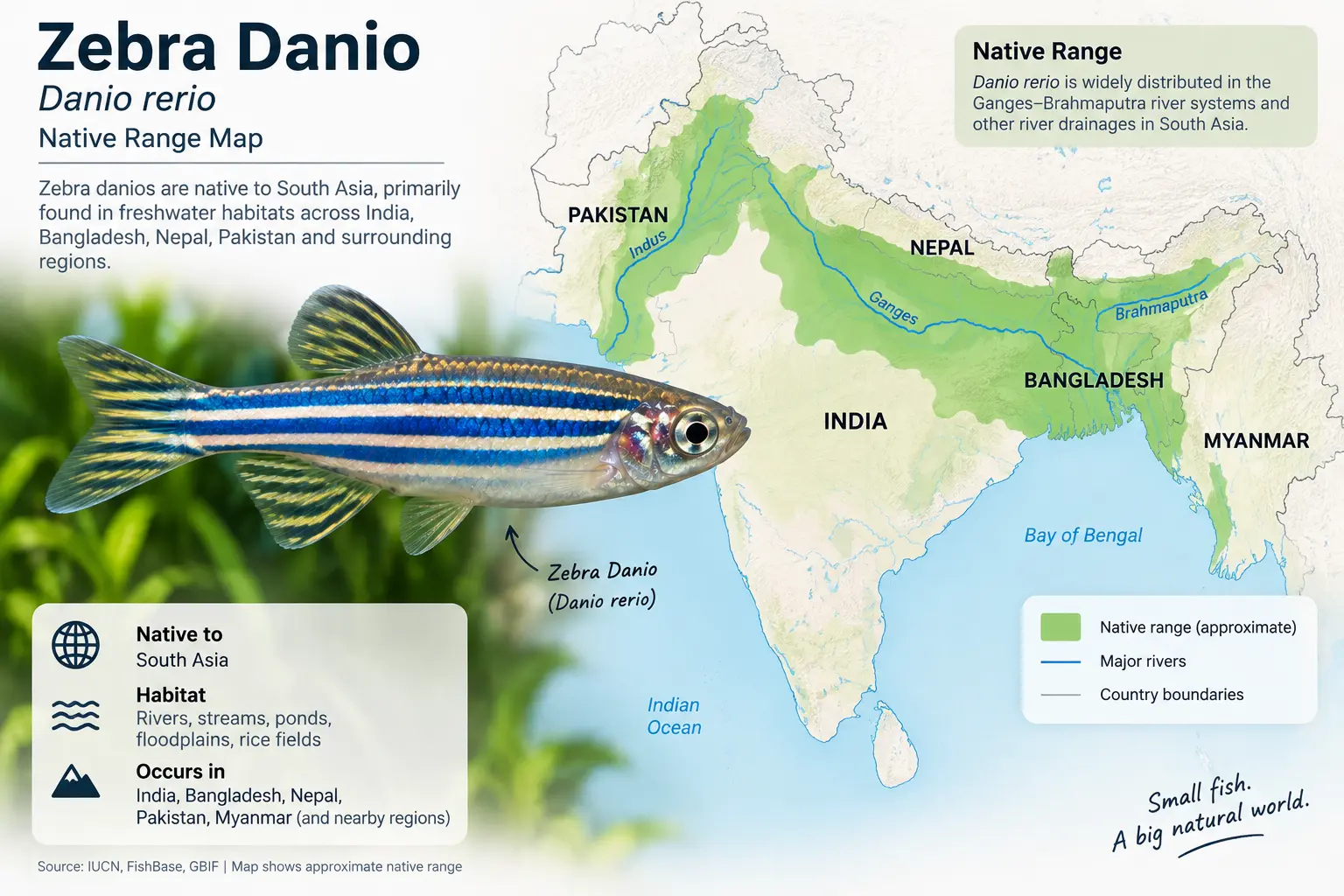
The zebra danio (Danio rerio) is a small, hardy cyprinid minnow from South Asia, instantly recognisable by the horizontal blue-and-silver stripes that run from gill cover to tail. Native to freshwater habitats across South Asia, particularly the Ganges and Brahmaputra drainage regions, it has been kept in aquariums for over a century and is one of the most widely kept — and most scientifically studied — fish in the world; virtually every zebra danio sold today is captive-bred.
It is an energetic, surface-loving shoaling fish that stays small, tolerates cool, unheated water, and eats nearly anything offered, which makes it one of the best beginner fish available. Its constant, darting activity gives planted tanks a lively focal point, and its flexibility with water chemistry lets it slot into peaceful community aquariums. The real care requirement is space and company: zebra danios are sprinters that need a long tank and a school of at least six to feel secure.
Types of zebra danios
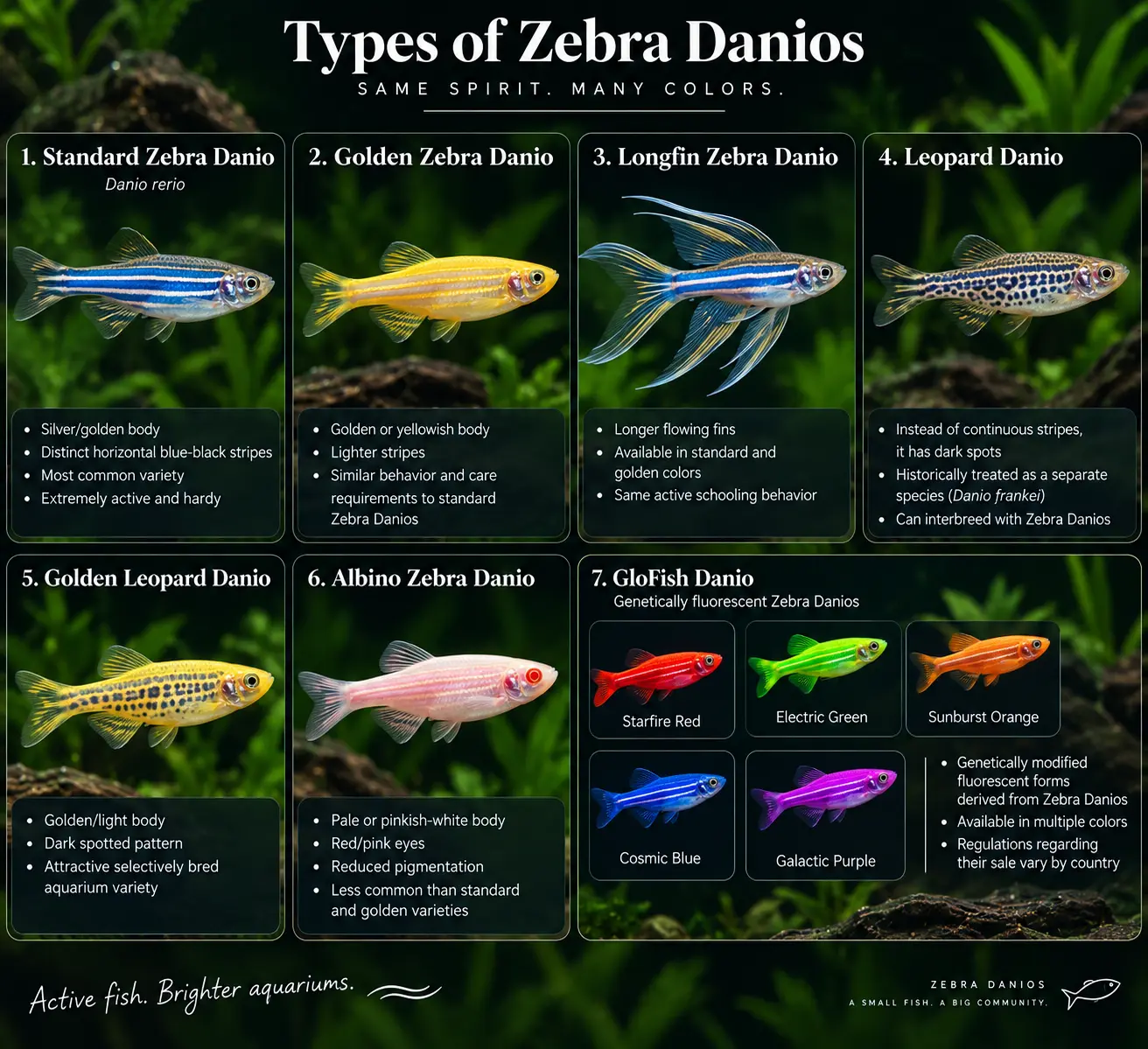
Every fish sold as a zebra danio is one species, Danio rerio — the different types are colour, pattern and fin-length strains, not separate species, and they all mix happily in a single school. The standard striped form is still the commonest, but these are the varieties you will meet in stores. (The “giant danio” often listed alongside them is a different genus altogether and grows twice the size — see the buyer’s notes below.)
Standard Zebra Danio
The original and most common variety: a silver to golden body with distinct horizontal blue-black stripes running from gill cover to tail. Extremely active and hardy — the template every other type is a variation on.
Golden Zebra Danio
A selectively bred colour morph with a golden or yellowish body and lighter, washed-out stripes. Behaviour and care requirements are identical to the standard zebra danio.
Longfin Zebra Danio
A long-finned variety of Danio rerio with longer, flowing fins. It is available in both standard striped and golden colour forms and shows the same active schooling behaviour; the fins simply need calm tankmates.
Leopard Danio
A spotted form of Danio rerio with dark spots replacing the continuous horizontal stripes. Leopard danios were historically described under the name Danio frankei (formerly Brachydanio frankei), but are widely treated in the aquarium hobby as a variety of zebra danio and interbreed freely with striped forms.
Golden Leopard Danio
The combination of the golden and leopard traits: a golden, light body covered in a dark spotted pattern. An attractive, selectively bred aquarium variety with the same easy care.
Albino Zebra Danio
Reduced pigmentation gives a pale, pinkish-white body with red or pink eyes and only faint striping. Less common than the standard and golden varieties, but just as hardy.
GloFish Danio
Fluorescent, genetically modified forms derived from zebra danios. Common commercial colours include Starfire Red, Electric Green, Sunburst Orange, Cosmic Blue and Galactic Purple. Their basic care requirements are similar to other zebra danios, although regulations governing their sale and ownership vary by country and region.
Zebra danio size & lifespan
How big do zebra danios get?
Adult zebra danios reach about 5–6 cm (2–2.5 in) from snout to tail — a slim, torpedo-shaped body built for constant cruising just below the water surface. Females grow slightly larger and rounder-bodied than males, which stay slimmer with crisper stripes. Longfin zebra danios are the same body size; only their fins are longer, giving them a flowing silhouette. If a danio at the store is markedly bigger than this, it is probably a giant danio (Devario aequipinnatus), a different species altogether.
How long do zebra danios live?
Zebra danios typically live 3–5 years, and well-kept schools often reach the top of that range. Lifespan depends less on temperature than on three things: clean, stable water, a varied omnivore diet, and the low stress that comes from living in a proper school of six or more. Kept alone in a small, warm tank, they fade early; kept as a shoal in cool water, they stay active and colourful for years.
Natural habitat & origin
Danio rerio originates from the Ganges and Brahmaputra drainage basins, with native populations recorded across India, Bangladesh, Nepal and Bhutan. Wild fish occupy shallow, slow-moving streams, canals, oxbow ponds and seasonally flooded rice paddies, usually over a sand or silt bottom with dense marginal vegetation.
Water in these habitats ranges from clear to turbid and shifts quickly with the monsoon cycle, which explains the species’ legendary tolerance for changing conditions. Shoals patrol open water just below the surface and dart into vegetation when startled. Aquarium strains have been domesticated so long that essentially all trade fish are farm-raised, but the wild-type striped pattern remains the classic look.
Zebra danio tank size & requirements
The commonly quoted 10-gallon (38 L) minimum works for a small group, but zebra danios are fast, horizontal swimmers that reward a longer footprint: a 20-gallon long (75 L, roughly a 60 × 30 cm base) is the practical recommendation for a school of six to ten. Height matters little — swimming room matters a lot. They are strong jumpers, so a tight-fitting lid is essential.
How many zebra danios in a 5, 10 or 20 gallon tank?
Stock by the school, not by the fish. A 5-gallon tank is too small for any danio school — the water volume is too unstable and there is no room to swim. A 10-gallon (38 L) tank is the working minimum for a group of six, and a 20-gallon long (75 L) is the sweet spot for a school of six to ten.
| 5 gal (19 L) | Not recommended — too small and unstable for any danio school. Choose a 10-gallon or larger tank instead. |
|---|---|
| 10 gal (38 L) | Up to 6 zebra danios — the minimum school in the minimum tank. |
| 20 gal long (75 L) | 6–10 zebra danios — the sweet spot, with room to swim and stable water. |
| 29 gal (110 L) | 10–12 zebra danios, or a smaller school plus peaceful tankmates. |
| 55 gal (208 L) | A large 12–20 fish school, or danios as the busy midwater layer of a community tank. |
Water parameters
| Temperature | 18–24 °C (65–75 °F) |
|---|---|
| pH | 6.0–8.0 |
| Hardness (GH) | 5–19 dGH |
| Filtration turnover | Moderate circulation with good oxygenation |
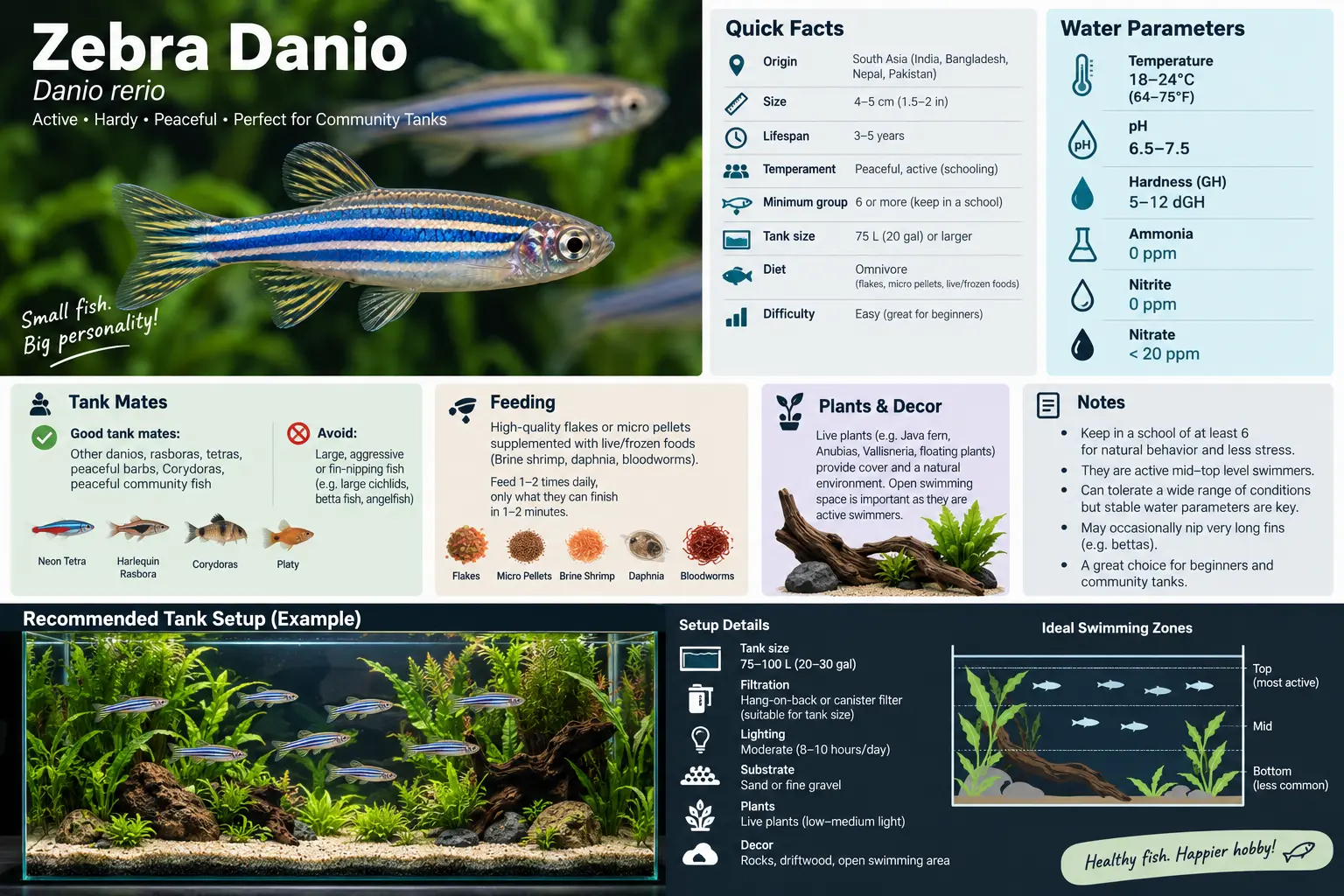
Room-temperature water suits them; a heater is only needed where the room dips below about 16 °C (61 °F). Any substrate works — fine gravel or sand shows off their stripes best. Leave an open swimming lane along the front two-thirds of the tank, plant densely along the back and sides (Vallisneria, Cryptocoryne, floating plants) for cover, and aim for moderate flow from the filter outlet. Standard lighting is fine.
Not sure how many litres your tank actually holds? Check it with the aquarium volume calculator.
What do zebra danios eat? Diet & feeding
Zebra danios eat almost anything small enough to swallow — they are unfussy omnivores with a taste for small live prey. A quality small flake or micro-pellet is a complete staple; supplement once or twice a week with live or frozen bloodworms, daphnia or brine shrimp to condition breeders and bring out coloration. Feed once or twice daily, only as much as the school finishes in about two minutes — danios are opportunists and will beg constantly.
They feed at all levels but spend most of their time in the upper half of the tank, so floating and slow-sinking foods suit them best. In the wild they pick tiny insects, crustaceans and algae off surfaces and from the water column.
Zebra danio tank mates & compatibility
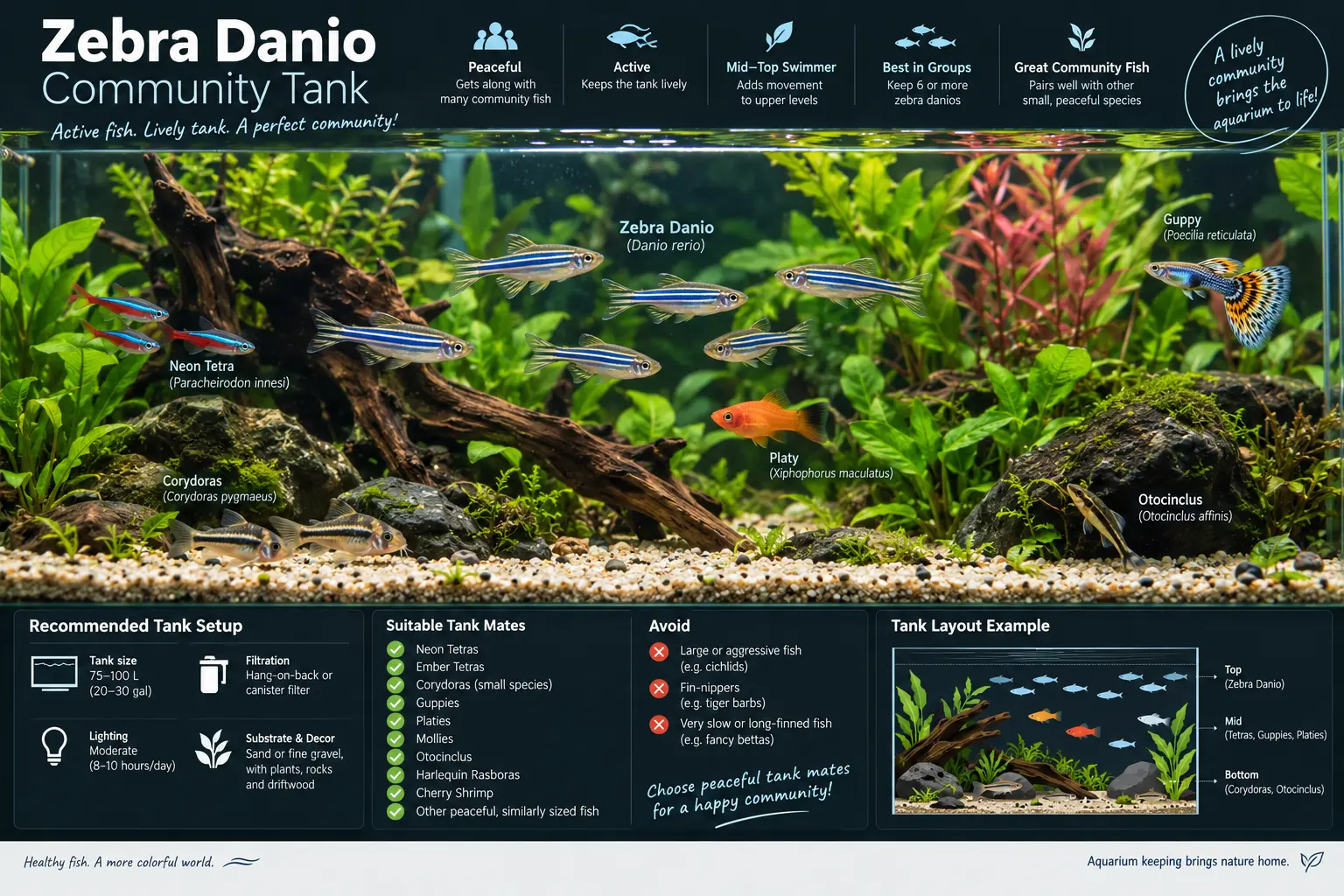
Keep zebra danios in a school of at least six — eight to ten is better. A full shoal spreads out the chasing that always goes on inside the group and keeps them from bothering other fish. Choose tank mates that enjoy similar cool water and can match or ignore their energy:
Are zebra danios aggressive? No — they are peaceful fish. The perpetual chasing you see inside a school is normal shoaling behaviour, not fighting, and a big enough group spreads it out so no single fish is harassed. The only genuine risk is fin-nipping at slow, long-finned tankmates, which is why bettas, fancy guppies and angelfish belong on the avoid list below.
Good zebra danio tank mates
- Other zebra danio varieties and compatible danio species
- Pearl danios and other similarly sized active schooling fish
- White cloud mountain minnows — similar preference for cooler water
- Peaceful rasboras where temperature requirements overlap
- Corydoras catfish suited to the same temperature range
- Kuhli loaches in appropriately sized, mature aquariums
- Bristlenose plecos in sufficiently large community tanks
- Other peaceful, active fish that tolerate similar water conditions
Avoid
- Slow, long-finned fish that may be stressed or nipped
- Fish requiring consistently warm water above the zebra danio’s preferred range
- Large or aggressive cichlids and predatory fish
- Very small shrimp and newly hatched fish fry, which may be eaten
How to breed zebra danios
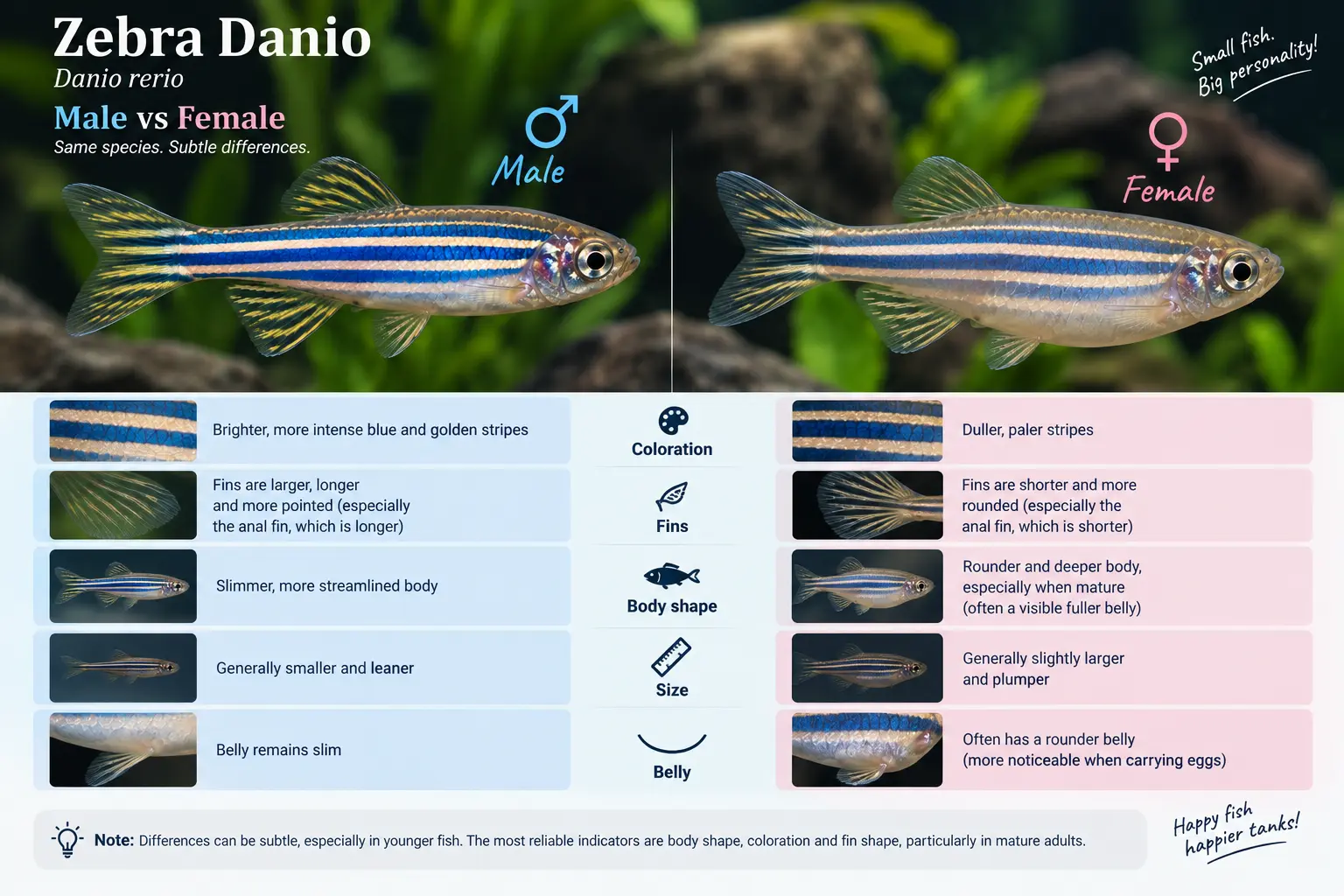
Breeding zebra danios is one of the easiest egg-laying projects in the hobby. They are egg-scatterers with no parental care: spawning happens at dawn over plants or bare substrate, and the adults will eat the eggs if given the chance. Sexing is straightforward — females are rounder-bodied and slightly duller, while males are slimmer with more vivid stripes, especially when conditioned.
For a dedicated attempt, set up a shallow 20–40 L spawning tank with about 15 cm of water, marble substrate or a mesh grid so eggs fall out of reach, gentle aeration, and a temperature of 24–26 °C. Add a conditioned pair (or two males per female) in the evening; they usually spawn at first light. Remove the adults immediately. Eggs hatch in 24–48 hours and fry swim freely three to four days later. Start them on infusoria or liquid fry food, then move to baby brine shrimp and microworms as they grow, with frequent small water changes.
Naming confusion & buyer’s notes
Few fish come with more trade-name baggage than the zebra danio. What the label says and what the fish actually is do not always match:
GloFish
A trademarked brand, not a species. The fluorescent Starfire Red, Electric Green, Sunburst Orange and similar varieties are genetically modified color strains ofDanio rerio with identical care requirements. Their sale is banned or restricted in some countries and US states, so check local rules.
Leopard danio
The spotted, leopard-print fish is a color morph of Danio rerio, not a separate species — it was once described as Brachydanio frankei but breeds freely with striped zebra danios. Same fish, different pattern gene.
Giant danio
Not a big zebra danio. The giant danio now sits in a different genus entirely (Devario aequipinnatus) and reaches twice the size — a 4-foot tank fish. Do not stock one on name similarity alone.
Longfin zebra danio, gold & other strains
“Longfin zebra danio” is a fin-length strain and “gold zebra danio” a color strain — both still Danio rerio. Rule of thumb: an adjective-heavy trade name with no binomial on the tag means strain, not species.
Balloon danios — welfare flag
“Balloon” or “bubble” danios are deliberately bred for a shortened, curved spine. This is a selected deformity, not a distinct species or subspecies, and the trait is ethically contested in the hobby because it can affect swimming and quality of life. Most keepers are better off with the normal body form.
Zebra danio FAQ
- How long do zebra danios live?
- Zebra danios typically live 3–5 years in home aquariums, and well-kept schools in cool, clean, stable water often reach the top of that range. Clean water, a varied diet and a proper school are what extend their lifespan.
- How big do zebra danios get?
- Adult zebra danios typically reach around 4–5 cm (1.5–2 in) long. Longfin zebra danios are the same body size — only their fins are longer. Females are slightly larger and rounder-bodied than males.
- What are the different types of zebra danios?
- The common aquarium varieties sold as zebra danios are forms of the same species, Danio rerio, differing mainly in colour, pattern and fin length. The main types are the standard striped danio, golden danio, longfin zebra danio, leopard danio (spotted), golden leopard danio, albino danio and the fluorescent GloFish strains. All true strains share identical care requirements and mix happily in one school, while the “giant danio” is actually a different species (Devario aequipinnatus).
- How many zebra danios should be kept together?
- Keep at least six, and eight to ten is better. Zebra danios are shoaling fish; a larger group spreads out the chasing, reduces stress, and produces far more natural, confident behaviour.
- How many zebra danios in a 5, 10 or 20 gallon tank?
- A 5-gallon tank is too small — it cannot hold a healthy school, so choose a bigger tank instead. A 10-gallon (38 L) tank can house a small group of six zebra danios. A 20-gallon long (75 L) comfortably houses six to ten and is the recommended setup for a school.
- Are zebra danios aggressive?
- Zebra danios are generally peaceful, fast-moving schooling fish, but they may occasionally nip the fins of slow-moving or long-finned tankmates. The constant chasing inside a school is normal shoaling behaviour, not fighting. The only real risk is fin-nipping at slow, long-finned tankmates such as bettas and fancy guppies.
- What do zebra danios eat?
- Zebra danios are unfussy omnivores. Feed a quality flake or micro-pellet as the daily staple, supplemented once or twice a week with live or frozen bloodworms, daphnia or brine shrimp. They favour floating and slow-sinking foods.
- Do zebra danios need a heater?
- Not necessarily. Zebra danios tolerate cooler temperatures than many tropical aquarium fish, but whether a heater is needed depends on your room temperature. In homes where aquarium temperatures regularly fall below about 18 °C (65 °F), heating may be needed to maintain stable conditions.
- Can zebra danios live with bettas?
- It is not recommended. Zebra danios prefer cooler water than bettas, and their constant, fast movement often stresses bettas — plus danios frequently nip long fins. Peaceful community fish with similar temperature needs are safer choices.
- Are GloFish danios the same as zebra danios?
- Yes. GloFish is a trademarked brand, not a species — the fluorescent "Starfire Red", "Electric Green" and similar varieties are genetically modified color strains of Danio rerio with identical care requirements. Their sale is restricted in some countries and US states.