
Malabar Danio
Devario malabaricus
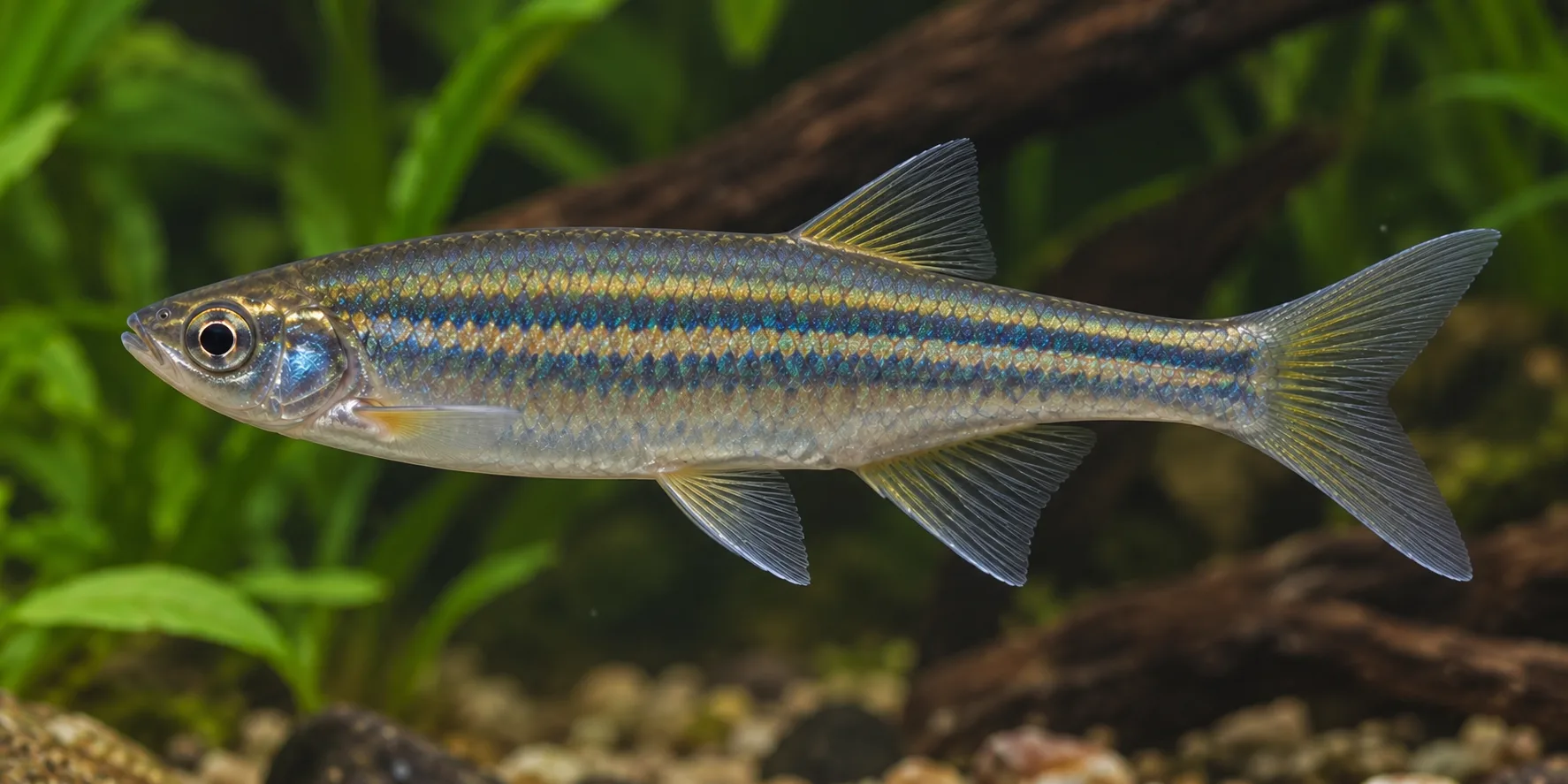
A large, metallic schooling danio built for speed — peaceful, hardy and spectacular in a spacious aquarium with plenty of open water.
Difficulty
Intermediate
Min tank size
240 L / 65 gal
Temperament
Peaceful, very active
Diet type
Omnivore
Adult size
8–12 cm / 3–4.7 in
Lifespan
5–7 years
Water type
Freshwater
Malabar danio at a glance
| Scientific name | Devario malabaricus (Jerdon, 1849) |
|---|---|
| Common names | Malabar danio, giant danio |
| Former scientific name | Danio malabaricus |
| Family | Danionidae (danios) |
| Origin | Western and southwestern India and Sri Lanka |
| Adult size | Commonly 8–10 cm; up to about 12 cm (4.7 in) |
| Tank size (minimum) | 240 L / 65 gal — preferably 120 cm / 4 ft long |
| Temperature | 18–25 °C (64–77 °F) |
| pH range | 6.0–8.0 |
| Water hardness | 2–15 dGH |
| Diet | Omnivore — flakes, pellets, insects, live and frozen foods |
| Temperament | Peaceful but extremely active schooling fish |
| Lifespan | Approximately 5–7 years |
| Care level | Intermediate |
Overview
The Malabar danio (Devario malabaricus) is one of the largest commonly kept members of the danio family. Known for its shimmering blue and gold markings, torpedo-shaped body and almost constant movement, it is a spectacular schooling fish for large freshwater aquariums.
Native to India and Sri Lanka, the species occurs in a wide range of freshwater habitats, including flowing streams, rivers, pools and mountain waters. Adults naturally form active shoals and spend much of their time moving through open water, especially near the upper and middle levels of the aquarium.
Despite being hardy and relatively easy to feed, the Malabar danio is not simply a larger zebra danio that can be kept in a standard community tank. Its size, speed and constant activity demand a long, spacious aquarium. A proper school in a four-foot aquarium is where this species shows its best colour, confidence and natural behaviour.
Malabar danio size & lifespan
How big do Malabar danios get?
Malabar danios commonly reach around 8–10 cm (3–4 inches) in the aquarium, although the species can reach approximately 12 cm (4.7 inches) in total length. Their long, streamlined bodies are built for fast, sustained swimming rather than hovering in one place.
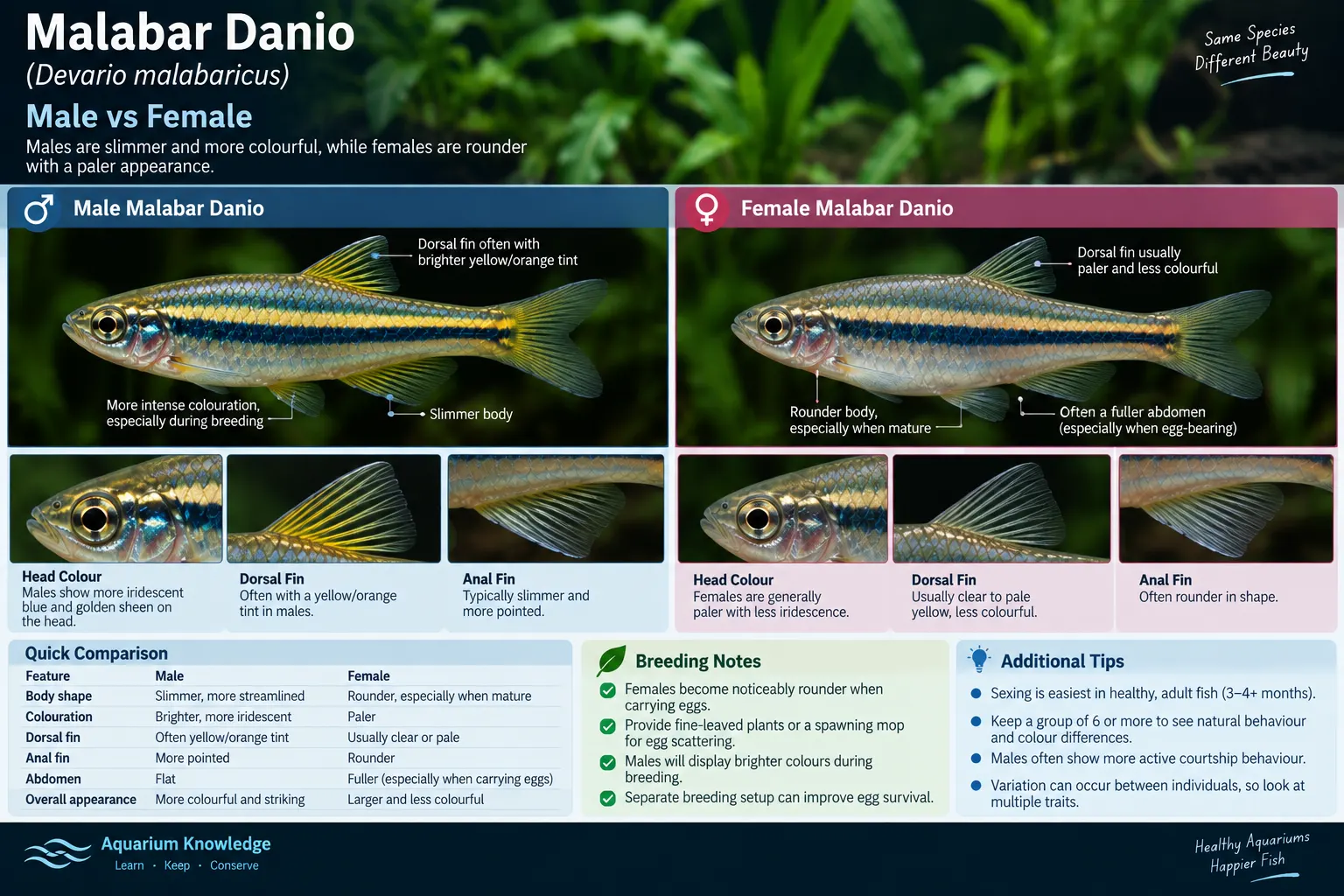
Females are generally deeper-bodied and noticeably rounder when carrying eggs. Males usually remain slimmer and may display stronger metallic blue coloration, particularly when breeding condition is reached.
How long do Malabar danios live?
A well-kept Malabar danio can live approximately 5–7 years. Lifespan depends heavily on providing enough swimming space, maintaining clean and oxygen-rich water, feeding a varied diet and keeping the fish in an appropriate social group.
The biggest long-term mistake with this species is keeping it in a cramped aquarium. Malabar danios may survive in smaller tanks when young, but their constant swimming behaviour means they need space to remain healthy and display normal schooling behaviour.
Natural habitat & origin
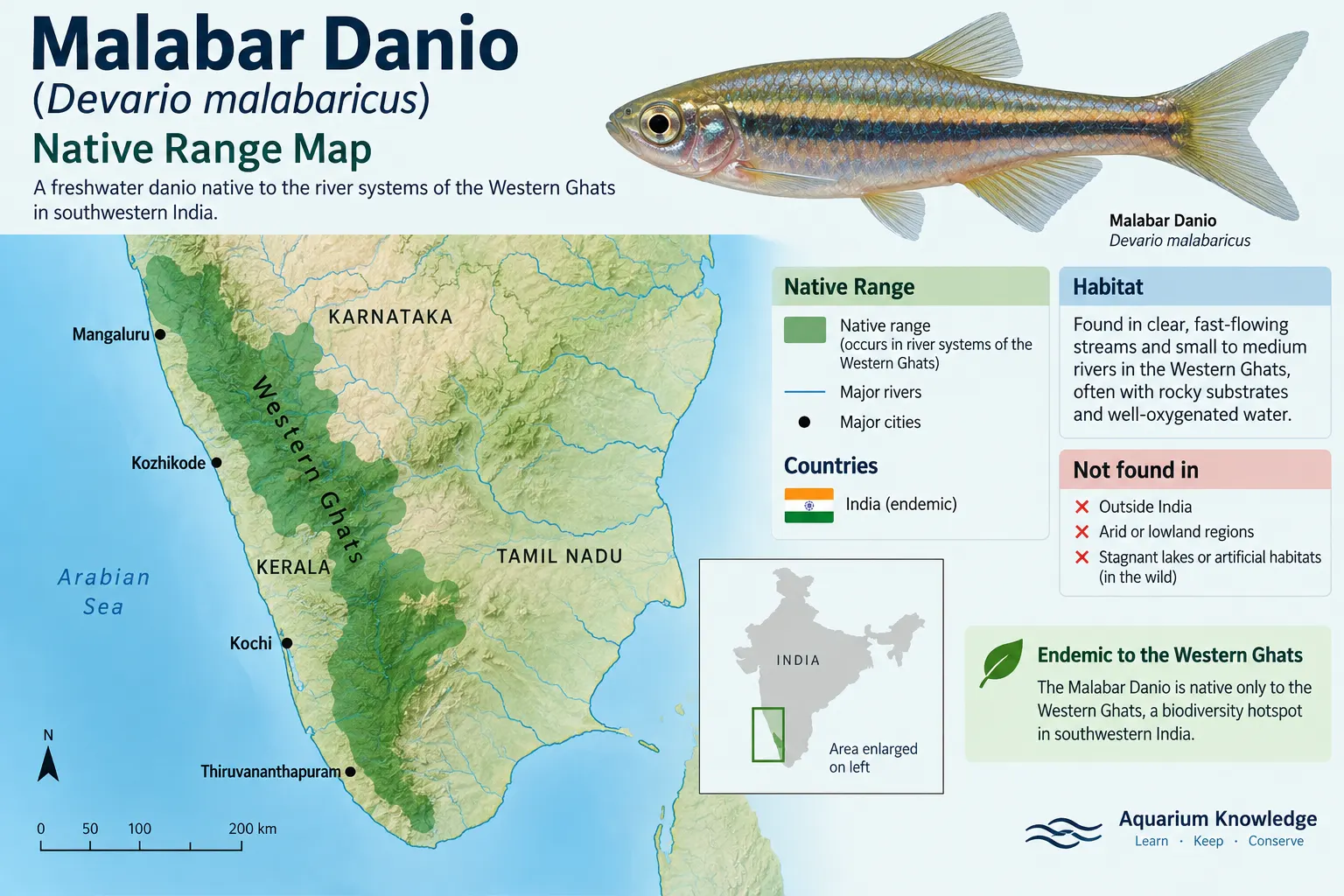
Devario malabaricus is native to the western and southwestern regions of India and Sri Lanka. Its distribution includes areas associated with the Western Ghats and a variety of freshwater environments across its range.
Unlike some fish restricted to one specialised habitat, Malabar danios can occur in different freshwater environments ranging from fast-moving mountain streams and rocky rivers to slower pools. They are most strongly associated with flowing, oxygen-rich water and are commonly encountered in active shoals.
Natural habitats often contain rocks, gravel, submerged roots and marginal vegetation. Seasonal rainfall and monsoon conditions can dramatically change water flow and available habitat, which may also influence spawning activity.
Malabar danio tank size & requirements
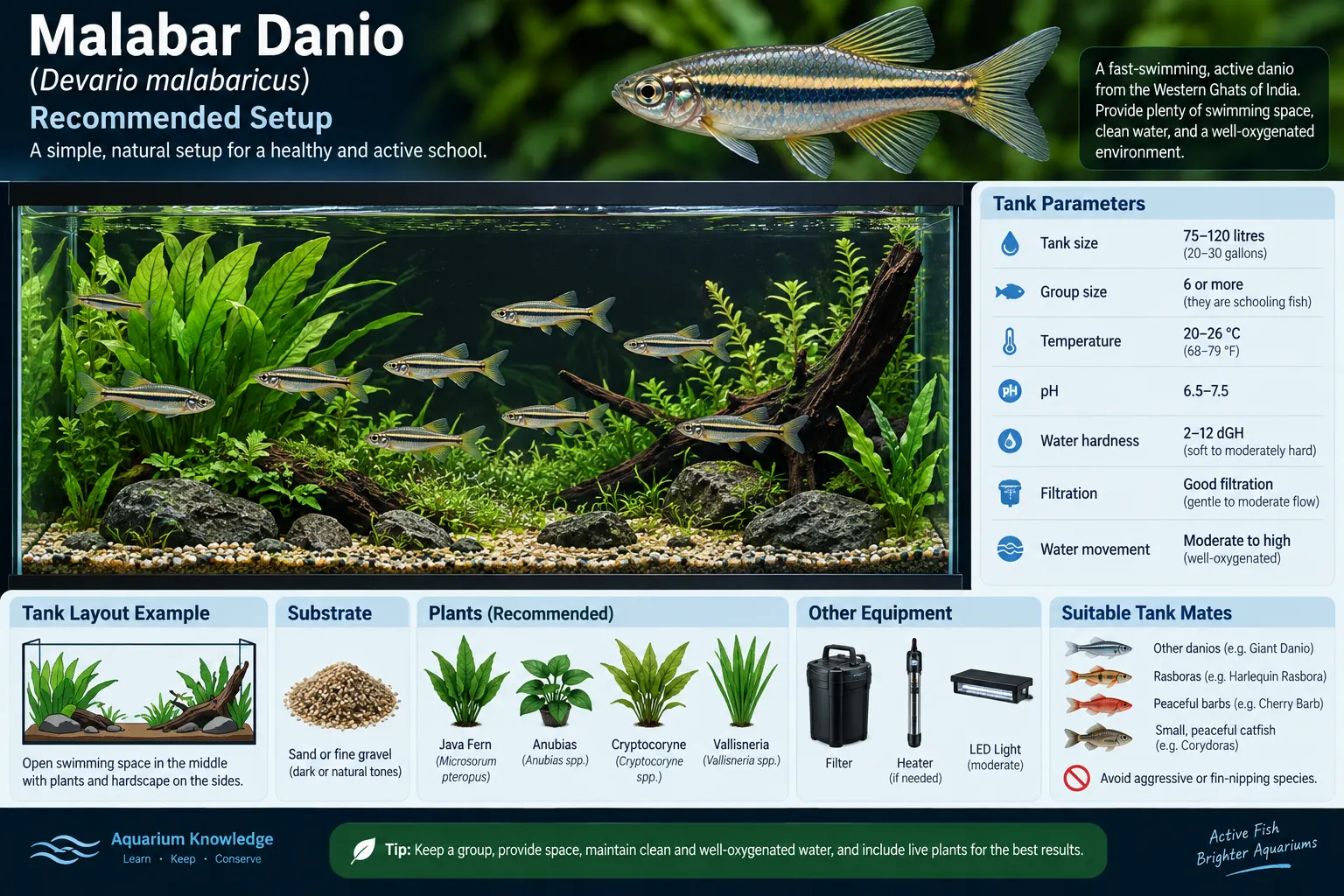
Malabar danios need considerably more swimming space than smaller danio species. A practical minimum is approximately 240 litres (65 gallons) with a tank length of at least 120 cm (4 feet). The length of the aquarium matters far more than height because these fish are powerful horizontal swimmers.
Keep a large area of open water available for the school while using plants, rocks, driftwood and other structure around the sides and back of the aquarium. A river-style layout works particularly well, with moderate water movement and good surface agitation.
A tight-fitting lid is essential. Malabar danios are powerful jumpers, and their speed can send them through surprisingly small openings around aquarium covers.
How many Malabar danios can you keep?
Stock the aquarium around the school rather than keeping one or two individuals. Six is the minimum group, while eight to twelve fish produces more natural schooling behaviour when aquarium size allows.
| 20 gal (75 L) | Not recommended — far too small for the adult size and constant swimming activity of this species. |
|---|---|
| 40 gal (150 L) | Still too small for a proper long-term school. The tank footprint is usually insufficient for this fast-swimming species. |
| 55 gal (208 L) | Borderline and only suitable if the aquarium is long and houses a modest school with minimal tankmates. |
| 65 gal (240 L) | Recommended minimum for a proper school of 6–8 Malabar danios in a 120 cm / 4 ft long aquarium. |
| 75–90 gal (280–340 L) | Excellent for 8–12 fish and compatible active community species. |
| 125 gal+ (470 L+) | Ideal for a large, impressive school and a spacious river-style community aquarium. |
Water parameters
| Temperature | 18–25 °C (64–77 °F) |
|---|---|
| pH | 6.0–8.0 |
| Hardness (GH) | 2–15 dGH |
| Water movement | Moderate to strong current with high oxygenation |
Good filtration is important, but avoid turning the aquarium into an extreme torrent unless the entire setup is designed for strong current. Moderate to strong circulation combined with high oxygen levels and clean water is ideal.
Not sure how many litres your aquarium actually holds? Check it with the aquarium volume calculator.
What do Malabar danios eat? Diet & feeding
Malabar danios are unfussy omnivores in the aquarium, although wild fish naturally consume terrestrial insects, insect larvae, small invertebrates, plant material and detritus.
A quality flake, granule or small pellet can form the daily staple. Supplement this regularly with frozen or live foods such as bloodworms, daphnia, mosquito larvae and brine shrimp. A varied diet improves coloration, conditioning and overall health.
These fish are enthusiastic feeders and extremely fast during feeding time. Slow or timid tankmates may struggle to compete, so food may need to be distributed across multiple areas of the aquarium.
Feed once or twice daily in portions the school can consume within a few minutes. Their energetic behaviour can make them appear constantly hungry, but overfeeding should still be avoided.
Malabar danio tank mates & compatibility
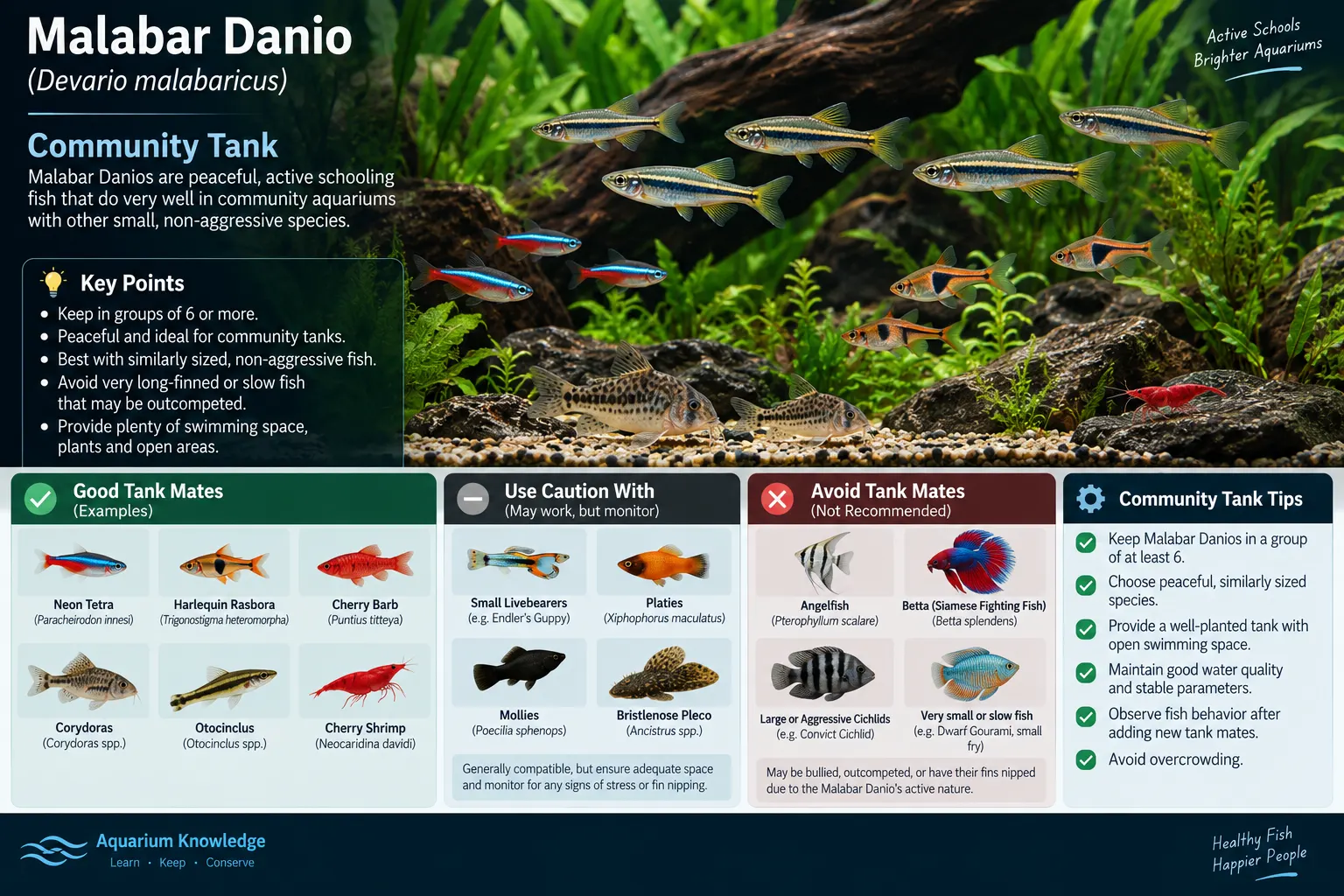
Malabar danios are peaceful fish, but compatibility depends more on their speed and activity level than aggression. They are almost constantly moving through the aquarium and can easily overwhelm shy, slow-moving or very small species.
The best companions are robust, similarly sized fish that enjoy similar temperatures and can comfortably tolerate an active environment. Always consider the full adult size of both species before stocking.
Good Malabar danio tank mates
- Other large, active danios and Devario species with similar water requirements
- Rainbowfish of appropriate size and temperature tolerance
- Larger peaceful barbs such as rosy barbs and similar robust species
- Peaceful medium-sized rasboras in sufficiently large aquariums
- Corydoras species that tolerate the same temperature range
- Loaches suited to flowing, oxygen-rich water
- Bristlenose plecos and other peaceful bottom-dwelling fish
- Robust, similarly sized community fish that are not slow or timid
Avoid
- Very small fish that may be intimidated or accidentally consumed
- Slow-moving or shy fish stressed by constant activity
- Long-finned fish vulnerable to accidental nipping or harassment
- Small nano fish that cannot compete during feeding
- Aggressive cichlids and predatory fish
- Fish requiring consistently warm tropical temperatures above 25–26 °C
How to breed Malabar danios
Malabar danios are egg-scattering fish with no parental care. Mature females become noticeably deeper-bodied when carrying eggs, while males are generally slimmer and may display stronger coloration during breeding condition.
For breeding, use a separate spawning aquarium with fine-leaved plants, spawning mops or Java moss. A mesh grid or marble layer can also be placed on the bottom so eggs fall out of reach of the adults.
Condition the breeding fish with high-quality live and frozen foods before spawning. Spawning may occur in the morning, often after environmental changes that simulate rainfall or fresh water conditions.
The adults should be removed after spawning because they may eat the eggs. The sticky eggs hatch within approximately one to two days depending on temperature. Fry become free-swimming several days later and should initially receive very small foods such as infusoria or commercial fry food before progressing to newly hatched brine shrimp.
Naming confusion & buyer’s notes
The Malabar danio has accumulated several scientific synonyms and aquarium trade names over time. The biggest potential source of confusion is the use of the name “giant danio” for multiple closely related Devario species.
Malabar danio
The accepted scientific name is Devario malabaricus. The common name refers to the Malabar region of southwestern India, where the species was originally described.
Giant danio
“Giant danio” is commonly used in the aquarium hobby for large Devario species, includingDevario malabaricus. However, trade names are not always taxonomically precise, so scientific names should be checked when purchasing fish.
Former scientific name
Older books and aquarium references may list this species asDanio malabaricus. Modern classification places the species in the genus Devario.
Do not buy by common name alone
Several large danios can look similar when young. Always check the scientific name, adult size and care requirements rather than relying entirely on a store label such as “giant danio” or “large danio”.
Biggest beginner mistake
Juvenile Malabar danios are often sold at only a few centimetres long, making them look suitable for a typical small community aquarium. They grow substantially larger and, more importantly, require far more swimming space than their juvenile size suggests. Plan the aquarium around their adult size and activity level from the beginning.
Malabar danio FAQ
- How big do Malabar danios get?
- Malabar danios commonly reach around 8–10 cm (3–4 inches) in aquariums, although the species can reach approximately 12 cm (4.7 inches) in total length. Their active swimming behaviour makes their tank footprint more important than their size alone.
- How long do Malabar danios live?
- A healthy Malabar danio can live around 5–7 years in a well-maintained aquarium. Clean, oxygen-rich water, adequate swimming space, a proper school and a varied diet all contribute to longevity.
- How many Malabar danios should be kept together?
- Keep at least six Malabar danios together, with eight or more being better when tank space allows. They are naturally schooling fish and become more confident and display more natural behaviour in a proper group.
- What size tank does a Malabar danio need?
- A 120 cm / 4-foot aquarium of approximately 240 litres (65 gallons) or larger is a practical minimum for a school. Malabar danios are extremely active horizontal swimmers, so aquarium length is more important than height.
- Are Malabar danios aggressive?
- Malabar danios are not aggressive predators and are generally peaceful community fish. However, their constant fast swimming and enthusiastic feeding behaviour can stress timid, slow-moving or very small tankmates.
- What do Malabar danios eat?
- Malabar danios are omnivorous and readily accept quality flakes and pellets. Their diet should be supplemented regularly with frozen or live foods such as bloodworms, daphnia, mosquito larvae and brine shrimp.
- Do Malabar danios need a heater?
- Not always. Malabar danios tolerate cooler water than many tropical fish and do well between approximately 18–25 °C. A heater is only necessary when room temperatures regularly fall below the safe lower range or fluctuate significantly.
- Are Malabar danios and giant danios the same fish?
- The name giant danio is commonly used for Devario malabaricus, including in parts of the aquarium trade. However, the taxonomy and trade naming of giant Devario species can be confusing, and fish labelled giant danio are not always identified consistently. Always check the scientific name when buying.
- Can Malabar danios live with zebra danios?
- They can coexist in a sufficiently large aquarium with suitable water conditions, but Malabar danios are much larger and significantly more active. A large tank and proper schooling groups for both species are essential.
- Are Malabar danios good beginner fish?
- They are hardy and relatively easy to feed, but their large tank requirement and extremely active nature make them better suited to an intermediate keeper or a beginner who already has a large, mature aquarium.