
Dracula Danio
Danionella dracula
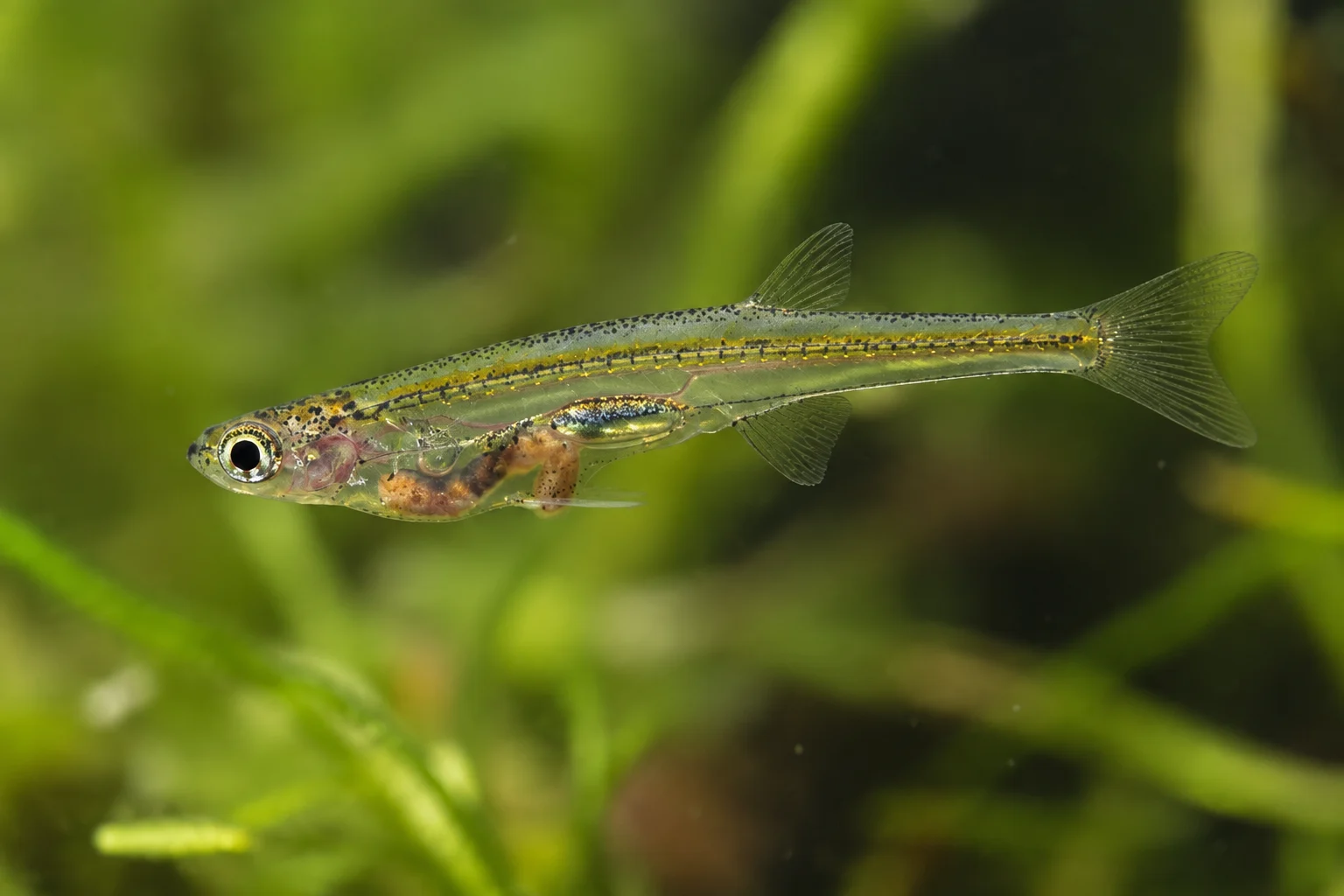
An extraordinary miniature freshwater fish from Myanmar, famous for its transparent body, tiny size and the unusual fang-like jaw structures found in males.
Difficulty
Advanced
Min tank size
30 L / 8 gal
Temperament
Peaceful, timid
Diet type
Micropredator
Adult size
Up to 1.7 cm / 0.7 in
Water type
Freshwater
Origin
Northern Myanmar
Dracula danio at a glance
| Scientific name | Danionella dracula Britz, Conway & Rüber, 2009 |
|---|---|
| Family | Danionidae (danios) |
| Origin | Northern Myanmar — known from the Mogaung Chaung drainage near Sha Du Zup, Kachin State |
| Adult size | Up to about 1.7 cm (0.7 in) standard length |
| Tank size (min) | 30 L / 8 gal — a larger footprint is easier to keep stable |
| Temperature | 20–26 °C (68–79 °F) |
| pH range | 6.5–7.5 |
| Water hardness | 1–5 dGH |
| Diet | Tiny live, frozen and suitably sized prepared foods |
| Temperament | Peaceful, shy and best kept in a group |
| Lifespan | Not well documented in captivity |
| Care level | Advanced / specialist |
Overview
The Dracula danio (Danionella dracula) is one of the most unusual freshwater fish known to aquarists. This tiny cyprinid belongs to the genus Danionella, a group of highly miniaturised fish from Myanmar. Adults remain exceptionally small and have translucent, almost colourless bodies through which internal structures can often be seen.
The species became famous because males possess remarkable fang-like structures associated with their jaws. These structures inspired the name dracula and make the fish anatomically distinctive among cypriniform fishes. Despite the intimidating name, Dracula danios are tiny, peaceful fish rather than predators capable of threatening other aquarium animals.
In the aquarium, the challenge is not providing a large tank but providing an appropriately scaled environment. Their extremely small mouths require tiny foods, their bodies make them vulnerable to almost any larger fish, and their small size means water quality can deteriorate quickly in poorly maintained nano aquariums. For these reasons, Danionella dracula is best considered a specialist microfish rather than a typical beginner nano species.
Dracula danio size & lifespan
How big do Dracula danios get?
Dracula danios are true microfish. The maximum recorded size is about 1.7 cm (0.7 in) standard length, although many aquarium specimens may appear even smaller. Their miniature adult size places them among the smallest freshwater fish commonly discussed in the aquarium hobby.
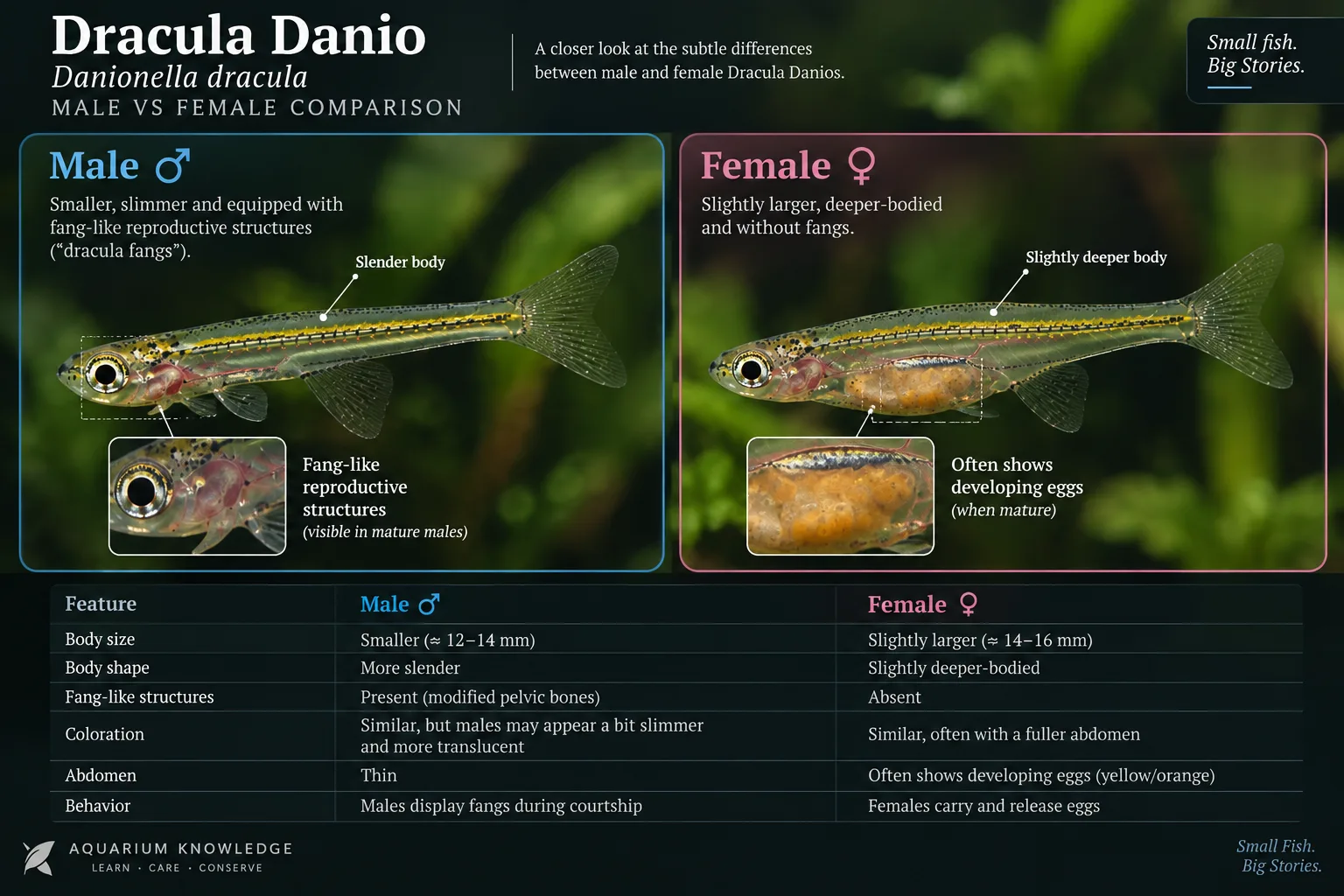
Their body is slender and largely transparent, with greatly reduced structures compared with larger danios. Males are especially notable for their prominent tooth-like bony projections, including the large fang-like structures that inspired the common name Dracula danio.
How long do Dracula danios live?
A reliable captive lifespan has not been well established for Danionella dracula. The species is still relatively uncommon in the aquarium hobby compared with established species such as zebra danios, and long-term aquarium data remain limited.
The best approach is to focus on stable water conditions, a consistent supply of appropriately sized foods, low stress and protection from unsuitable tankmates rather than relying on a fixed lifespan estimate.
Natural habitat & origin
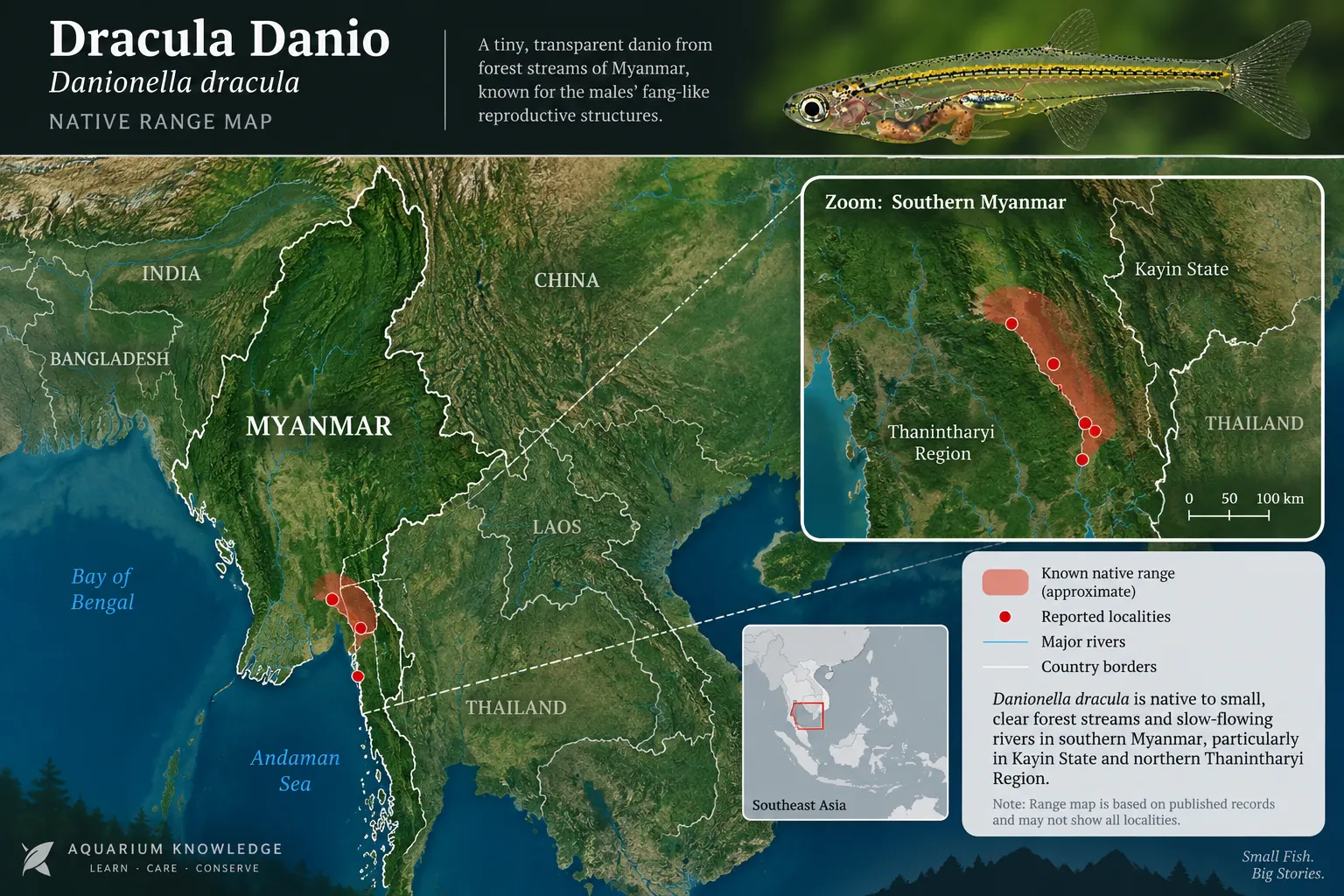
Danionella dracula is native to northern Myanmar. It is known from the Mogaung Chaung drainage in Kachin State, including the type locality near Sha Du Zup between Mogaung and Tanai. The area lies within the upper Ayeyarwady River system.
The species inhabits small freshwater streams and associated calm habitats. Unlike the fast-flowing mountain streams often associated with larger danios, Dracula danios are adapted to tiny, sheltered freshwater environments where dense vegetation, leaf litter and organic material can provide cover and feeding opportunities.
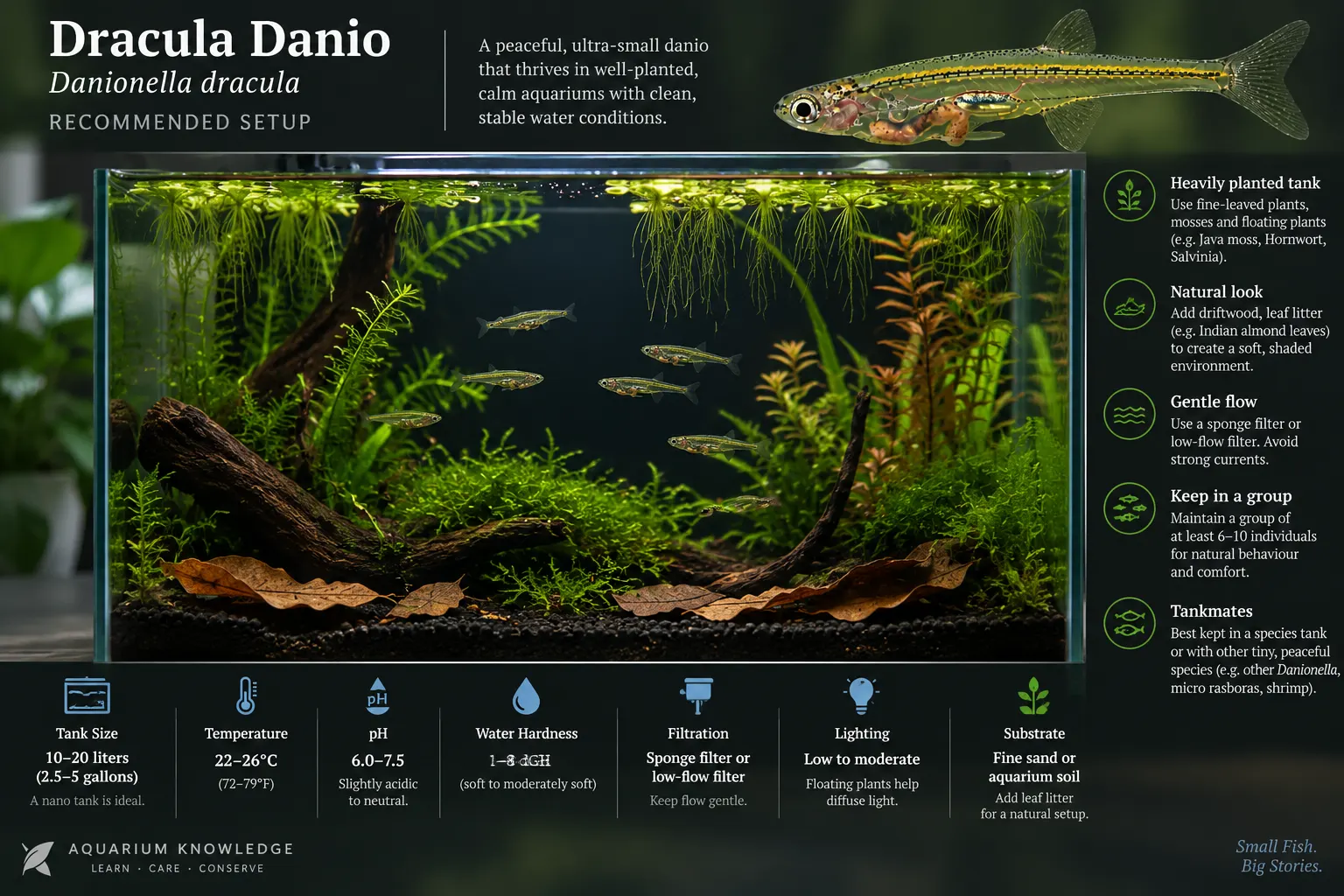
An aquarium does not need to reproduce the wild habitat exactly, but a natural approach works well: subdued lighting, fine-leaved plants, mosses, floating plants, gentle filtration and a mature biological environment provide a more suitable setting than a bare, brightly illuminated tank with strong current.
Dracula danio tank size & requirements
Dracula danios do not require a large aquarium because of their tiny adult size, but extremely small tanks are not automatically easier to maintain. Stable water quality is far more important than simply choosing the smallest possible aquarium.
Around 30 L / 8 gallons is a practical minimum for a small group, while a 38 L / 10-gallon aquarium provides more stable water and additional space for a proper school. A mature, established aquarium is strongly preferable to a newly set up tank.
How many Dracula danios can you keep?
Dracula danios should be kept as a group. A small school of around 10–15 fish allows more natural behaviour and reduces the tendency for individuals to remain hidden. Stocking should always be adjusted according to filtration, maintenance and the presence of any other livestock.
| 5 gal (19 L) | Possible only for experienced keepers, but water stability and maintenance become more difficult. |
|---|---|
| 8 gal (30 L) | A practical minimum for a small species-focused group in a mature, densely planted aquarium. |
| 10 gal (38 L) | Recommended for a group of around 10–15 fish, with more stable water and additional space. |
| 15 gal (57 L) | Excellent for a larger group and a heavily planted, natural-style species aquarium. |
| 20 gal (75 L) | Provides excellent stability and room for a large colony, though height is less important than footprint and cover. |
Water parameters
| Temperature | 20–26 °C (68–79 °F) |
|---|---|
| pH | 6.5–7.5 |
| Hardness (GH) | 1–5 dGH |
| Filtration turnover | Gentle filtration and very low to moderate water movement |
Use gentle filtration and avoid excessive current. A sponge filter or carefully adjusted small filter is often easier to manage than a powerful outlet. Dense planting helps provide cover, while mosses, fine-leaved plants and floating vegetation create a more secure environment for these tiny fish.
Keep the aquarium well covered where necessary and avoid large intake openings that could trap or injure such small fish. A mature biological filter and regular, gentle maintenance are more important than high water movement.
Not sure how many litres your tank actually holds? Check it with the aquarium volume calculator.
What do Dracula danios eat? Diet & feeding
Feeding is one of the most important parts of Dracula danio care. Their mouths are extremely small, meaning ordinary community-fish foods are often too large even when crushed. Food particle size must be appropriate for the fish.
Suitable foods include freshly hatched brine shrimp (Artemia nauplii), microworms, very small live foods, tiny frozen foods and finely crushed or powdered high-quality prepared foods. Variety is useful because a diet based only on one food source may not provide complete nutrition.
Live microfoods are particularly useful when conditioning newly acquired fish or encouraging breeding behaviour. Because Dracula danios are tiny and easily outcompeted, food should be delivered carefully and observed to ensure every fish has an opportunity to feed.
Feed small portions regularly rather than adding large quantities at once. Uneaten fine food can quickly affect water quality in a nano aquarium, so careful feeding and regular maintenance must work together.
Dracula danio tank mates & compatibility
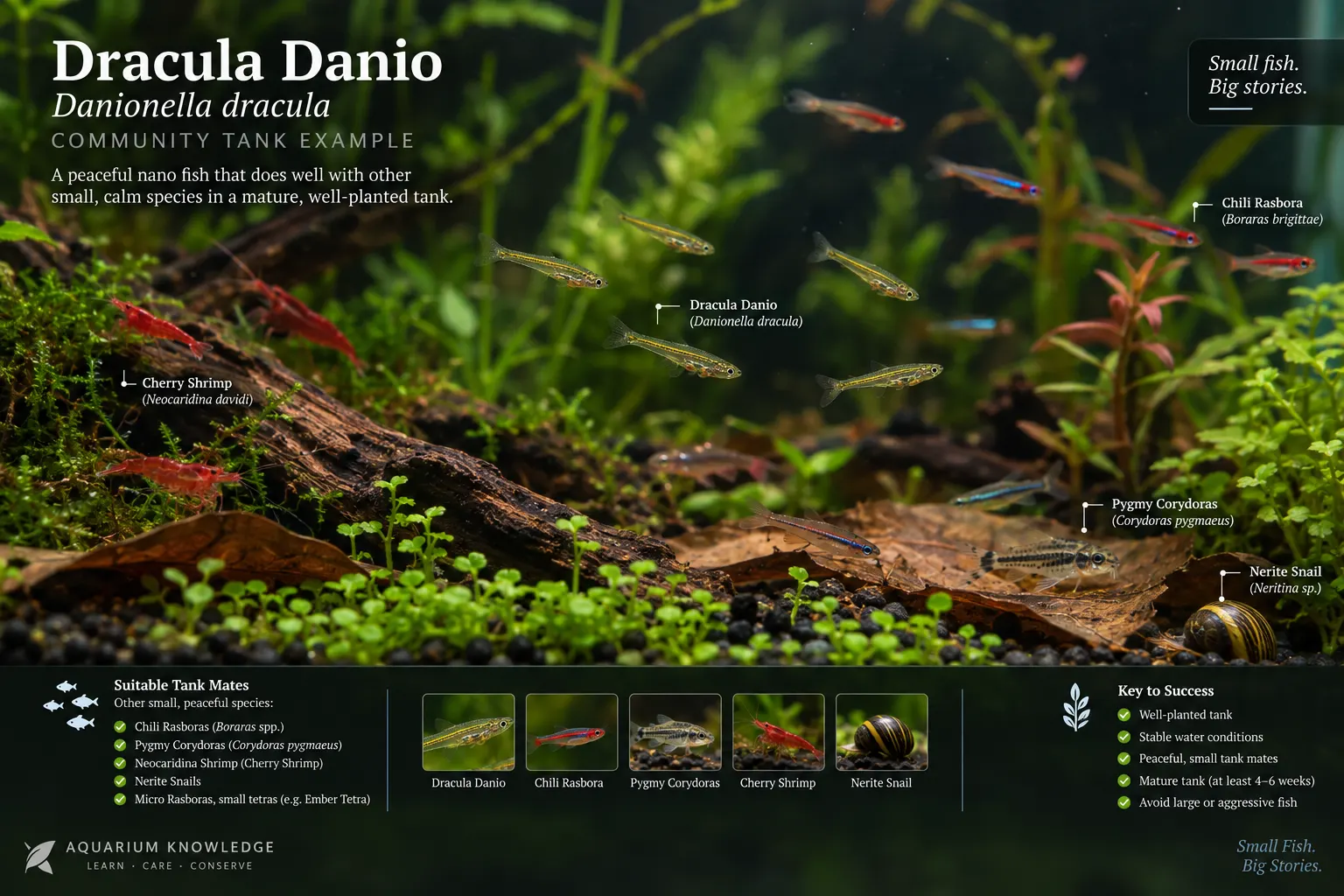
The safest choice for Dracula danios is usually a species-only aquarium. Their extremely small size makes compatibility more complicated than it might first appear.
A fish does not need to be aggressive to cause problems. Many peaceful community fish are simply faster and larger, allowing them to consume food before Dracula danios have a chance to feed. Anything capable of swallowing a 1–2 cm fish should obviously be avoided.
Are Dracula danios aggressive? No — they are generally peaceful microfish. Males may display or spar with one another, particularly because of their specialized jaw structures, but the species is not a threat to normal aquarium fish.
Suitable tank mates
- Best kept in a species-only aquarium
- Other extremely small, peaceful fish only when feeding competition can be avoided
- Tiny shrimp may coexist in heavily planted aquariums, though newborn shrimp can potentially be eaten
- Very small, gentle invertebrates where conditions and feeding requirements overlap
Avoid
- Most standard community fish, even peaceful species that are much larger
- Fast, active schooling fish that outcompete them for food
- Any fish large enough to swallow a 1–2 cm microfish
- Aggressive or territorial species
- Fish requiring strong current or significantly different water conditions
How to breed Dracula danios
Breeding Danionella dracula is considerably more specialized than breeding common aquarium danios. Captive breeding information remains limited compared with widely bred species such as zebra danios, and the tiny size of the adults and fry makes every stage more demanding.
A dedicated breeding aquarium is preferable. Use stable, mature water, gentle filtration and plenty of fine spawning cover such as mosses and dense plants. Conditioning adults with appropriately sized live foods can help encourage spawning activity.
Males can be distinguished by their specialized jaw structures, including the prominent fang-like projections. Females generally lack the pronounced structures and may appear deeper-bodied when carrying eggs.
Because adults may consume eggs or fry, separating eggs or removing adults can improve survival. Newly hatched fry are extremely small and require microscopic first foods such as infusoria or other suitable microfoods before they are large enough to accept newly hatched brine shrimp.
Dracula danio special considerations
Dracula danios are unusual enough that several details deserve special attention before buying them. Their tiny size is their biggest advantage and also their biggest challenge.
Extremely small microfish
At less than 2 cm long, Danionella dracula can easily be injured, eaten or outcompeted by fish that would normally be considered harmless nano community species.
The famous fangs
The Dracula name comes from unusual tooth-like bony structures in males. The largest anterior projections resemble small fangs, but these fish are not dangerous predators.
Food size matters
One of the most common potential problems is offering food that is simply too large. A reliable supply of microscopic or very fine foods should be available before purchasing the fish.
Best in a mature aquarium
A fully cycled, stable aquarium is strongly recommended. Newly established nano tanks can fluctuate quickly, while mature planted aquariums offer more biological stability and natural microfauna.
Relatively uncommon in the aquarium trade
Dracula danios are not as widely available as common danio species and may occasionally appear under alternative informal trade names. Confirm the scientific name Danionella dracula when purchasing, since several miniature Danionella species can look superficially similar.
Dracula danio FAQ
- How big do Dracula danios get?
- Dracula danios are extremely small fish. Danionella dracula reaches a maximum recorded size of about 1.7 cm (0.7 in) standard length, making it one of the smallest aquarium fish available.
- Are Dracula danios good for beginners?
- Generally, no. Their water chemistry is not exceptionally difficult, but their tiny size creates specialist care requirements. They need mature water conditions, extremely small foods, gentle filtration and tankmates that cannot outcompete or eat them.
- How many Dracula danios should be kept together?
- They should be kept in a proper group rather than singly or as a pair. A group of around 10–15 fish works well in a suitable nano aquarium, allowing more natural social behaviour and reducing stress.
- Why is it called the Dracula danio?
- The name comes from the unusual fang-like structures found in males. These are not true teeth but specialized tooth-like bony processes associated with the jaws. The large anterior projections inspired the species name dracula.
- Are Dracula danios aggressive?
- They are generally peaceful toward other fish. Males may display or spar with one another, but Danionella dracula is far too small to be considered an aggressive community fish. The greater concern is protecting them from larger or faster tankmates.
- What do Dracula danios eat?
- They require extremely small foods. Suitable options include Artemia nauplii, microworms, very small daphnia where available, tiny frozen foods and finely crushed or powdered dry foods. Food particle size is one of the most important parts of their care.
- Can Dracula danios live in a community tank?
- They are not ideal community fish. Even peaceful nano species may outcompete them for food, while larger fish may see them as prey. A species-only aquarium is usually the safest and most reliable setup.
- Do Dracula danios need a heater?
- They prefer temperatures around 20–26 °C (68–79 °F). Whether a heater is necessary depends on room temperature, but aquarium temperatures should remain stable and within their preferred range.
- Are Dracula danios transparent?
- Yes. Danionella dracula has a highly reduced, translucent body, and internal structures may be visible through the body. This transparency is one of the distinctive characteristics of the genus Danionella.
- How do you breed Dracula danios?
- Captive breeding is possible but remains a specialist project. They require stable conditions, tiny live foods and suitable spawning cover. Adults may consume eggs or fry, so a dedicated breeding setup and careful separation can improve survival.