
Pearl Danio
Danio albolineatus
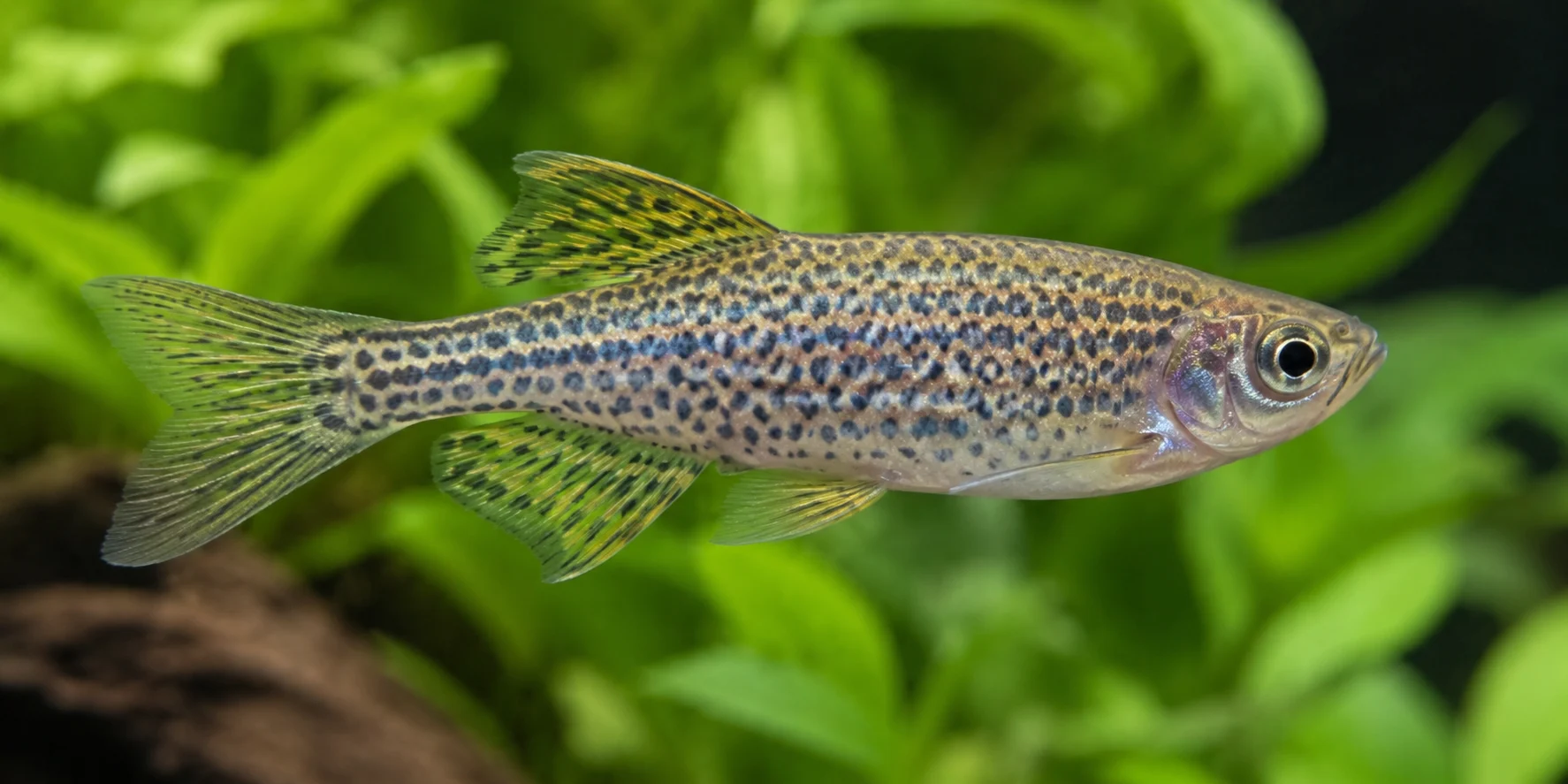
A peaceful, shimmering schooling fish known for its pearlescent colours, energetic swimming behaviour and excellent suitability for community aquariums.
Difficulty
Beginner
Min tank size
75 L / 20 gal
Temperament
Peaceful, active
Diet type
Omnivore
Adult size
5–6 cm / 2–2.5 in
Lifespan
3–5 years
Water type
Freshwater
Pearl danio at a glance
| Scientific name | Danio albolineatus (Blyth, 1860) |
|---|---|
| Family | Danionidae (danios) |
| Origin | Southeast Asia — Myanmar, Thailand, Laos, Cambodia and nearby regions |
| Adult size | 5–6 cm (2–2.5 in) |
| Tank size (min) | 75 L / 20 gal long for a proper school |
| Temperature | 22–26 °C (72–79 °F) |
| pH range | 6.0–7.5 |
| Water hardness | 5–15 dGH |
| Diet | Omnivore — flakes, micro-pellets, live and frozen foods |
| Temperament | Peaceful, active shoaling fish |
| Lifespan | 3–5 years |
| Care level | Beginner |
Overview
The pearl danio (Danio albolineatus) is a beautiful freshwater schooling fish from Southeast Asia. Its common name comes from the iridescent, pearl-like sheen that appears across the body when light reflects off its scales. Depending on the angle and lighting, the fish can display shades of blue, pink, violet, gold and green.
Pearl danios are peaceful, active and hardy fish that spend most of their time swimming through the upper and middle levels of the aquarium. They are excellent community fish and work particularly well in long, planted aquariums with plenty of open swimming space.
Like most danios, they are shoaling fish and should never be kept alone. A group of at least six is recommended, while larger schools of eight or more usually produce more confident and natural behaviour. Their main care requirement is space: pearl danios are constantly active swimmers and benefit from a long aquarium rather than a tall one.
Pearl danio size & lifespan
How big do pearl danios get?
Adult pearl danios typically reach around 5–6 cm (2–2.5 inches) in length. They are larger and slightly more deep-bodied than the common zebra danio, with a streamlined body designed for constant active swimming.
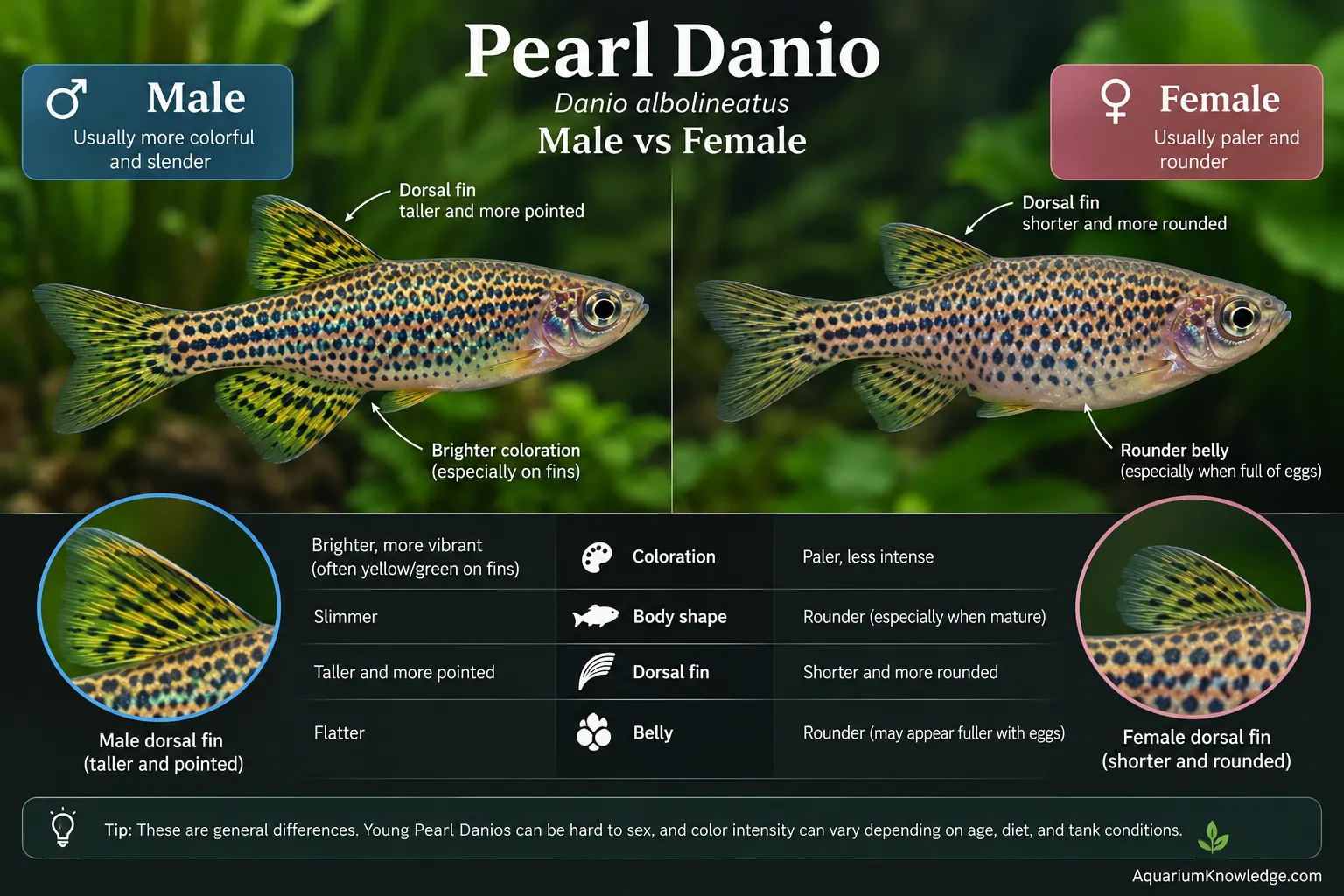
Females are generally fuller and rounder-bodied, particularly when carrying eggs. Males tend to be slimmer and may display stronger iridescent coloration, especially during breeding activity.
How long do pearl danios live?
Pearl danios typically live around 3–5 years in home aquariums. Good water quality, a varied omnivore diet, plenty of swimming space and the security of a proper school all contribute to a longer lifespan.
Natural habitat & origin
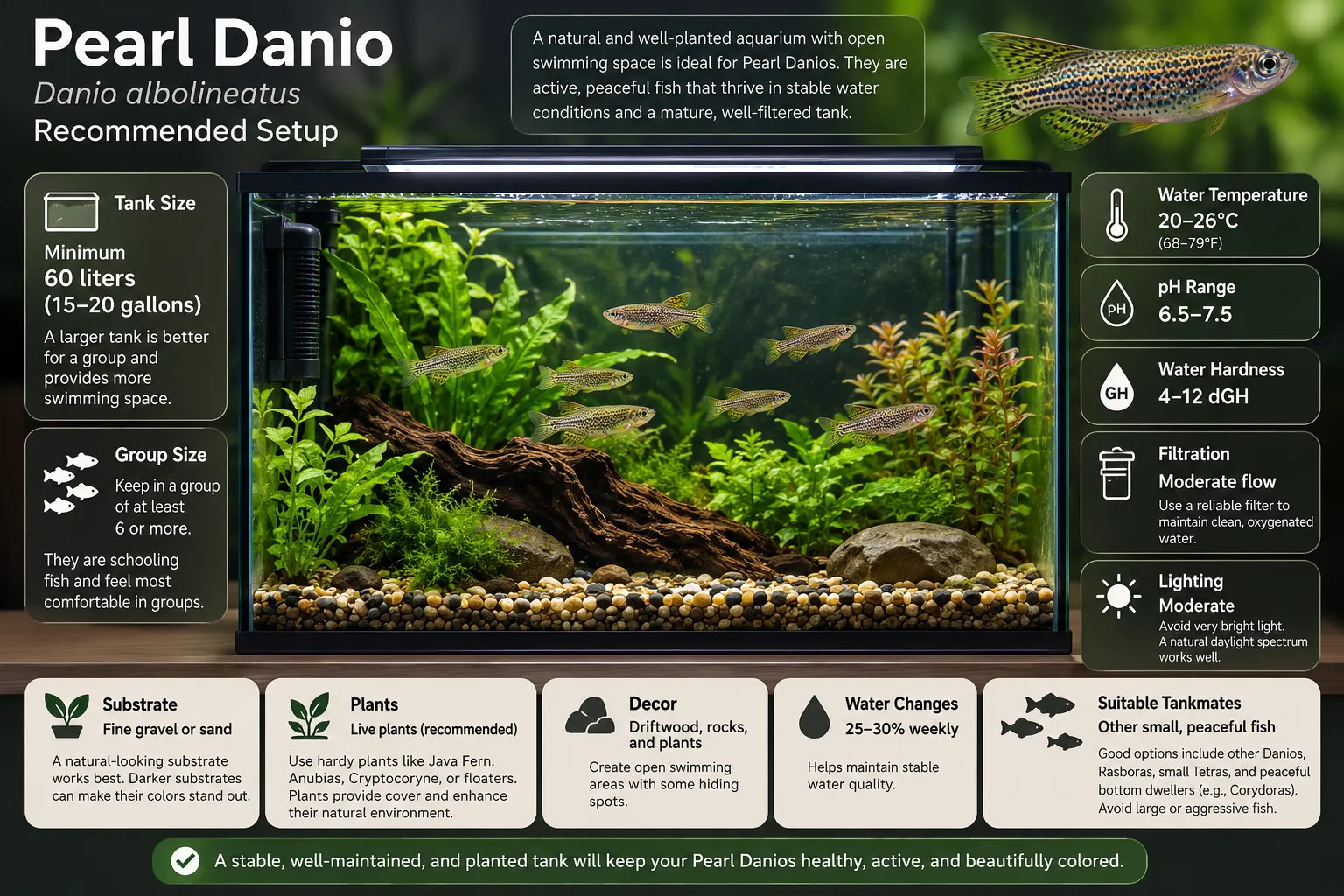
Danio albolineatus originates from Southeast Asia, particularly parts of Myanmar, Thailand, Laos and Cambodia. Wild populations occur in streams, rivers, ponds, canals and other freshwater environments where water conditions can vary seasonally.
Pearl danios are commonly associated with clear or lightly turbid flowing waters and areas with submerged vegetation. Seasonal rainfall and monsoon conditions can significantly change water levels and flow, which helps explain the adaptability of the species.
In the aquarium, this natural lifestyle translates well into a setup with moderate water movement, good oxygenation, open swimming areas and planted sections that provide shelter and visual cover.
Pearl danio tank size & requirements
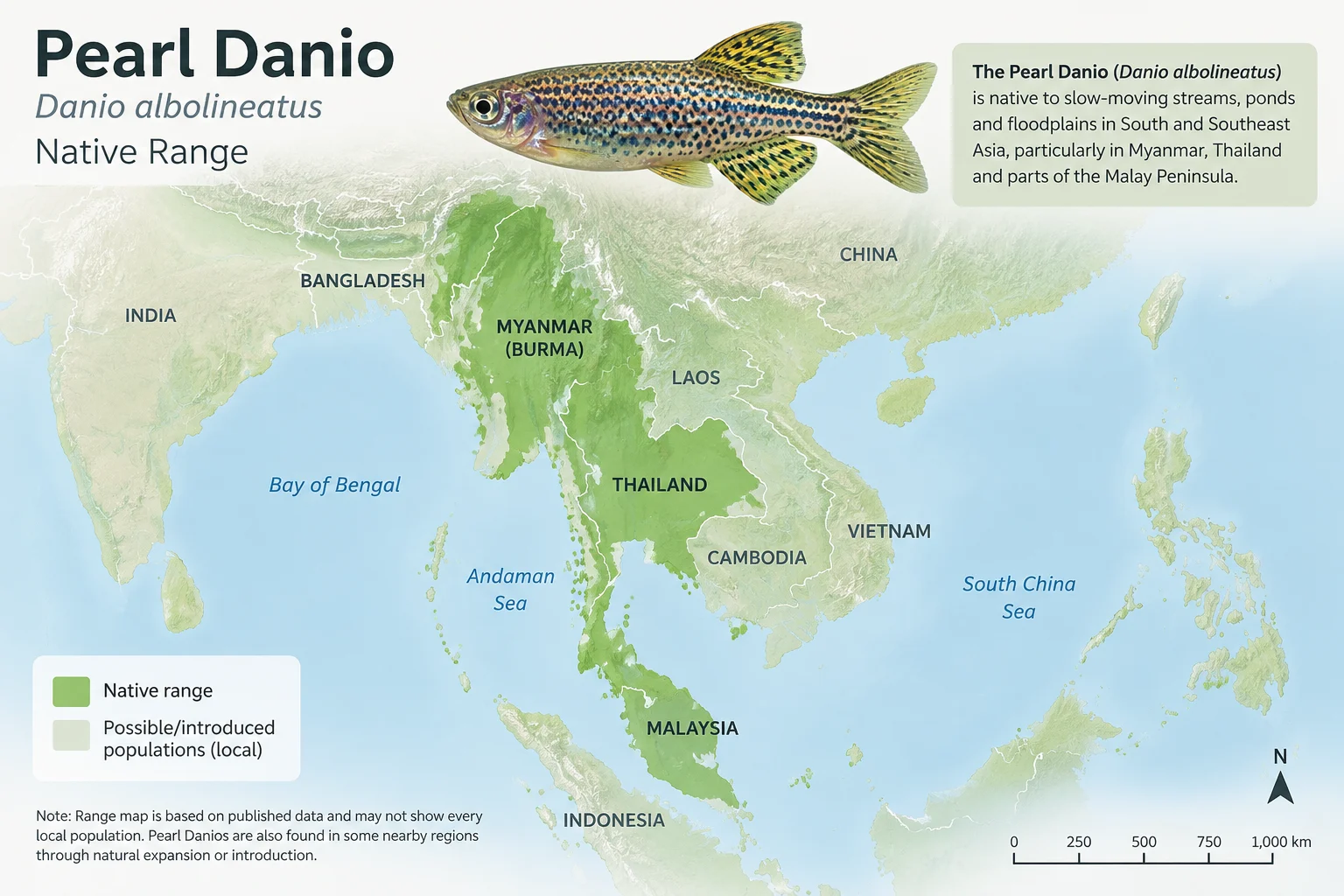
Pearl danios are active horizontal swimmers, so aquarium length is more important than height. A 20-gallon long (75 L) aquarium is a practical minimum for a school of six, while larger tanks allow for bigger schools and peaceful community tankmates.
Avoid keeping them in very small aquariums. Although pearl danios are not large fish, their constant movement means they need significantly more swimming space than slow-moving species of similar size. A secure lid is also recommended because danios can jump when startled.
How many pearl danios can you keep?
| 10 gal (38 L) | Not recommended — pearl danios are active swimmers and need more horizontal swimming space. |
|---|---|
| 20 gal long (75 L) | 6 pearl danios — the practical minimum school and recommended starting tank size. |
| 29 gal (110 L) | 8–10 pearl danios, or a school combined with peaceful community fish. |
| 40 gal (150 L) | 10–15 pearl danios with plenty of swimming space and room for compatible tankmates. |
| 55 gal (208 L) | A large school of 15–20 pearl danios or a spacious active community aquarium. |
Water parameters
| Temperature | 22–26 °C (72–79 °F) |
|---|---|
| pH | 6.0–7.5 |
| Hardness (GH) | 5–15 dGH |
| Filtration turnover | Moderate circulation with good oxygenation |
Use a substrate of fine gravel or sand and include plants around the back and sides of the aquarium while keeping the central and front areas open for swimming. Vallisneria, Cryptocoryne, Java fern and floating plants all work well in a pearl danio aquarium.
Moderate filtration and good oxygenation are ideal. Avoid extremely powerful currents, but some water movement from the filter outlet is beneficial and matches the active lifestyle of the species.
Not sure how many litres your tank actually holds? Check it with the aquarium volume calculator.
What do pearl danios eat? Diet & feeding
Pearl danios are unfussy omnivores and will readily accept a wide range of prepared and live foods. A high-quality flake food or small micro-pellet should form the basis of their daily diet.
Supplement the staple food with frozen or live foods such as brine shrimp, daphnia, bloodworms and mosquito larvae where appropriate. These foods provide additional protein, encourage natural feeding behaviour and can improve overall condition and coloration.
Feed once or twice daily in small portions that the school can consume within a few minutes. Pearl danios are enthusiastic feeders and may appear hungry even when they have already received enough food, so avoid overfeeding.
Pearl danio tank mates & compatibility
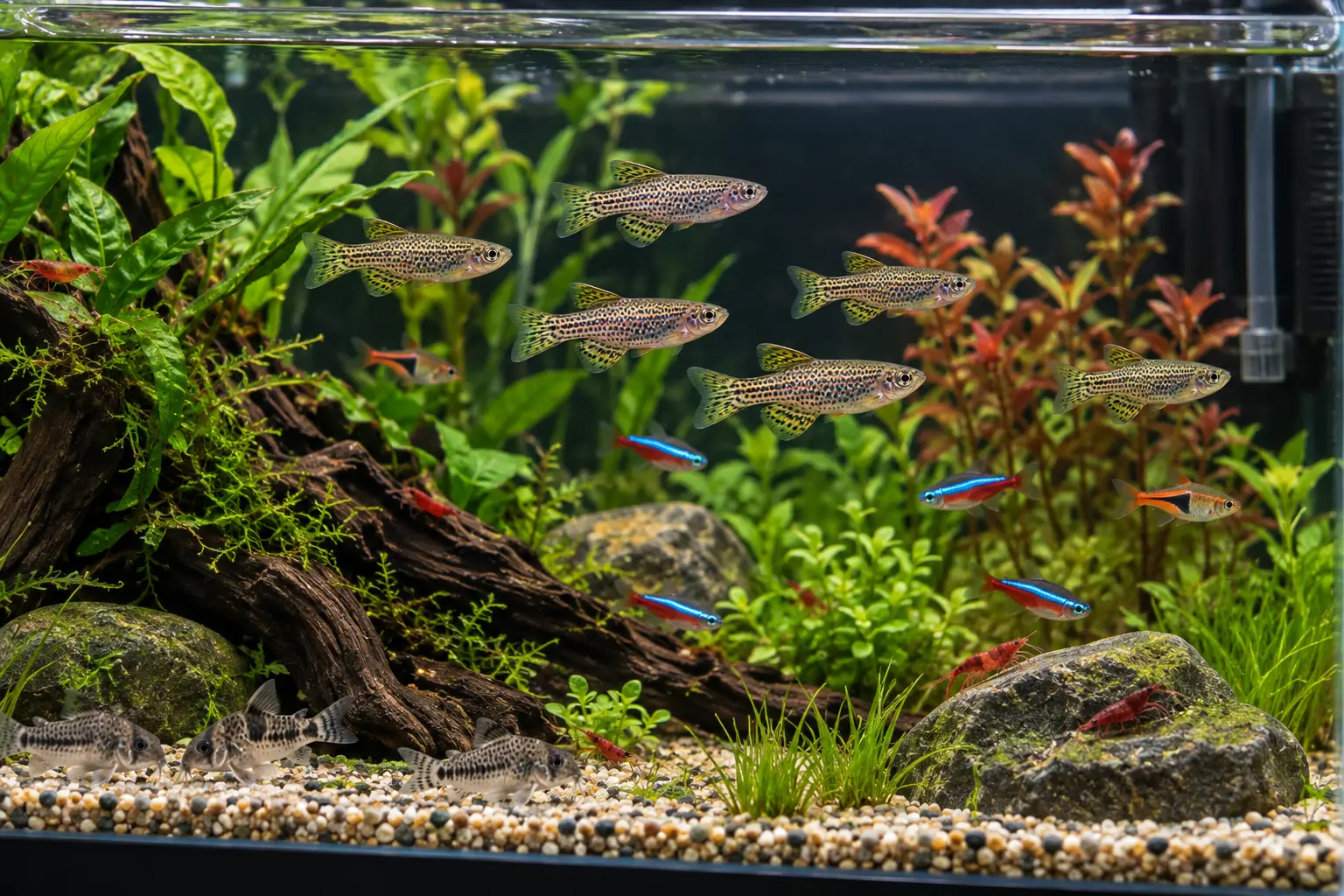
Pearl danios are peaceful community fish, but they are highly active. The best tankmates are fish that tolerate similar water conditions and are not easily stressed by constant movement.
Keep pearl danios in a school of at least six. A larger group of eight or more usually reduces excessive chasing and creates more natural shoaling behaviour. In a proper group, they generally coexist well with many peaceful community species.
Good pearl danio tank mates
- Zebra danios and other similarly sized peaceful danios
- Harlequin rasboras and other peaceful rasboras
- Cherry barbs and other peaceful barbs
- Corydoras catfish
- Kuhli loaches in mature community aquariums
- Bristlenose plecos in sufficiently large tanks
- Honey gouramis and other peaceful gouramis
- Peaceful tetras with similar water requirements
- Other active community fish that tolerate similar temperatures
Avoid
- Large aggressive cichlids and predatory fish
- Very slow or shy fish that may be stressed by constant activity
- Large fin-nipping species
- Fish requiring significantly cooler or hotter water
- Very small shrimp fry, which may be eaten
How to breed pearl danios
Pearl danios are egg-scattering fish and can be bred in a dedicated aquarium. Like many danios, they provide no parental care and adults may eat the eggs if they remain in the breeding tank after spawning.
Females are usually rounder and fuller-bodied, while males are slimmer and often display stronger coloration. Conditioning the breeding group with high-quality live and frozen foods can improve spawning success.
Set up a separate breeding aquarium of around 20–40 litres with gentle filtration or aeration. Use fine-leaved plants, spawning mops or a mesh barrier that allows eggs to fall beyond the reach of the adults.
Spawning often occurs during the early morning. Once eggs have been laid, remove the adults to prevent egg predation. The eggs generally hatch within a few days depending on temperature, and the fry can be started on infusoria or commercially prepared fry food before moving to newly hatched brine shrimp and other small live foods.
Naming confusion & buyer’s notes
Pearl danios are sometimes confused with other iridescent danio species because common names in the aquarium trade are not always scientifically precise. Always check the scientific name on the label when possible.
Pearl danio
The true pearl danio is Danio albolineatus. It is known for its iridescent body coloration and typically grows to around 5–6 cm.
Zebra danio
The zebra danio is Danio rerio, a different species with distinctive horizontal stripes. Zebra danios are generally smaller and prefer slightly cooler water than pearl danios.
Leopard danio
Leopard danios are spotted forms associated with Danio rerioand are commonly sold alongside zebra danios. Despite the similar common name, they are not pearl danios.
Giant danio
Giant danios are a completely different and much larger species, Devario aequipinnatus. They require substantially more swimming space and should not be confused with pearl danios.
Check the scientific name
Aquarium common names can vary between countries and retailers. The safest way to identify a pearl danio is by checking for the scientific name Danio albolineatus rather than relying only on trade names or colour descriptions.
Pearl danio FAQ
- How long do pearl danios live?
- Pearl danios typically live around 3–5 years in a well-maintained home aquarium. Stable water quality, a varied diet, adequate swimming space and keeping them in a proper school all help maximize their lifespan.
- How big do pearl danios get?
- Adult pearl danios usually reach about 5–6 cm (2–2.5 inches) in length. They are slightly larger and more deep-bodied than zebra danios, with an elongated body adapted for active swimming.
- How many pearl danios should be kept together?
- Keep at least six pearl danios together, although eight or more is even better. They are shoaling fish and become more confident, active and natural when maintained in a proper group.
- What size tank do pearl danios need?
- A 20-gallon long (75 L) aquarium is a good minimum for a school of six pearl danios. They are active horizontal swimmers and benefit more from tank length than height.
- Are pearl danios aggressive?
- Pearl danios are generally peaceful community fish. They are energetic and constantly active, but serious aggression is uncommon. Males may occasionally chase one another, especially during feeding or breeding, but this is usually harmless in a properly sized school.
- What do pearl danios eat?
- Pearl danios are omnivores and accept most small aquarium foods. A quality flake or micro-pellet should form the staple diet, supplemented with frozen or live foods such as brine shrimp, daphnia and bloodworms.
- Do pearl danios need a heater?
- Usually yes. Pearl danios prefer warmer tropical water than zebra danios, generally around 22–26 °C (72–79 °F). A heater is recommended unless the aquarium naturally remains within this stable temperature range.
- Can pearl danios live with zebra danios?
- Yes. Pearl danios and zebra danios can usually live together because both are peaceful, active schooling fish. However, pearl danios generally prefer slightly warmer water, so keep the aquarium within a temperature range suitable for both species.
- Are pearl danios good for beginners?
- Yes. Pearl danios are hardy, peaceful and adaptable, making them suitable for beginners with an appropriately sized aquarium. Their main requirements are clean water, a proper school and plenty of open swimming space.