
Celestial Pearl Danio (Galaxy Rasbora)
Danio margaritatus
A tiny freshwater jewel covered in pearl-like spots — peaceful, colourful and perfect for a heavily planted nano aquarium.
Difficulty
Beginner–Intermediate
Min tank size
40 L / 10 gal
Temperament
Peaceful, shy
Diet type
Omnivore
Adult size
2–2.5 cm / ~1 in
Lifespan
3–5 years
Water type
Freshwater
Celestial pearl danio at a glance
| Scientific name | Danio margaritatus (Roberts, 2007) |
|---|---|
| Family | Danionidae (danios) |
| Origin | Myanmar — Shan State and the Salween River basin region |
| Adult size | 2–2.5 cm (about 1 in) |
| Tank size (min) | 40 L / 10 gal — larger planted tanks preferred |
| Temperature | 20–26 °C (68–79 °F) |
| pH range | 6.5–7.5 |
| Water hardness | 5–15 dGH |
| Diet | Omnivore — micro-pellets, tiny live and frozen foods |
| Temperament | Peaceful, shy shoaling fish |
| Lifespan | 3–5 years |
| Care level | Beginner to Intermediate |
Overview
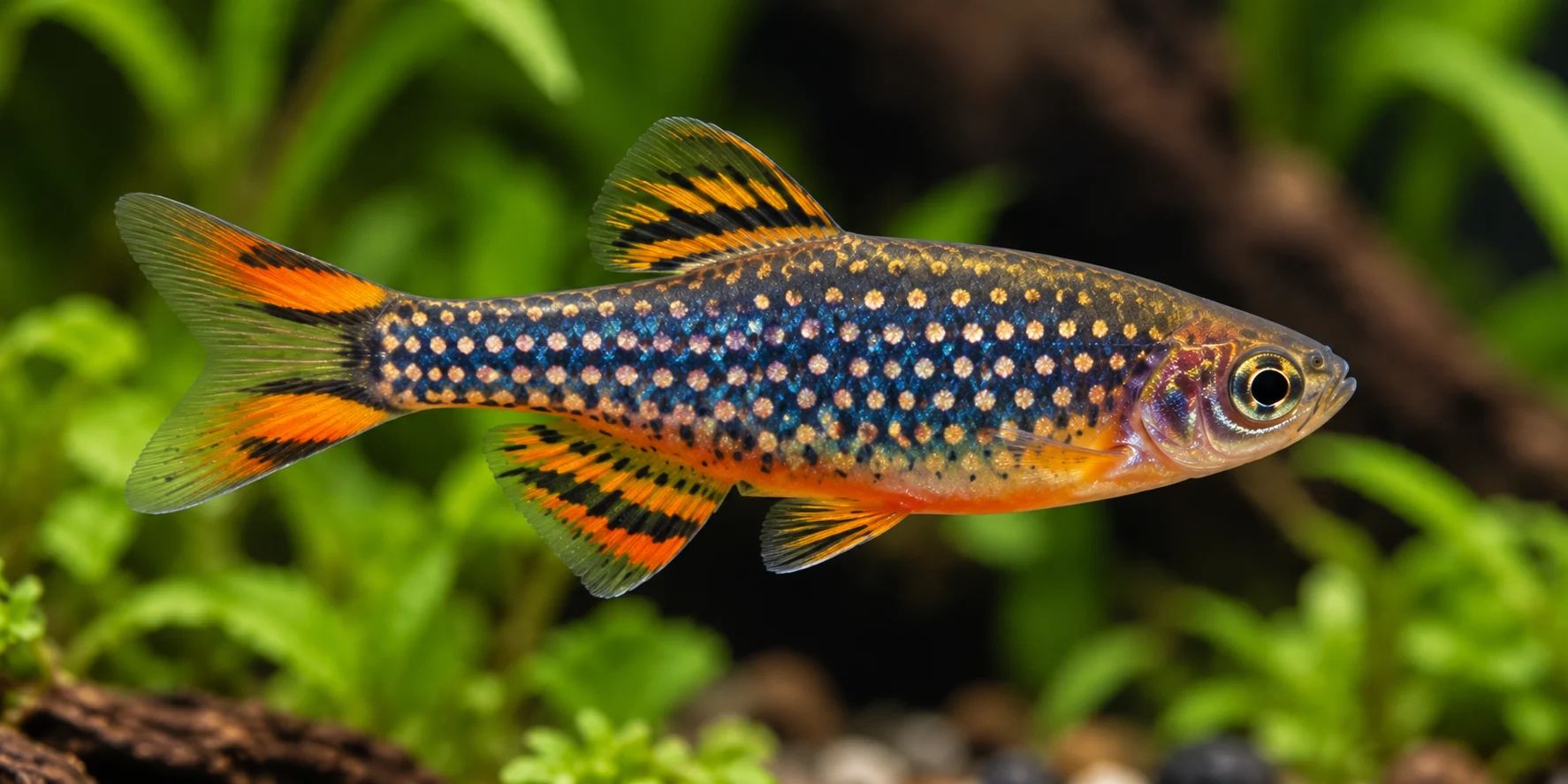
The celestial pearl danio, also widely sold as the galaxy rasbora (Danio margaritatus), is one of the most visually striking nano fish in the aquarium hobby. Despite growing to only about one inch long, its dark blue body is covered in pale, pearl-like spots, while mature males develop red and orange coloration across their fins.
The species became internationally popular shortly after its scientific discovery and aquarium introduction in the mid-2000s. Its combination of tiny size, unusual appearance and peaceful behaviour quickly made it a favourite for planted nano aquariums.
Unlike the constantly energetic zebra danio, celestial pearl danios are comparatively shy and deliberate. They spend much of their time weaving through plants and vegetation, occasionally moving into open water. They become significantly more confident when kept in larger groups and provided with dense planting.
Celestial pearl danio size & lifespan
How big do celestial pearl danios get?
Celestial pearl danios are very small fish, reaching approximately 2–2.5 cm (about 1 inch) as adults. Their compact size makes them ideal for nano aquariums, although their small size should not be mistaken for low space requirements.
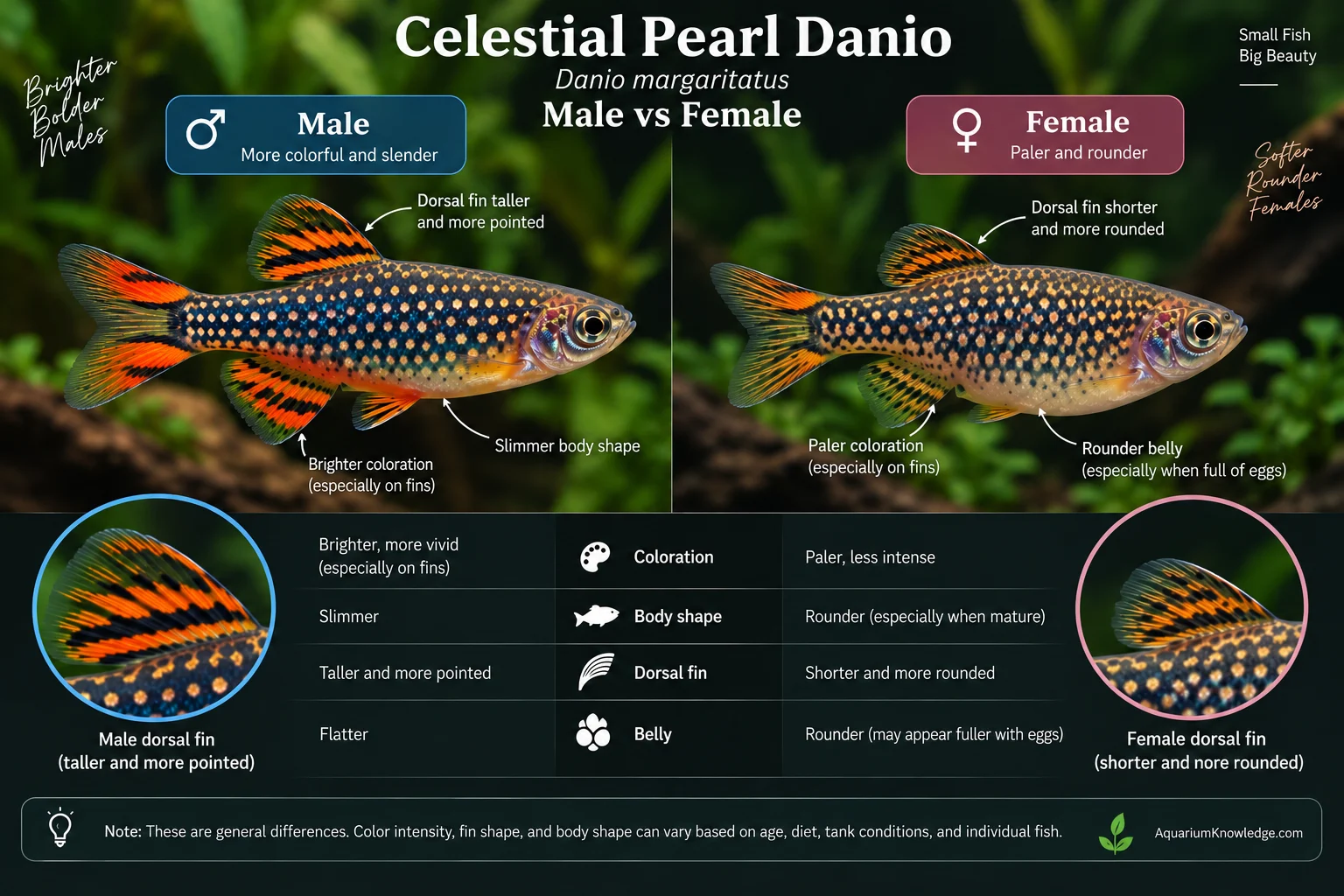
Males are generally slimmer and more intensely coloured, particularly around the fins. Females tend to have rounder bodies and less dramatic coloration, especially when carrying eggs.
How long do celestial pearl danios live?
In a well-maintained aquarium, celestial pearl danios typically live around 3–5 years. Their lifespan depends heavily on stable water quality, proper nutrition and avoiding stressful tankmates.
Natural habitat & origin
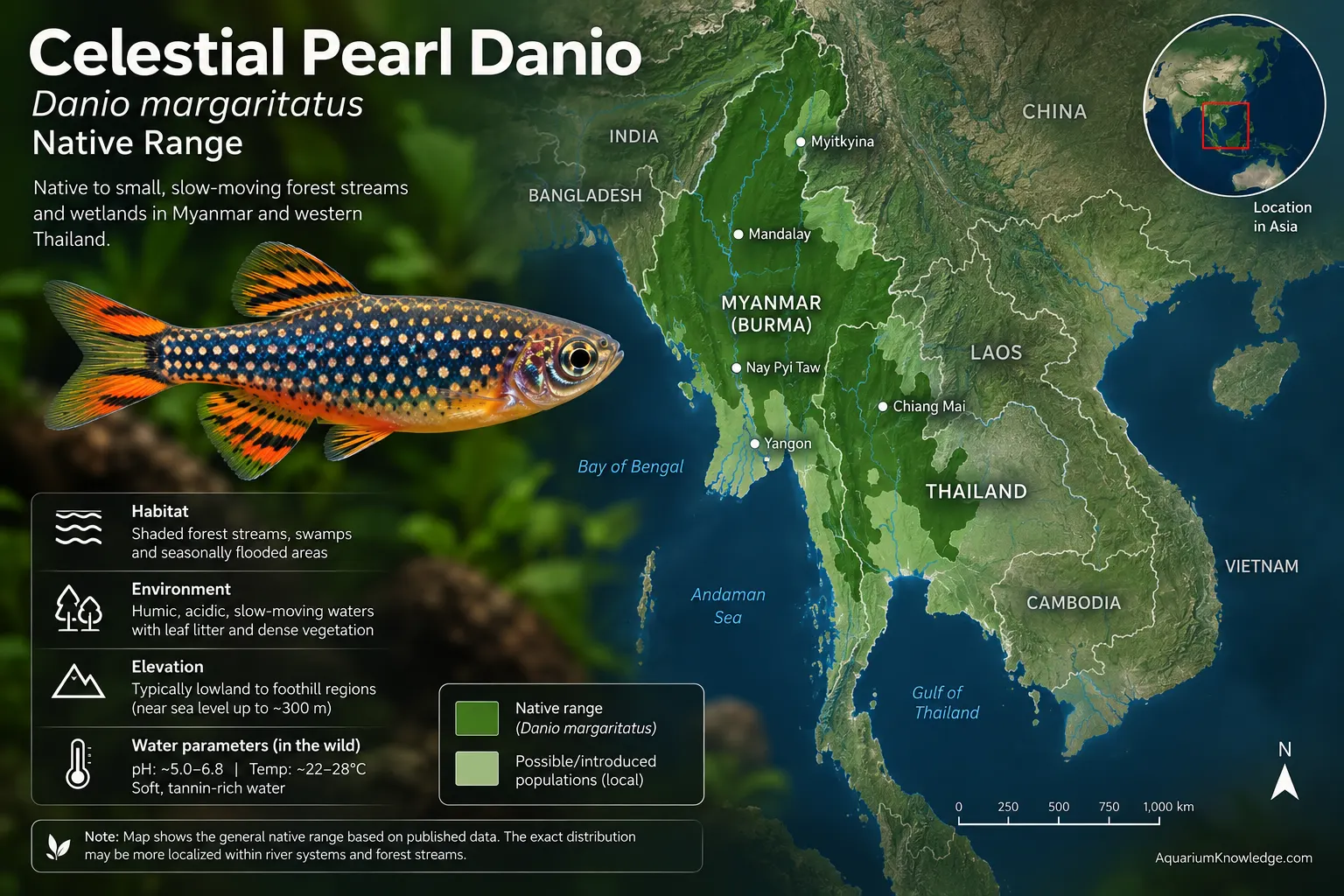
Danio margaritatus originates from Myanmar, particularly the highland region of Shan State near the Salween River drainage. Its natural environment consists of shallow freshwater ponds, wetlands and vegetated waters rather than large, fast-flowing rivers.
These habitats often contain dense aquatic vegetation and relatively calm water. The fish use plants for shelter, feeding and breeding, which explains why planted aquariums are especially suitable for keeping the species.
Their native environment can experience relatively cool temperatures, particularly compared with many tropical aquarium fish. For this reason, celestial pearl danios generally do not require excessively warm water and should not be kept permanently at high tropical temperatures.
Celestial pearl danio tank size & requirements
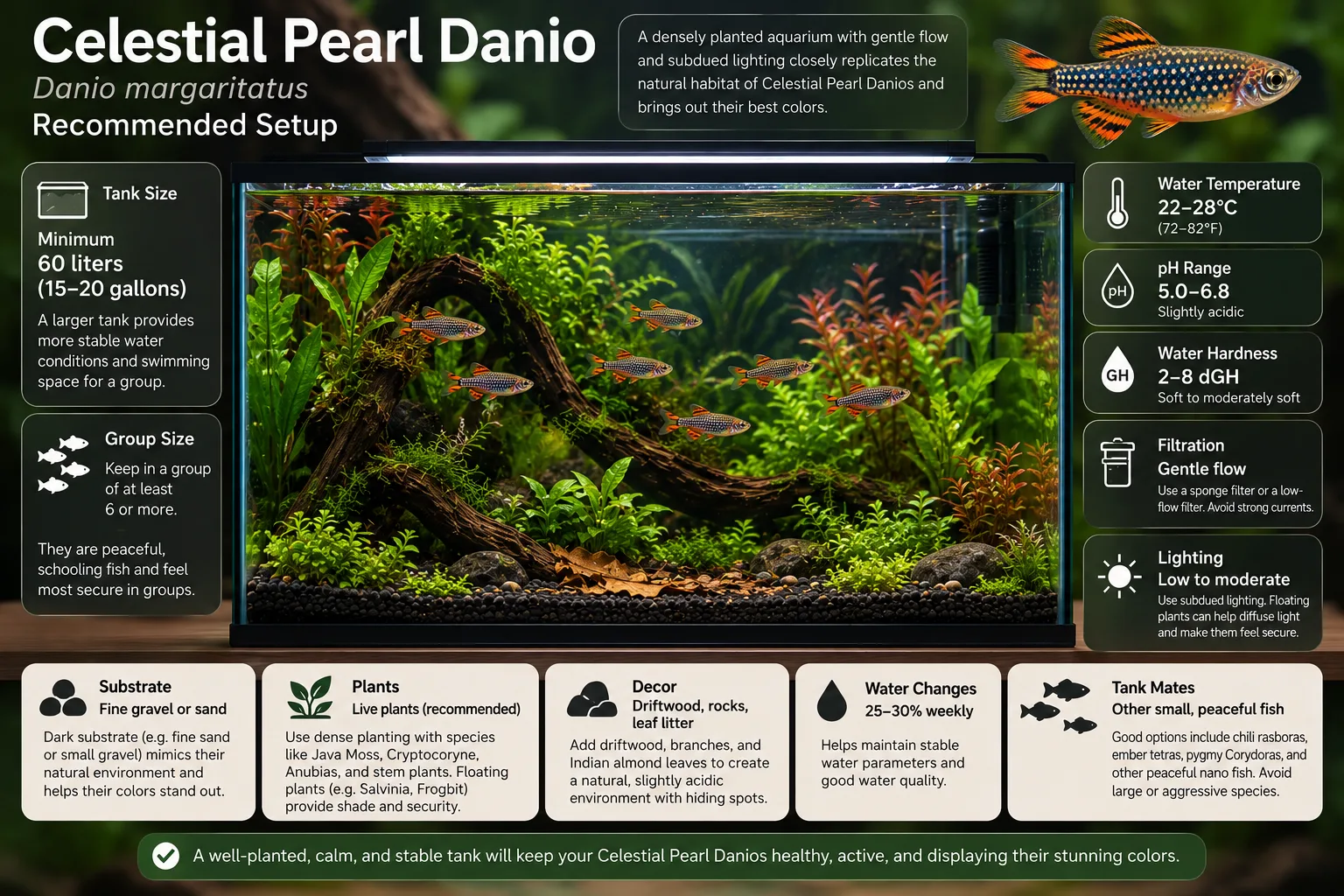
A 10-gallon (40 L) aquarium is a practical minimum for a small group of celestial pearl danios, but larger aquariums provide more stable water conditions and allow a larger school to display more natural behaviour.
A heavily planted aquarium is strongly recommended. Use dense stem plants, mosses, floating plants and other vegetation to create shelter while leaving some open areas for swimming. Fish kept in sparse aquariums often remain shy and spend much of their time hiding.
How many celestial pearl danios can you keep?
| 5 gal (19 L) | Not recommended for a proper school. Water stability and swimming space are limited. |
|---|---|
| 10 gal (40 L) | 6–8 celestial pearl danios in a heavily planted aquarium with stable water. |
| 15–20 gal (60–75 L) | 10–15 fish — ideal for a larger school and much more natural behaviour. |
| 29 gal (110 L) | 15–20 fish or a larger planted nano community with compatible species. |
| 55 gal (208 L) | A large colony with extensive planting and carefully selected peaceful tankmates. |
Water parameters
| Temperature | 20–26 °C (68–79 °F) |
|---|---|
| pH | 6.5–7.5 |
| Hardness (GH) | 5–15 dGH |
| Filtration | Gentle to moderate flow with excellent water quality |
Gentle filtration is preferred because celestial pearl danios do not require strong currents. A sponge filter or carefully adjusted hang-on or internal filter works well. Water quality should be stable, with ammonia and nitrite always maintained at zero.
A dark substrate and dense green planting can also improve their appearance by making their pearl-like spots and colourful fins stand out more clearly.
Not sure how many litres your aquarium holds? Use the aquarium volume calculator.
What do celestial pearl danios eat? Diet & feeding
Celestial pearl danios are omnivores, but their tiny mouths mean food size is extremely important. Large flakes and pellets may be ignored or impossible for them to swallow.
Use crushed high-quality flakes, nano pellets or micro granules as the main diet. Supplement regularly with tiny live or frozen foods such as baby brine shrimp, daphnia, microworms and finely chopped bloodworms.
Feed small portions once or twice daily. In community aquariums, make sure faster tankmates do not consume all the food before the celestial pearl danios have a chance to eat.
Celestial pearl danio tank mates & compatibility
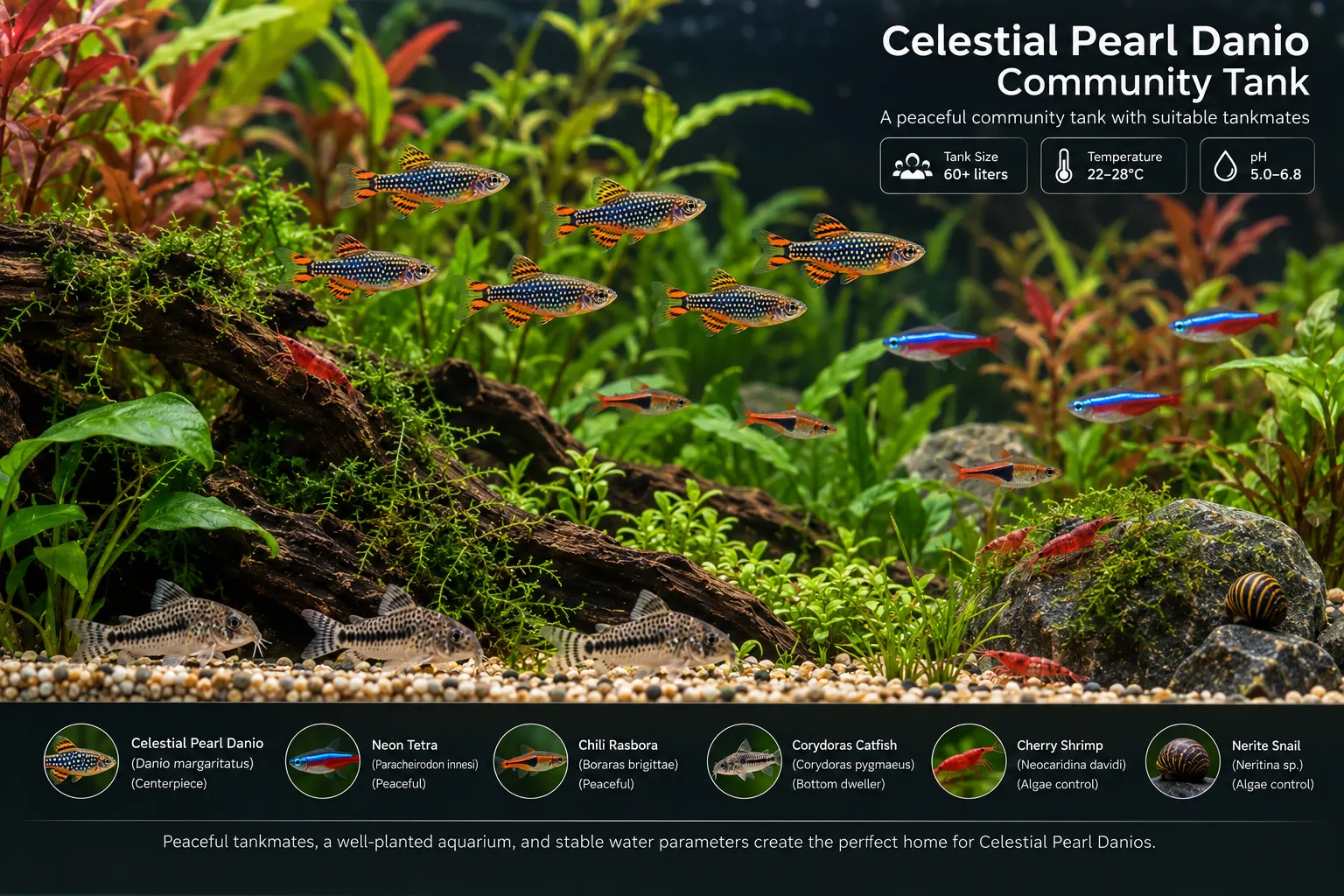
Celestial pearl danios are peaceful but relatively shy. Their ideal tankmates are calm nano fish that will not intimidate them or aggressively compete for food.
The biggest compatibility mistake is assuming that their peaceful nature means they can live with any peaceful community fish. Large, fast or constantly active species may not attack them, but can still cause stress and prevent them from feeding properly.
Good celestial pearl danio tank mates
- Other celestial pearl danios
- Chili rasboras and other very small peaceful rasboras
- Ember tetras
- Green neon tetras
- Small Corydoras species such as pygmy corydoras
- Kuhli loaches in sufficiently large mature aquariums
- Otocinclus catfish in established tanks
- Small peaceful shrimp, although tiny shrimplets may be eaten
- Other calm nano fish that will not outcompete them for food
Avoid
- Large or aggressive fish
- Fast, boisterous fish that outcompete them for food
- Large barbs and active danios
- Predatory fish of any size capable of eating them
- Fin-nipping species
- Very active community fish that may cause constant stress
How to breed celestial pearl danios
Celestial pearl danios are egg scatterers and can breed readily in heavily planted aquariums. Unlike some larger fish, successful breeding often happens naturally when a healthy group is maintained in excellent conditions.
Males display brighter colours and may perform short displays or chases when courting females. Females become noticeably rounder when carrying eggs.
For controlled breeding, use a separate small aquarium with Java moss, spawning mops or dense fine-leaved plants. Gentle filtration and stable water conditions are important.
Eggs are scattered among plants and are relatively small. Adults may eat some eggs and fry, so remove the adults if you want to maximize fry survival. Fry initially require microscopic foods such as infusoria or prepared liquid fry food before graduating to baby brine shrimp and microworms.
Naming confusion & buyer’s notes
The celestial pearl danio has acquired several names since its discovery, which can occasionally confuse new aquarium keepers.
Celestial pearl danio
The accepted scientific name is Danio margaritatus. The common name refers to the pale, pearl-like spots covering the body.
Galaxy rasbora
"Galaxy rasbora" is another extremely common trade name for the same fish. Despite the name, it is not a true rasbora — it belongs to the genus Danio.
Microrasbora galaxy
Early aquarium trade names sometimes included "Microrasbora galaxy." This is an outdated informal name and does not represent the current scientific classification.
Not a rasbora
Despite being sold as a galaxy rasbora, the species is classified asDanio margaritatus, making it more closely associated with danios than with true rasboras.
Wild collection concerns
The species experienced extremely high demand shortly after its discovery, creating concerns about overcollection from its limited native range. Today, captive-bred celestial pearl danios are widely available and are generally the preferred choice for the aquarium hobby.
Celestial pearl danio FAQ
- Is a celestial pearl danio the same fish as a galaxy rasbora?
- Yes. Celestial pearl danio and galaxy rasbora are two common names for the same species, Danio margaritatus. Galaxy rasbora remains widely used in the aquarium trade, but the fish is classified as a danio rather than a true rasbora.
- How long do celestial pearl danios live?
- Celestial pearl danios typically live around 3–5 years in a well-maintained aquarium. Clean water, a varied diet, a stable environment and keeping them in a proper group all contribute to a longer lifespan.
- How big do celestial pearl danios get?
- Adult celestial pearl danios usually reach around 2–2.5 cm (about 1 inch) long. Despite their small size, they display remarkably detailed coloration, including pearl-like body spots and colourful fins.
- How many celestial pearl danios should be kept together?
- Keep at least six celestial pearl danios, although groups of ten or more are strongly recommended. Larger groups make them more confident and allow their natural social behaviour to develop.
- What size tank do celestial pearl danios need?
- A 10-gallon (40 L) aquarium is a practical minimum for a small group, but a 15–20 gallon planted aquarium is better for a larger school. Dense planting and stable water conditions are more important than simply maximizing fish numbers.
- Are celestial pearl danios aggressive?
- Celestial pearl danios are peaceful overall, but males can display and chase one another when establishing small territories or competing for females. This behaviour is usually harmless when the aquarium has enough space, plants and hiding areas.
- What do celestial pearl danios eat?
- Celestial pearl danios are omnivores but have very small mouths. Feed crushed flakes, nano pellets, micro granules and tiny live or frozen foods such as baby brine shrimp, daphnia and microworms.
- Do celestial pearl danios need a heater?
- It depends on room temperature. Celestial pearl danios tolerate relatively cool water and generally do well between 20–26 °C (68–79 °F). A heater is recommended if temperatures regularly fall below their preferred range or fluctuate significantly.
- Are celestial pearl danios good for beginners?
- They can be suitable for beginners who can maintain stable water conditions. They are not difficult to feed or care for, but their small size and sensitivity to stressful tankmates mean they do best in a mature, peaceful, heavily planted aquarium.
- Can celestial pearl danios live with shrimp?
- Yes, celestial pearl danios can live with adult dwarf shrimp in a planted aquarium. However, they may eat very small shrimp fry, especially when hiding places are limited. Dense moss and plants improve shrimplet survival.
- Why are celestial pearl danios hiding?
- Hiding is common when celestial pearl danios are newly introduced, kept in too small a group or housed with overly active tankmates. Dense plants and a school of at least six to ten fish usually help them become more confident.