
Emerald Dwarf Rasbora
Danio erythromicron
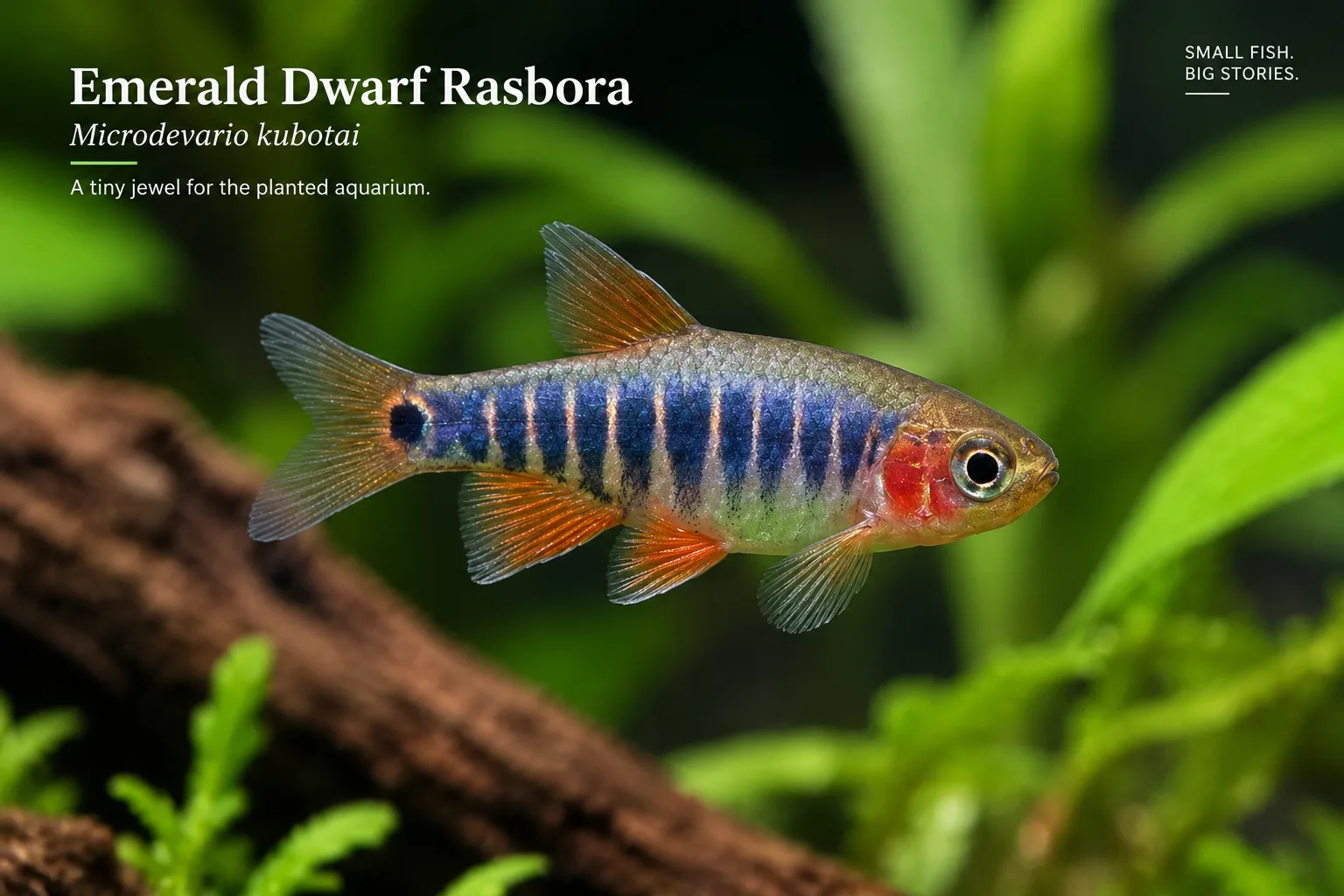
A tiny jewel-like danio from Myanmar's Lake Inle — brilliantly patterned, peaceful and fascinating to keep in a mature, densely planted nano aquarium.
Difficulty
Intermediate
Min tank size
45–60 L / 12–15 gal
Temperament
Peaceful, shy
Diet type
Omnivore / micropredator
Adult size
2–3 cm / 0.8–1.2 in
Lifespan
3–5 years
Water type
Freshwater
Emerald Dwarf Rasbora at a glance
| Scientific name | Danio erythromicron (Annandale, 1918) |
|---|---|
| Alternative scientific names | Microrasbora erythromicron; Celestichthys erythromicron |
| Family | Danionidae (danios) |
| Origin | Myanmar — Lake Inle basin in Shan State |
| Adult size | 2–3 cm (0.8–1.2 in) |
| Tank size (min) | 45–60 L / 12–15 gal — 60 cm long aquarium recommended |
| Temperature | 20–24 °C (68–75 °F) |
| pH range | 7.0–8.0 |
| Water hardness | 10–20 dGH |
| Diet | Micro-predatory omnivore — micro-pellets, live and frozen foods |
| Temperament | Peaceful but shy; males may spar with one another |
| Lifespan | 3–5 years |
| Care level | Intermediate |
Overview
The Emerald Dwarf Rasbora (Danio erythromicron) is one of the smallest and most visually distinctive members of the danio group. Native to the Lake Inle region of Myanmar, this tiny freshwater fish is famous for its brilliant combination of orange-red body colour and narrow, iridescent blue-green vertical bars.
Despite its common name, the Emerald Dwarf Rasbora is not a true rasbora. It is currently placed in the genus Danio, although it has also appeared in aquarium literature under the names Microrasbora erythromicron and Celestichthys erythromicron. This long history of changing scientific names continues to create confusion among aquarium keepers and retailers.
This species is peaceful but naturally shy, especially when kept in small numbers or in an overly open aquarium. A large group in a densely planted tank produces much more confident behaviour. Mature males can also display toward one another, intensifying their remarkable colours while engaging in short periods of sparring and territorial behaviour.
Emerald Dwarf Rasboras are best suited to aquarists who can provide a mature, stable aquarium and carefully selected water conditions. Their preference for relatively cool, neutral to alkaline water makes them different from many commonly kept Southeast Asian nano fish.
Emerald Dwarf Rasbora size & lifespan
How big do Emerald Dwarf Rasboras get?
Adult Emerald Dwarf Rasboras usually reach approximately 2–3 cm (0.8–1.2 inches) in length. Their compact body and tiny adult size make them genuine nano fish, but their social requirements mean they should not simply be placed in the smallest possible aquarium.
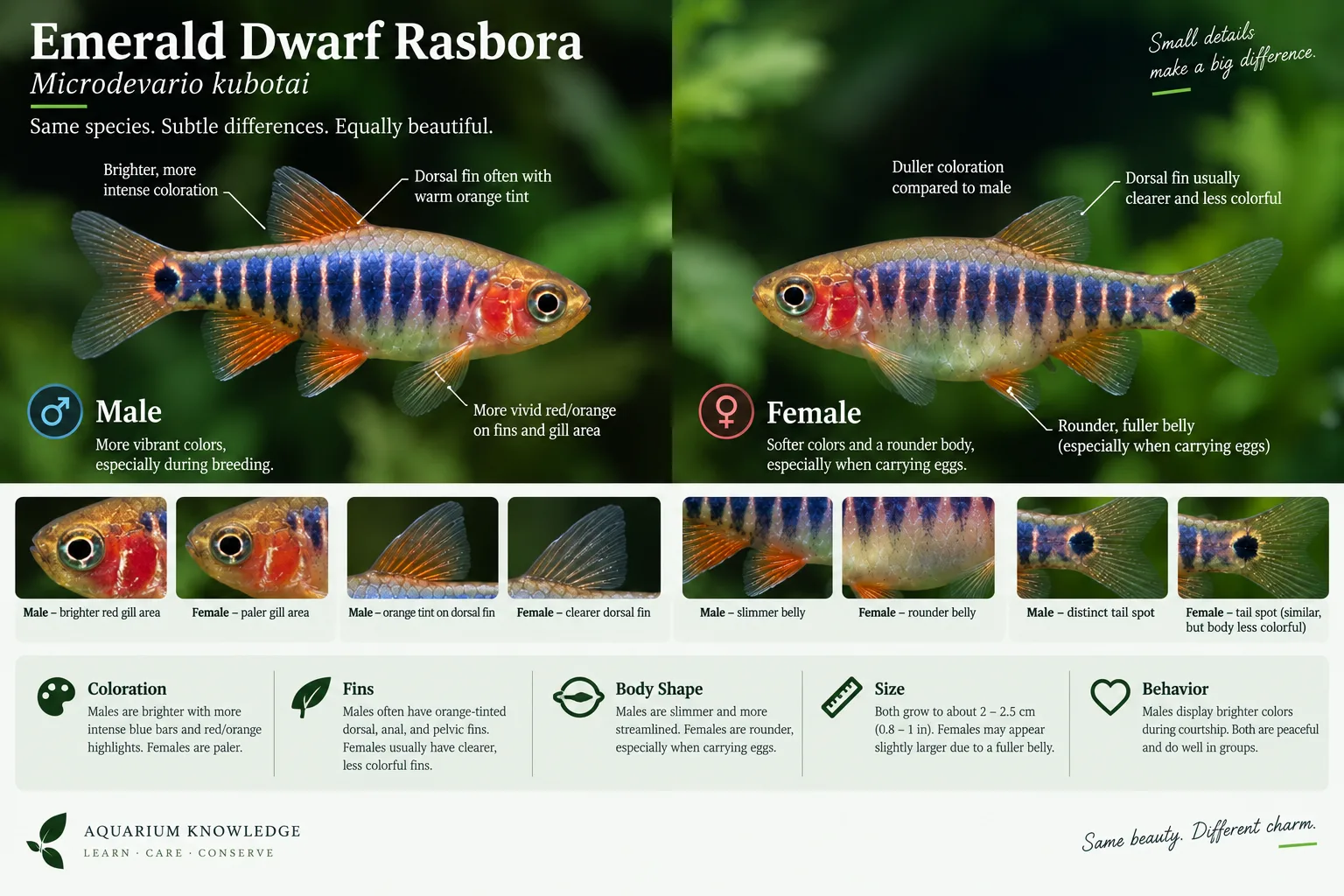
Mature males are generally slimmer and significantly more colourful, displaying stronger orange-red pigmentation and more intense iridescent blue-green bars. Females tend to be slightly larger, less intensely coloured and noticeably rounder through the abdomen when carrying eggs.
How long do Emerald Dwarf Rasboras live?
Emerald Dwarf Rasboras generally live around 3–5 years in a well-managed home aquarium. Their lifespan depends on stable water quality, suitable temperatures, proper nutrition and avoiding stress caused by inadequate group size or overly aggressive tank mates.
Natural habitat & origin
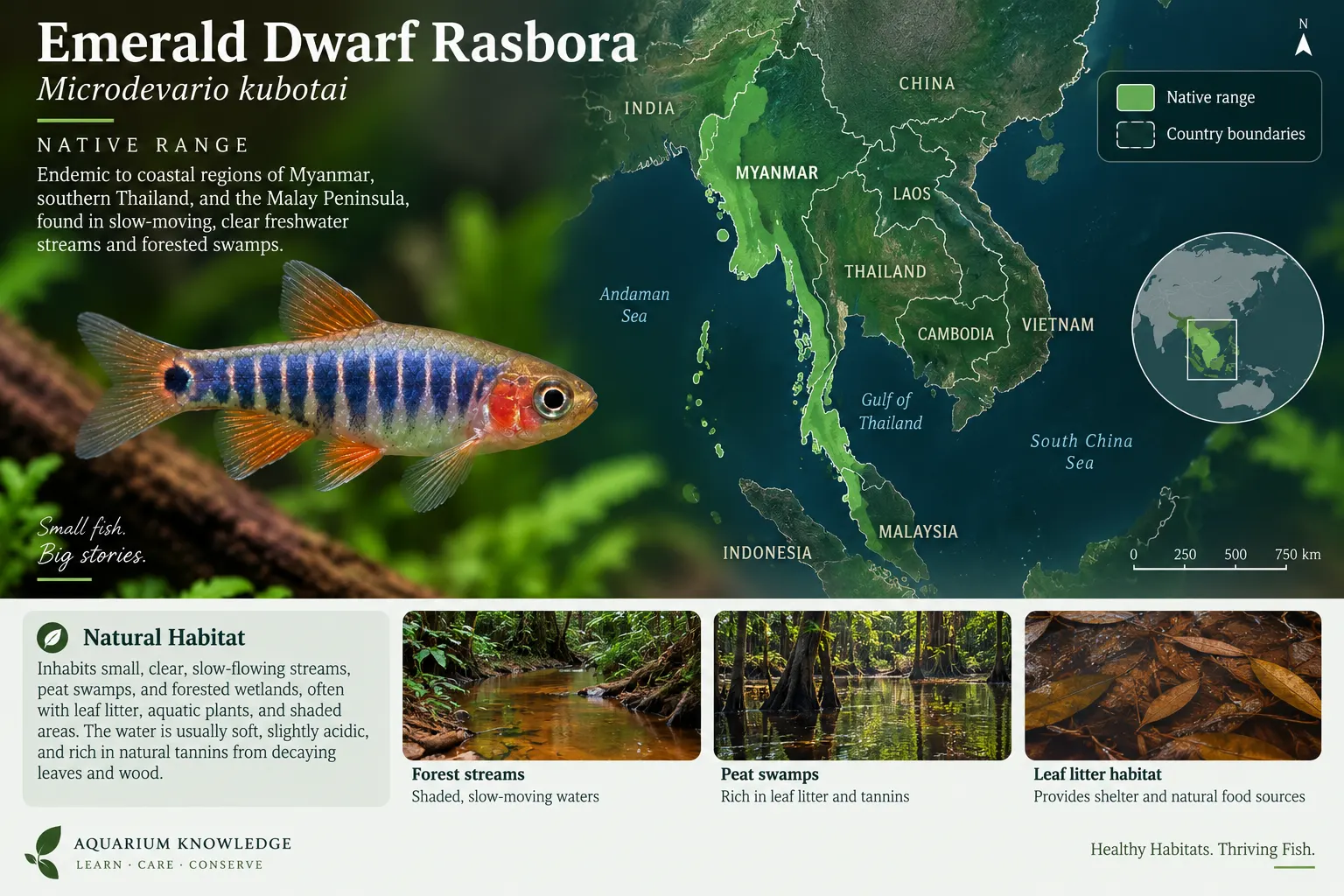
Danio erythromicron is native to Myanmar and is closely associated with the Lake Inle basin in Shan State. Lake Inle is a highland freshwater ecosystem surrounded by limestone-rich terrain, giving the species a very different natural environment from the warm, acidic blackwater habitats often associated with other small Southeast Asian aquarium fish.
Wild Emerald Dwarf Rasboras inhabit shallow, clear and heavily vegetated areas. Dense aquatic plants provide cover, feeding opportunities and protection, while the open spaces between vegetation allow small groups to move and forage.
Lake Inle's elevated location contributes to relatively cool water temperatures. The natural environment is generally neutral to alkaline and moderately hard rather than soft and acidic. This is one of the most important facts to understand when setting up an aquarium for this species.
In the aquarium, dense planting is beneficial, but the goal should not be to recreate a dark blackwater environment. Instead, provide clean, stable water, moderate mineral content, gentle filtration and numerous visual barriers created by plants.
Emerald Dwarf Rasbora tank size & requirements
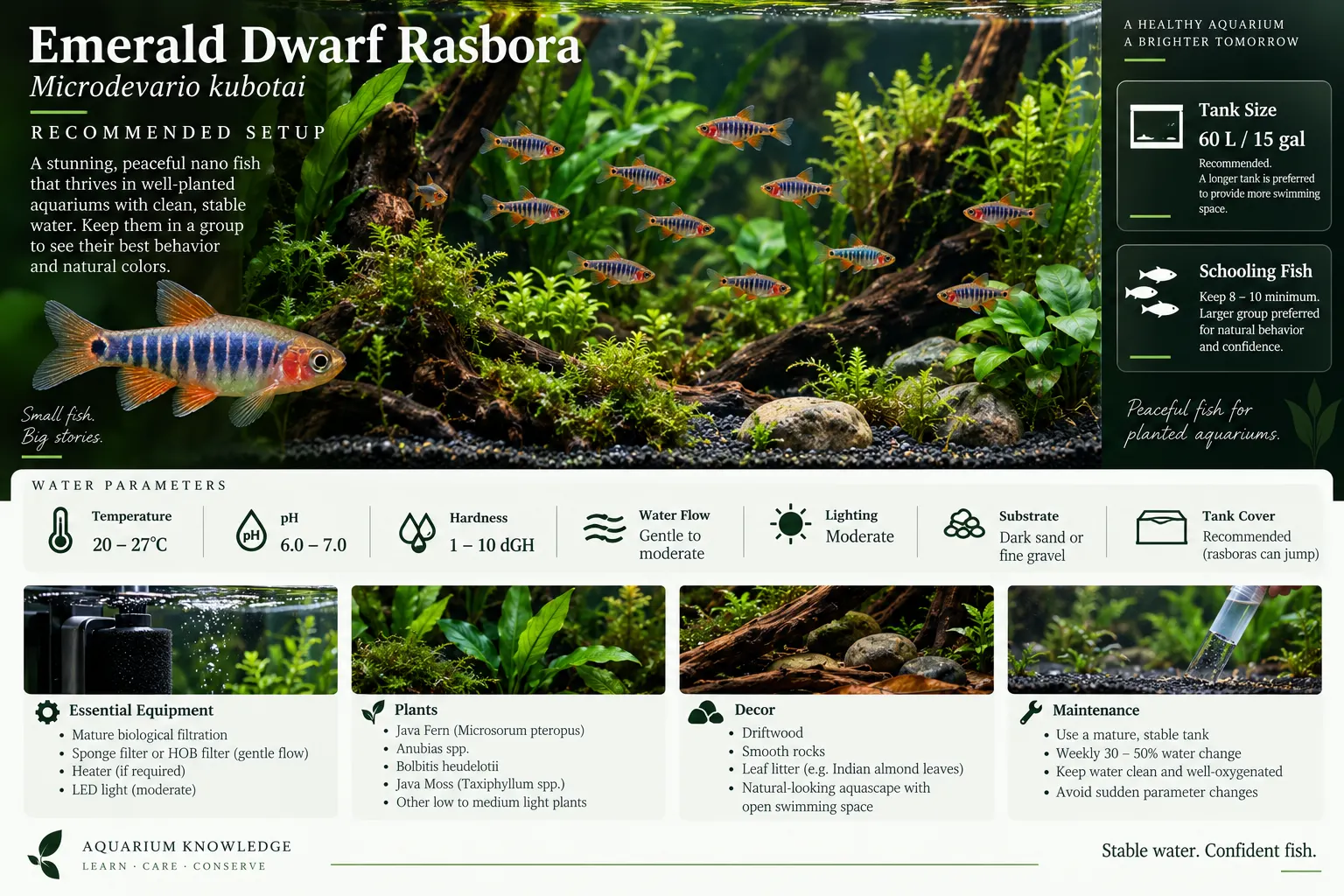
A 12-gallon (45 L) aquarium can work as a practical minimum for a species-focused group, but a 15-gallon (60 L) aquarium with a 60 cm footprint is strongly recommended. These fish are tiny, but they need enough space for a proper group, dense planting and natural social behaviour.
How many Emerald Dwarf Rasboras should be kept together?
Keep at least 8–10 Emerald Dwarf Rasboras together, although larger groups of 12–20 are even better when aquarium space permits. A larger group makes the fish more confident and helps distribute male display behaviour rather than allowing one individual to become the constant target of aggression.
| 10 gal (38 L) | Possible only for a small species-focused group, but not ideal for long-term keeping. A larger footprint provides better space and more stable conditions. |
|---|---|
| 12 gal (45 L) | Practical minimum for a group of 8–10 Emerald Dwarf Rasboras in a densely planted aquarium. |
| 15 gal (60 L) | Recommended minimum for 10–15 fish, offering better swimming space and more opportunities to create planted sight barriers. |
| 20 gal long (75 L) | Excellent for a larger group of 15–20 Emerald Dwarf Rasboras or a carefully selected nano community. |
| 29 gal (110 L) | Suitable for a large school with peaceful, similarly sized species while maintaining excellent stability and territorial space. |
Water parameters
| Temperature | 20–24 °C (68–75 °F) |
|---|---|
| pH | 7.0–8.0 |
| Hardness (GH) | 10–20 dGH |
| Filtration turnover | Gentle to moderate filtration with clean, stable water |
A heavily planted aquarium is ideal. Use fine-leaved aquatic plants, stem plants and other dense vegetation to break lines of sight between individuals. This helps shy fish feel secure and gives males space to establish temporary display areas.
Dark substrate can help the fish feel more secure and makes their colours stand out, while floating plants can soften bright lighting. Gentle filtration is preferred because these small fish do not need strong current constantly pushing them through the aquarium.
Avoid treating this species like a typical soft-water rasbora. Extremely acidic or very soft water does not reflect the conditions associated with its Lake Inle habitat. Stability is more important than constantly attempting to manipulate water chemistry.
Not sure how many litres your tank actually holds? Check it with the aquarium volume calculator.
What do Emerald Dwarf Rasboras eat? Diet & feeding
Emerald Dwarf Rasboras are tiny omnivorous micropredators. In nature, they feed on very small invertebrates, zooplankton and other microscopic food sources available among dense aquatic vegetation.
In the aquarium, high-quality micro-pellets, crushed flakes and powdered foods can form the foundation of the diet. Because their mouths are very small, standard-sized flakes and pellets may be too large unless broken into appropriately sized particles.
For the best colouration and conditioning, regularly provide small live or frozen foods such as daphnia, cyclops, baby brine shrimp, Artemia nauplii and other suitably sized invertebrates. A varied diet is particularly useful when conditioning adults for breeding.
Feed small portions once or twice daily. These fish can be shy and may lose out to larger or faster tank mates during feeding, so make sure food is reaching the entire group.
Emerald Dwarf Rasbora tank mates & compatibility
Emerald Dwarf Rasboras are peaceful but extremely small and can be shy. Tank mate selection should therefore focus on calm species that will not intimidate them, compete aggressively for food or require significantly different water conditions.
A species-only aquarium is often the best option for observing their natural behaviour and encouraging breeding. In a community aquarium, choose similarly sized peaceful fish and maintain plenty of plants and cover.
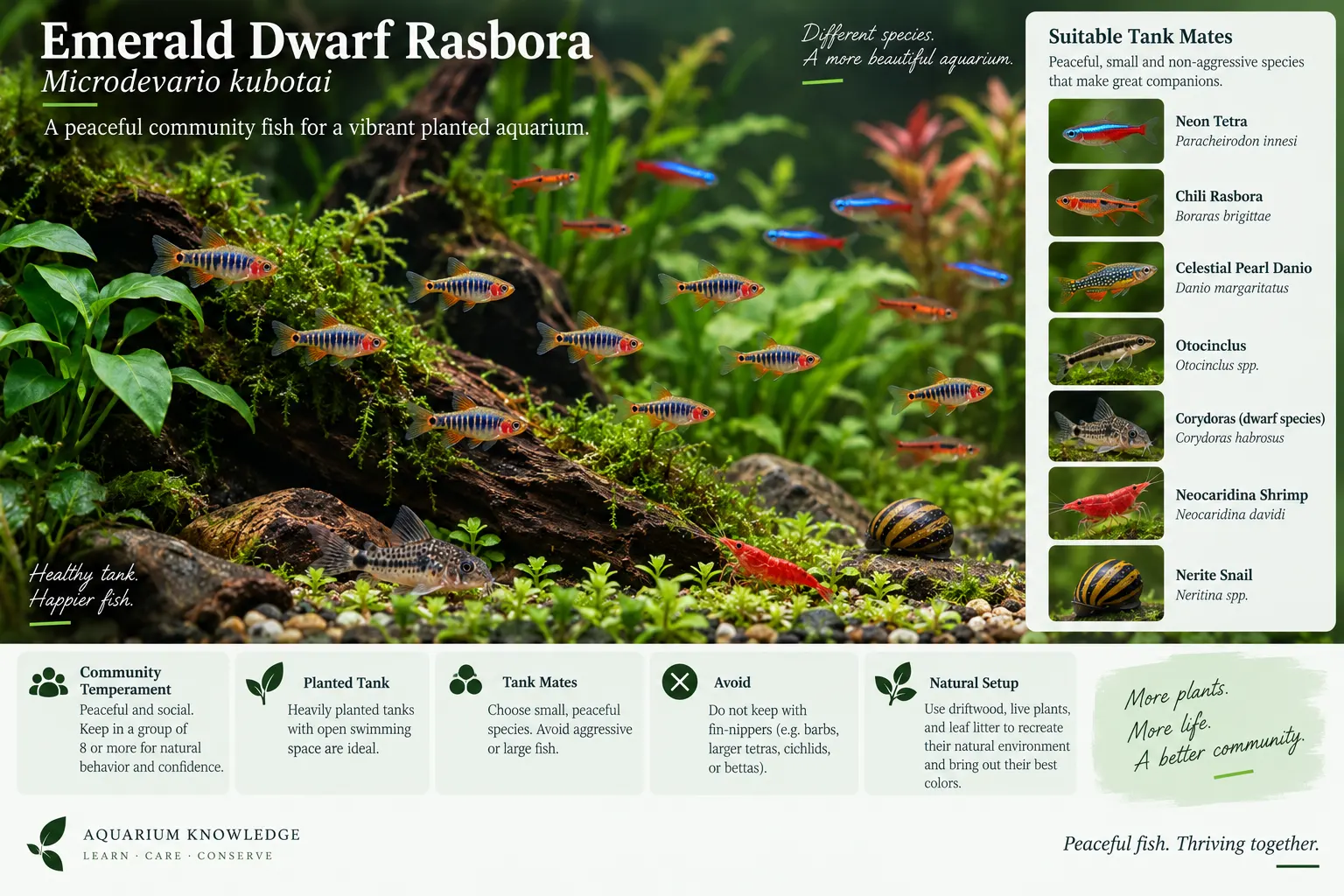
Good Emerald Dwarf Rasbora tank mates
- Small peaceful Danionidae species with compatible cool, alkaline water requirements
- Celestial Pearl Danios only with careful consideration of compatibility and breeding separation
- Small peaceful Corydoras species suited to similar temperatures
- Otocinclus catfish in mature, established aquariums
- Small peaceful loaches where water requirements overlap
- Other calm nano fish that will not outcompete them for food
- Freshwater shrimp may coexist, although tiny shrimplets can be eaten
Avoid
- Large fish capable of eating such a small species
- Aggressive or highly territorial fish
- Fast, boisterous species that dominate feeding time
- Large active danios that may intimidate them
- Fish requiring consistently warm tropical temperatures
- Species that require strongly acidic, very soft blackwater conditions
How to breed Emerald Dwarf Rasboras
Emerald Dwarf Rasboras are egg-scattering fish and provide no parental care. Mature females are generally fuller-bodied, especially when carrying eggs, while males are slimmer and considerably more colourful with intense blue-green bars and reddish fins.
A mature, densely planted aquarium may occasionally produce fry naturally if adults are well-conditioned. However, adults can consume eggs, so a dedicated breeding setup provides better survival rates.
Condition breeding adults with high-quality foods including live or frozen daphnia and baby brine shrimp. A separate breeding container can be furnished with Java moss, fine-leaved plants or spawning mops where eggs can fall and remain protected.
After spawning, remove the adults to prevent egg predation. Eggs generally hatch after approximately two to three days depending on temperature. The fry are extremely small and initially require microscopic foods such as infusoria or suitably sized commercial fry foods before progressing to Artemia nauplii and other larger foods.
Fry are sensitive to poor water quality, so clean and stable conditions are especially important during the first weeks of development.
Naming & buyer’s notes
The Emerald Dwarf Rasbora has one of the more confusing naming histories in the aquarium hobby. Depending on the source, shop or older aquarium book, the same species may appear under several different scientific and common names.
Not actually a true rasbora
Despite its common name, the Emerald Dwarf Rasbora is currently placed in the genus Danio as Danio erythromicron. The name "rasbora" remains widely used in the aquarium trade but does not reflect its current generic classification.
Older scientific names
Older literature and aquarium references may use Microrasbora erythromicron or Celestichthys erythromicron. These names refer to the same species, which is now generally listed as Danio erythromicron.
Emerald Dwarf Danio
"Emerald Dwarf Danio" is another common aquarium name for this same fish. It is useful when searching for the species because some sellers may not use the word "rasbora" at all.
Gold Ring Burmese Danio
"Gold Ring Burmese Danio" is a trade name associated with this species. It should not be treated as a separate fish entry or distinct species. Always check the scientific name Danio erythromicron when purchasing.
Important water chemistry note
One of the biggest care mistakes is assuming that the word "rasbora" automatically means soft, acidic water. Emerald Dwarf Rasboras come from the Lake Inle region and generally prefer neutral to alkaline, moderately hard water. Their natural conditions are significantly different from those required by many blackwater rasbora species.
Emerald Dwarf Rasbora FAQ
- How big do Emerald Dwarf Rasboras get?
- Emerald Dwarf Rasboras are extremely small fish, usually reaching around 2–3 cm (0.8–1.2 inches). Their tiny adult size makes them suitable for planted nano aquariums, but their social behaviour means they should still be given adequate horizontal space and kept in a proper group.
- How long do Emerald Dwarf Rasboras live?
- Emerald Dwarf Rasboras generally live around 3–5 years in a well-maintained aquarium. Stable water conditions, cool temperatures, a varied diet and keeping them in an appropriate-sized group can help maximise their lifespan.
- How many Emerald Dwarf Rasboras should be kept together?
- A group of at least 8–10 fish is recommended, while larger groups of 12–20 are even better when aquarium space allows. Larger groups make the fish more confident and help spread the occasional sparring and display behaviour between males.
- What size tank do Emerald Dwarf Rasboras need?
- A 12-gallon (45 L) aquarium is a practical minimum, but a 15-gallon (60 L) aquarium with a 60 cm footprint is recommended. Despite their tiny size, they benefit from planted space, broken sight lines and room for a proper social group.
- Are Emerald Dwarf Rasboras peaceful?
- Yes. They are generally peaceful toward other species, although males can display and spar with one another. This behaviour is usually limited to the group and is less problematic when the fish are kept in sufficient numbers with plenty of plants and visual barriers.
- What do Emerald Dwarf Rasboras eat?
- Emerald Dwarf Rasboras eat small aquarium foods including crushed flakes, micro-pellets and powdered foods. They benefit greatly from regular live or frozen foods such as daphnia, baby brine shrimp, cyclops and other suitably sized invertebrates.
- Do Emerald Dwarf Rasboras need a heater?
- They come from the highland Lake Inle region, where water temperatures are cooler than those preferred by many tropical aquarium fish. A heater may be useful to maintain stable conditions around 20–24 °C (68–75 °F), especially where room temperatures fluctuate.
- Are Emerald Dwarf Rasboras true rasboras?
- No. Despite the common name, this species is currently placed in the genus Danio as Danio erythromicron. It has historically been known as Microrasbora erythromicron and Celestichthys erythromicron, which explains why older aquarium literature and shops may use different names.
- Can Emerald Dwarf Rasboras live with shrimp?
- Adult shrimp can often coexist with Emerald Dwarf Rasboras in a densely planted aquarium. However, very small shrimp shrimplets may be eaten. Moss, dense plants and complex cover improve survival for breeding shrimp.
- Are Emerald Dwarf Rasboras good for beginners?
- They are best considered an intermediate nano fish. Their small size, shy nature and preference for relatively cool, alkaline water make them less forgiving than common beginner fish. They do best in mature, stable aquariums with carefully selected tank mates.
- What is the difference between an Emerald Dwarf Rasbora and a Celestial Pearl Danio?
- They are different species from the Lake Inle region of Myanmar. The Emerald Dwarf Rasbora, Danio erythromicron, has distinctive vertical blue-green bars over an orange-red body, while the Celestial Pearl Danio, Danio margaritatus, has pale spots on a darker body. Both are small danionins but have different patterns, behaviour and aquarium requirements.