
Cardinal Tetra
Paracheirodon axelrodi
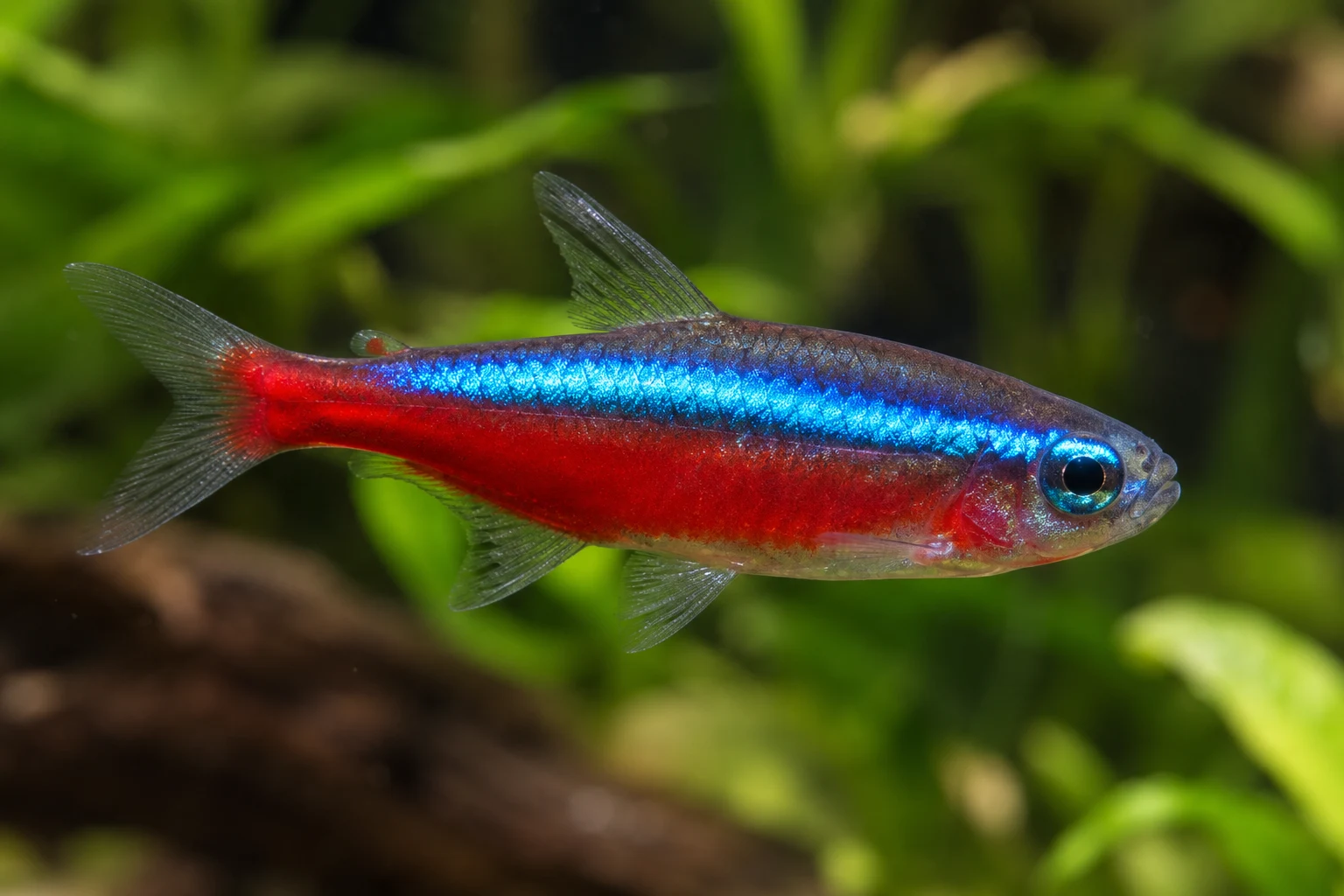
A hardy, active South American tetra known for its silvery body, dark-edged fins and energetic schooling behaviour.
Difficulty
Beginner
Min tank size
75 L / 20 gal
Temperament
Peaceful, active
Diet type
Omnivore
Adult size
4–5 cm / 1.6–2 in
Lifespan
4–5 years
Water type
Freshwater
Cardinal tetra at a glance
| Scientific name | Paracheirodon axelrodi |
|---|---|
| Order | Characiformes |
| Family | Characidae |
| Genus | Paracheirodon |
| Origin | South America — Brazil and Colombia, especially the Rio Negro and upper Orinoco drainage |
| Adult size | About 4–5 cm (1.6–2 in) |
| Tank size (min) | 75 L / 20 gal for a school; a longer footprint is preferred |
| Temperature | 23–28 °C (73–82 °F) |
| pH range | 4.0–7.0 |
| Water hardness | Very soft to soft |
| Diet | Omnivore — flakes, pellets, frozen and live foods |
| Temperament | Peaceful, energetic schooling fish |
| Care level | Beginner |
Overview
The Cardinal tetra (Paracheirodon axelrodi) is a robust South American characin that has been popular in the aquarium hobby for decades. Its silvery body, darker dorsal and anal fins and warm red accents make it easy to recognise, while its energetic nature gives a community aquarium plenty of movement.
This is a more substantial tetra than many nano species. It is peaceful enough for a community aquarium, but its constant swimming and occasional fin-nipping mean it should be kept with appropriately sized, active tankmates. A proper school and a long aquarium are much more important than keeping it in a small decorative tank.
Cardinal tetra size & lifespan
How big do Cardinal tetras get?
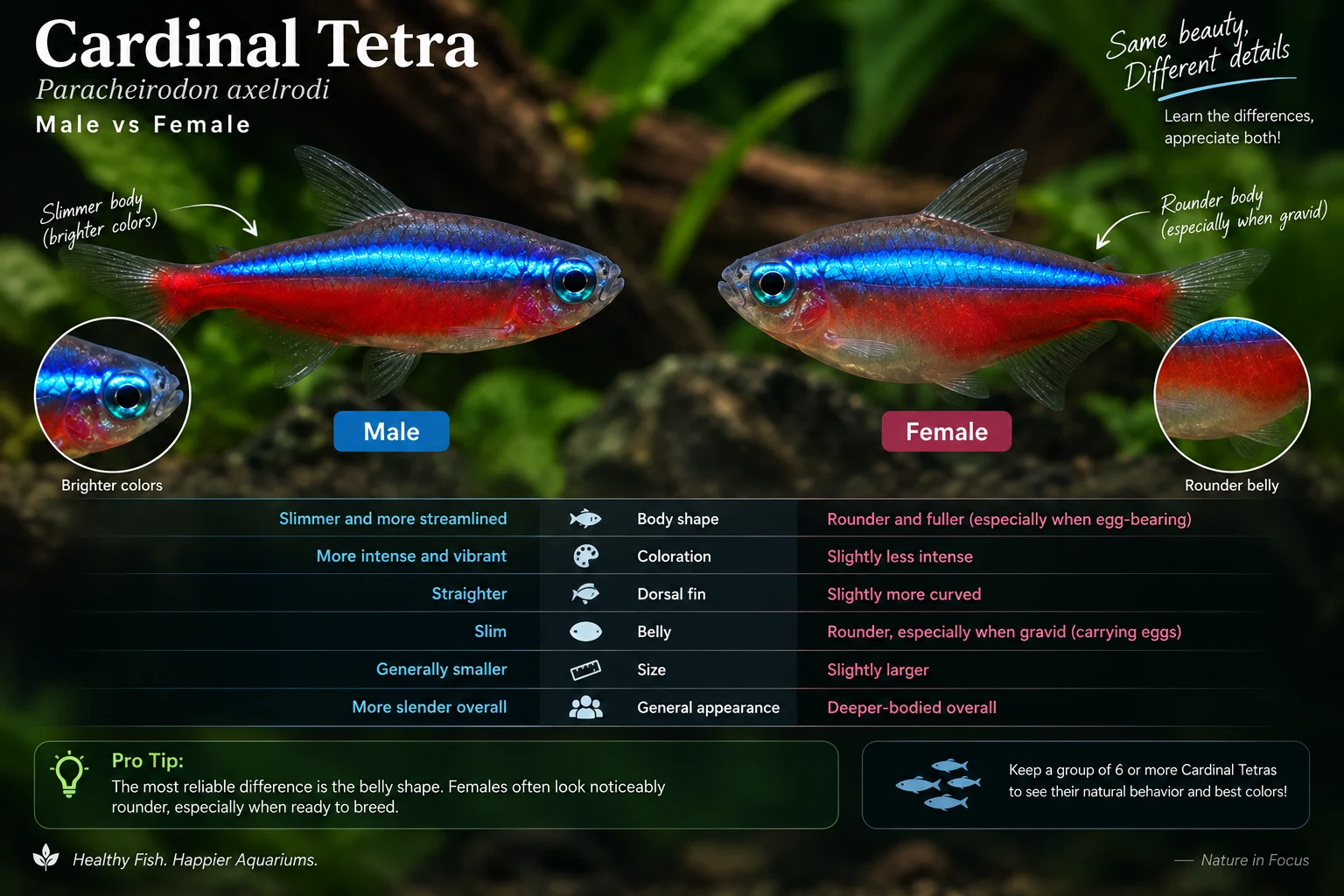
Adults usually reach about 4–5 cm (1.6–2 inches). Females can look deeper-bodied than males, especially when mature and carrying eggs.
How long do Cardinal tetras live?
In a clean, stable aquarium, Cardinal tetras can live around 4–5 years, sometimes longer. A varied omnivore diet, good filtration, regular maintenance and sufficient swimming space are key factors in keeping them healthy over the long term.
Natural habitat & origin
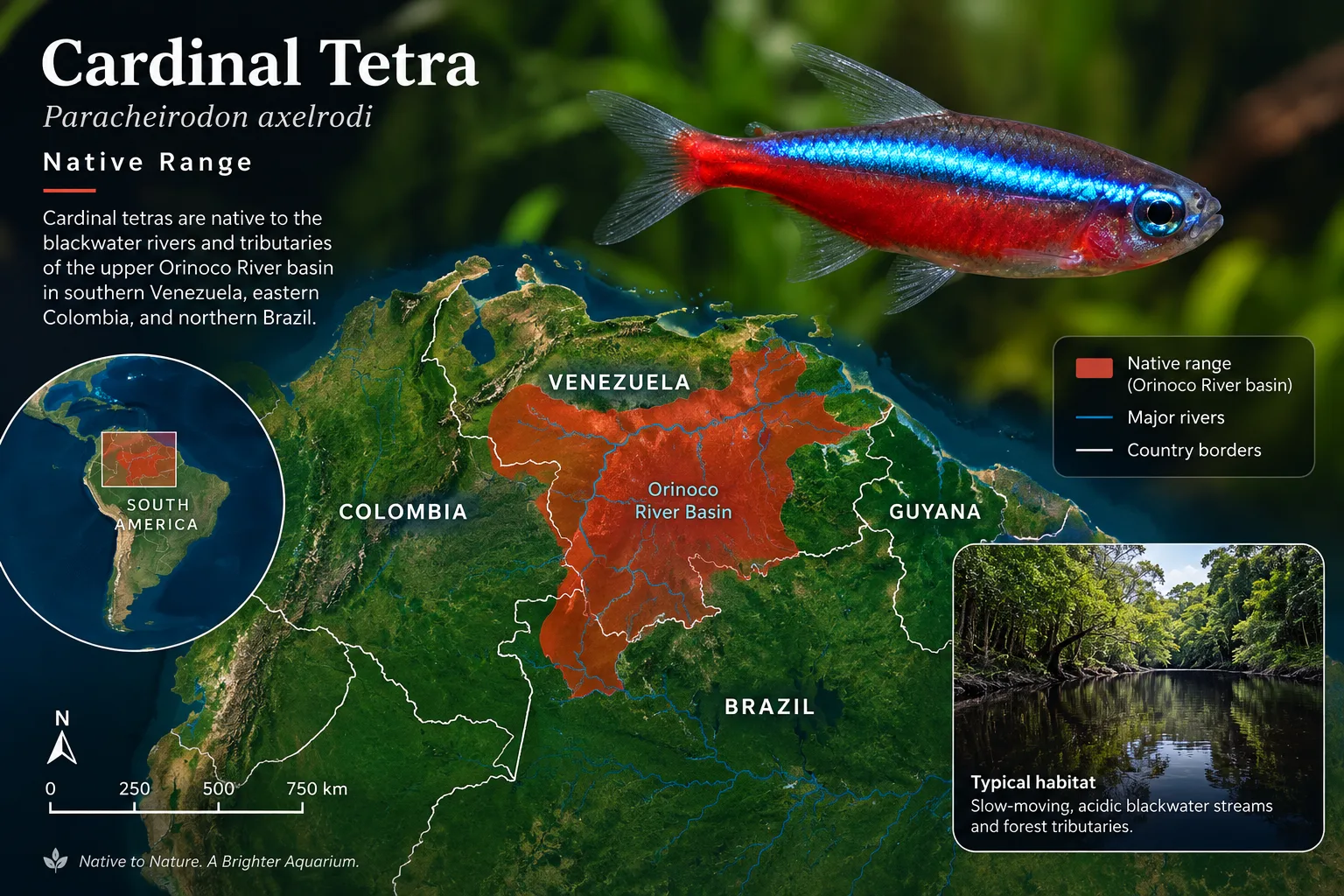
Paracheirodon axelrodi is native to the upper Amazon and Orinoco drainage systems of northern South America, especially the Rio Negro region of Brazil and parts of Colombia. Wild fish are associated with slow-moving, shaded blackwater environments where leaf litter, submerged roots and dense vegetation provide cover and feeding opportunities.
Aquarium specimens are widely captive-bred. A planted aquarium with open swimming space, moderate current, good oxygenation and stable water conditions provides a suitable captive environment without needing to duplicate every detail of the wild habitat.
Cardinal tetra tank size & requirements
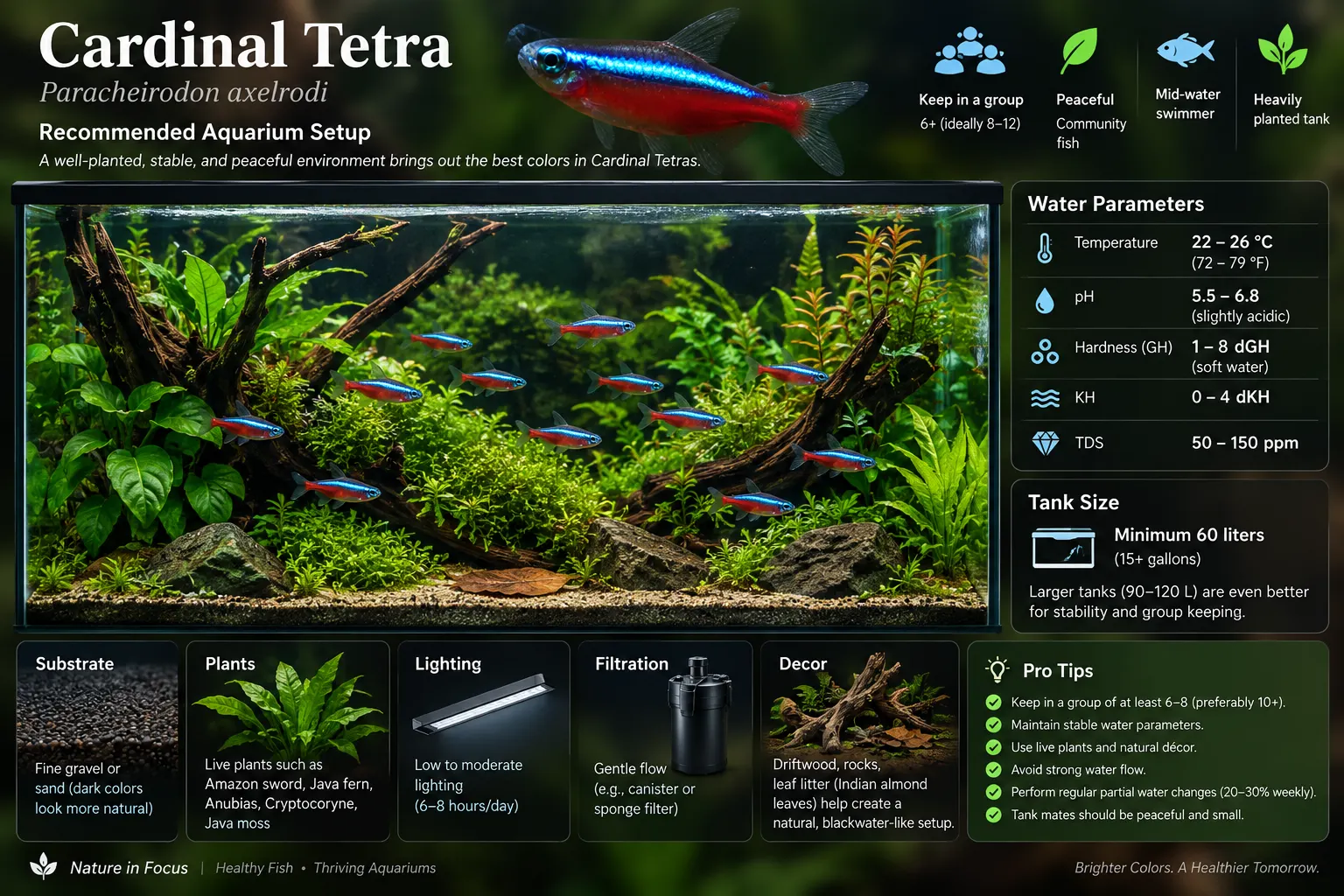
A 20-gallon (75 L) long aquarium is a sensible minimum for a school of Cardinal tetras. The species is active and can reach a substantial size for a tetra, so horizontal swimming room is more useful than extra tank height. A secure lid is recommended because active tetras can jump when startled.
How many Cardinal tetras in a 10 or 20 gallon tank?
A 10-gallon aquarium is generally too cramped for a proper long-term school. In a 20-gallon tank, a group of six to eight is a reasonable starting point when filtration and maintenance are strong. Larger aquariums are better for larger groups and mixed community stocking.
| 5 gal (19 L) | Not recommended — too small for an active school of Cardinal tetras. |
|---|---|
| 10 gal (38 L) | Not recommended as a long-term home; a school needs more swimming room and stable water quality than a small nano aquarium can reliably provide. |
| 20 gal (75 L) | A practical minimum for a school of 6–8, preferably in a longer aquarium. |
| 29 gal (110 L) | 8–12 Cardinal tetras, with room for compatible peaceful tankmates. |
| 55 gal (208 L) | A larger school of 12–20 can work well, with substantial swimming space and careful community stocking. |
Water parameters
| Temperature | 23–28 °C (73–82 °F) |
|---|---|
| pH | 4.0–7.0 |
| Hardness (GH) | Very soft to soft |
| Filtration turnover | Moderate circulation with good oxygenation |
Use a fine gravel or sand substrate, hardy live plants and an unobstructed swimming lane through the middle of the aquarium. Cardinal tetras may nibble tender vegetation, so tougher plants are a safer choice than delicate soft-leaved species. Moderate filtration and good oxygenation suit their active nature.
Not sure how many litres your tank holds? Check it with theaquarium volume calculator.
What do Cardinal tetras eat? Diet & feeding
Cardinal tetras are unfussy omnivores. A quality flake or appropriately sized pellet makes a good daily staple, while frozen or live foods such as daphnia, brine shrimp and bloodworms provide variety and useful enrichment.
Feed small portions once or twice daily and provide only enough food for the school to finish in a few minutes. Because these fish are active and persistent feeders, overfeeding is easy and can quickly contribute to poor water quality.
Cardinal tetra tank mates & compatibility
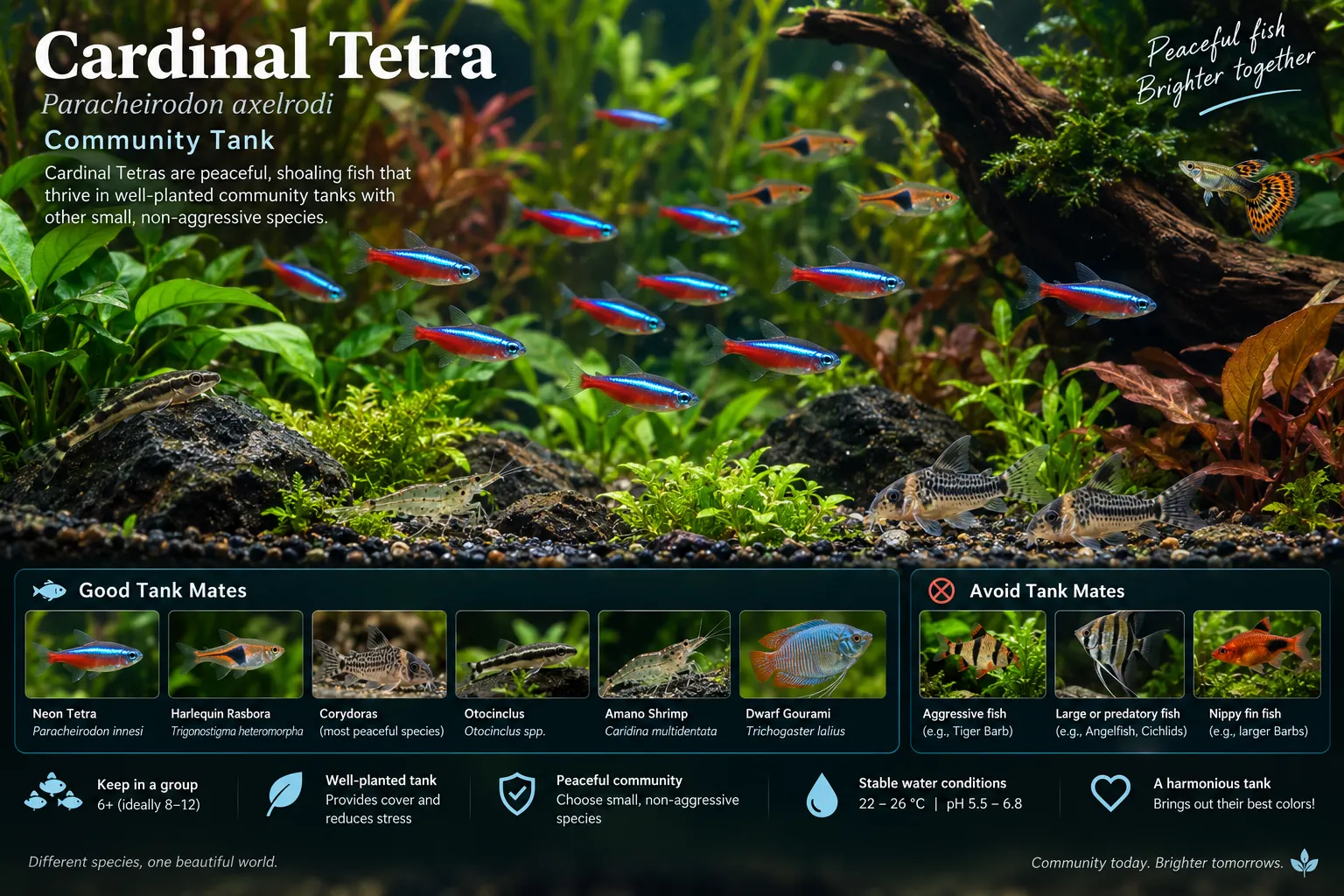
Keep Cardinal tetras in a school of at least six. They are peaceful by nature, but their energetic swimming style makes them a better match for robust, similarly active community fish than for timid nano species.
Are Cardinal tetras aggressive? They are not usually aggressive, but individuals may chase one another or nip fins. This behaviour becomes more noticeable in cramped tanks or when they are kept in an undersized group. Spacious aquariums and compatible tankmates are the best prevention.
Good Cardinal tetra tank mates
- Other peaceful, similarly sized tetras and characins
- Larger peaceful rasboras and active community schooling fish
- Corydoras catfish suited to the same temperature range
- Peaceful loaches and other bottom-dwelling community fish
- Bristlenose plecos in appropriately sized mature aquariums
- Peaceful medium-sized livebearers when water chemistry overlaps
- Other robust community fish that can tolerate their active swimming
Avoid
- Large predatory fish that can swallow adult Cardinal tetras
- Highly aggressive or territorial cichlids
- Very slow, delicate or long-finned fish that may be stressed by their activity
- Tiny shrimp and newly hatched fry, which may be eaten
How to breed Cardinal tetras
Cardinal tetras are egg-scattering fish and can spawn readily when adults are healthy and well conditioned. Feed a varied, nutritious diet for several days before moving selected adults to a separate breeding aquarium.
Use fine-leaved plants or a spawning mop to catch the eggs, provide gentle aeration and keep lighting subdued. Remove the adults after spawning because they may eat the eggs. Once the fry hatch, provide suitably tiny first foods and gradually transition them to newly hatched brine shrimp and other larger foods as they grow.
Naming & buyer’s notes
Cardinal tetra is the standard aquarium name for Paracheirodon axelrodi. When buying, choose active fish with clear eyes, intact fins, good body condition and strong interest in food. Avoid specimens that remain lethargic, have clamped fins or show obvious signs of disease.
A larger tetra
Do not plan for this species like a tiny nano tetra. Its adult size and constant activity make a longer aquarium much more appropriate.
Plant selection
They are generally plant-safe. Dense planting and floating cover can provide useful shade and help the school feel secure.
Buy a group
A school is essential for normal social behaviour. Buying several healthy specimens together is preferable to keeping a single Cardinal tetra as a display fish.
Cardinal tetra FAQ
- How big do Cardinal tetras get?
- Cardinal tetras commonly reach around 4–5 cm (1.6–2 inches) as adults. Their compact size makes them a popular schooling fish for planted and blackwater-style community aquariums.
- How long do Cardinal tetras live?
- Cardinal tetras commonly live around 4–5 years in a well-maintained aquarium, with some individuals living longer when water quality, nutrition and husbandry are consistently good. Good water quality, a varied diet, adequate swimming space and proper schooling conditions help them reach a healthy lifespan.
- How many Cardinal tetras should be kept together?
- Keep at least six together, with a larger group often producing more natural schooling behaviour. They are active social fish and generally do best when they are not kept singly or as a pair.
- What size tank do Cardinal tetras need?
- A 20-gallon (75 L) aquarium is a practical minimum for a proper school, but a longer aquarium is preferable because Cardinal tetras are active schooling fish and benefit from a longer swimming footprint.
- What do Cardinal tetras eat?
- They are omnivores and readily accept quality flakes and pellets. Supplement the staple diet with frozen or live foods such as daphnia, brine shrimp and bloodworms. Small portions once or twice daily are appropriate.
- Are Cardinal tetras aggressive?
- They are generally peaceful, but they are energetic and can occasionally chase or nip. Their activity can be too much for slow, delicate or long-finned tankmates. A sufficiently large school and spacious aquarium usually help keep social behaviour manageable.
- Do Cardinal tetras eat plants?
- They generally do not damage healthy aquarium plants. A planted tank with fine-leaved plants, floating cover and shaded areas can actually help Cardinal tetras feel secure and display more natural schooling behaviour.
- Can Cardinal tetras live with other tetras?
- Yes, provided the aquarium is large enough and the other species are peaceful and robust enough to tolerate their activity. Avoid pairing them with very small, timid species that may be overwhelmed by their constant movement.
- How do you breed Cardinal tetras?
- Cardinal tetras are egg-scatterers. Condition males and females with varied foods, then place them in a separate breeding aquarium with fine-leaved plants or a spawning mop. After spawning, remove the adults because they may eat the eggs. Raise the tiny fry on suitably sized first foods before moving to larger foods as they grow.