
Black Phantom Tetra
Hyphessobrycon megalopterus
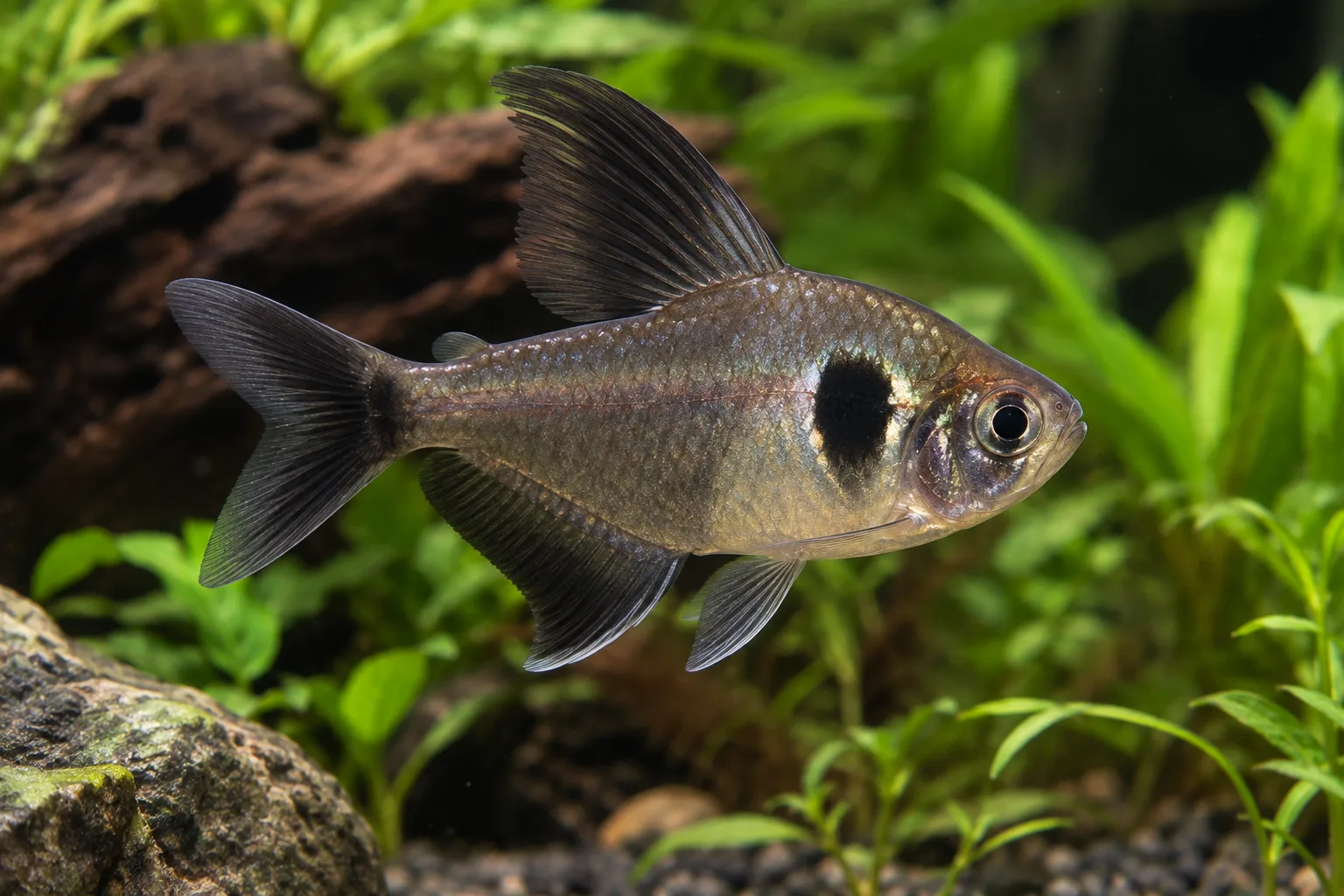
A peaceful South American schooling tetra with a smoky-black body, striking fins and bold silver-white markings — active, social and an excellent planted-community fish.
Difficulty
Beginner
Min tank size
38 L / 10 gal
Temperament
Peaceful, active
Diet type
Omnivore
Adult size
4–5 cm / 1.6–2 in
Lifespan
5–6 years
Water type
Freshwater
Black phantom tetra at a glance
| Scientific name | Hyphessobrycon megalopterus |
|---|---|
| Former scientific name | Megalamphodus megalopterus |
| Order | Characiformes |
| Family | Characidae (characins) |
| Genus | Hyphessobrycon |
| Origin | South America — Brazil and neighbouring Paraguay and Bolivia basin waters |
| Adult size | About 4–5 cm (1.6–2 in) |
| Tank size (min) | 38 L / 10 gal; 75 L / 20 gal long is better for a larger school |
| Temperature | 23–28 °C (73–82 °F) |
| pH range | 6.0–7.5 |
| Water hardness | Soft to moderately hard |
| Diet | Omnivore — flakes, micro-pellets, frozen and live foods |
| Temperament | Peaceful schooling fish; males may spar displayfully |
| Care level | Beginner |
Overview
The black phantom tetra (Hyphessobrycon megalopterus) is a small freshwater characin from South America, especially Brazil and neighbouring drainage systems. It is named for its smoky dark body and distinctive dark fins, with a pale vertical patch behind the gill cover. Mature males can intensify their colour and spread their fins during social displays.
Black phantom tetras are peaceful, active schooling fish that look best in groups and are particularly effective in planted aquariums with a dark substrate, subdued lighting and open midwater swimming space. They are adaptable and relatively easy to keep, but their small size means they should not be housed with large predators or overly aggressive community fish.
Black phantom tetra size & lifespan
How big do black phantom tetras get?
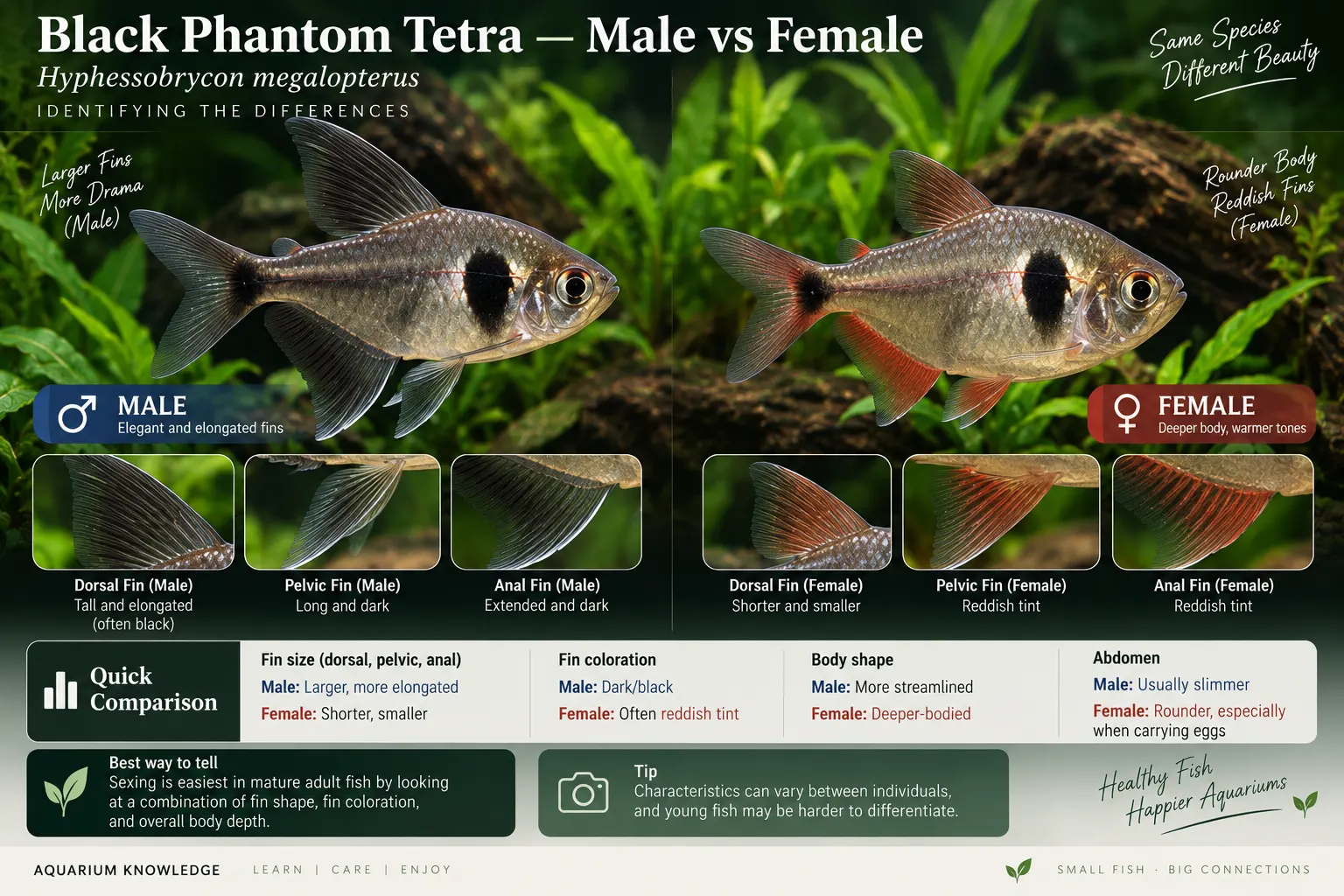
Adult black phantom tetras generally reach about 4–5 cm (1.6–2 in). Females often look slightly fuller through the abdomen, particularly when mature and carrying eggs, while males are usually slimmer.
How long do black phantom tetras live?
A typical aquarium lifespan is around 5–6 years when the fish receive stable water conditions, a varied diet and enough companions. Poor water quality, chronic stress, overcrowding and unsuitable tankmates can shorten that lifespan considerably.
Natural habitat & origin
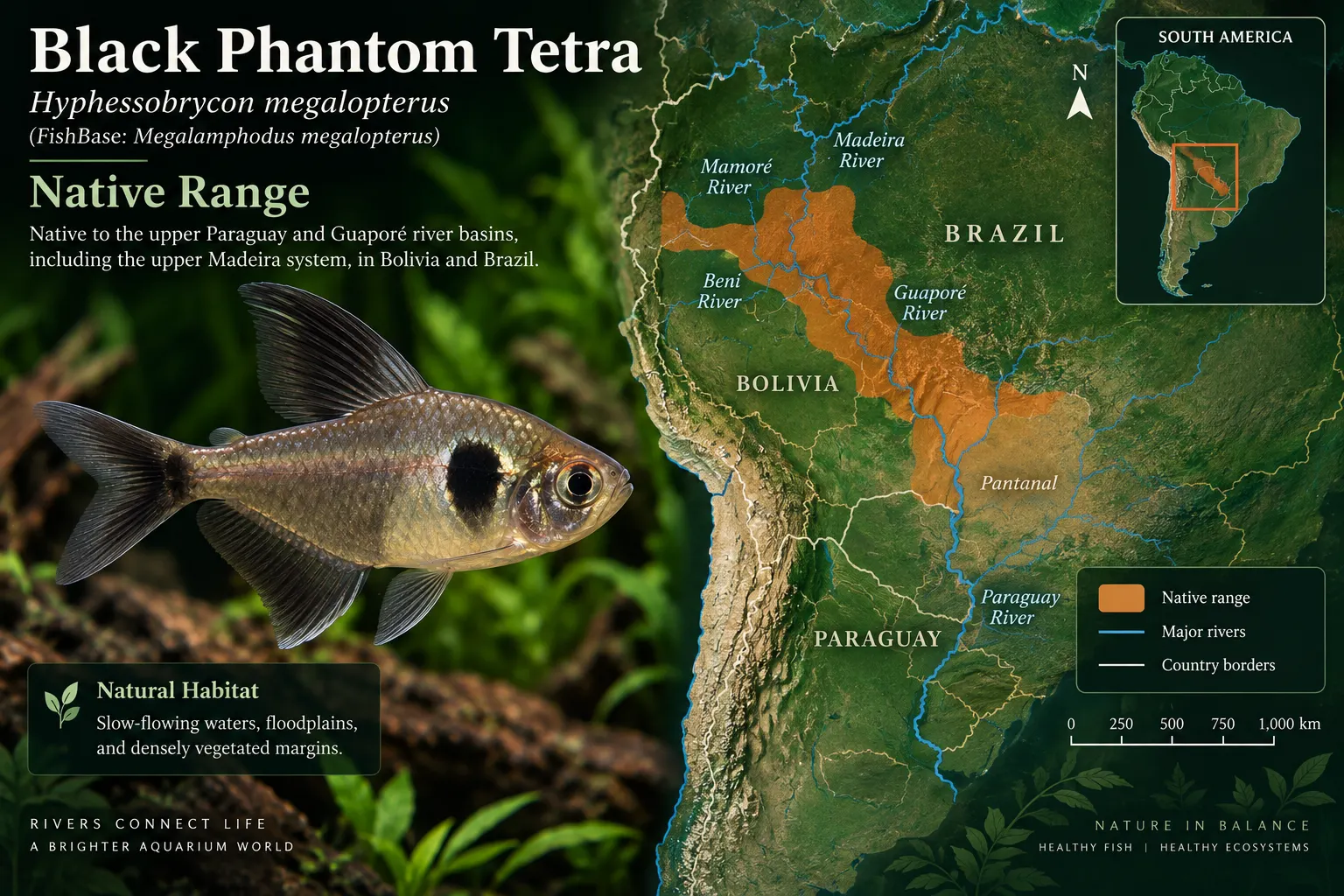
Hyphessobrycon megalopterus is native to South America, particularly Brazil and neighbouring drainage systems associated with the upper Paraguay and Amazon regions. It inhabits warm freshwater environments with vegetation and subdued cover.
Aquarium specimens are commonly captive-bred. A planted aquarium with shaded areas, wood, leaf litter or floating plants can reproduce some of the visual character of its natural environment while still providing an open lane for schooling.
Black phantom tetra tank size & requirements
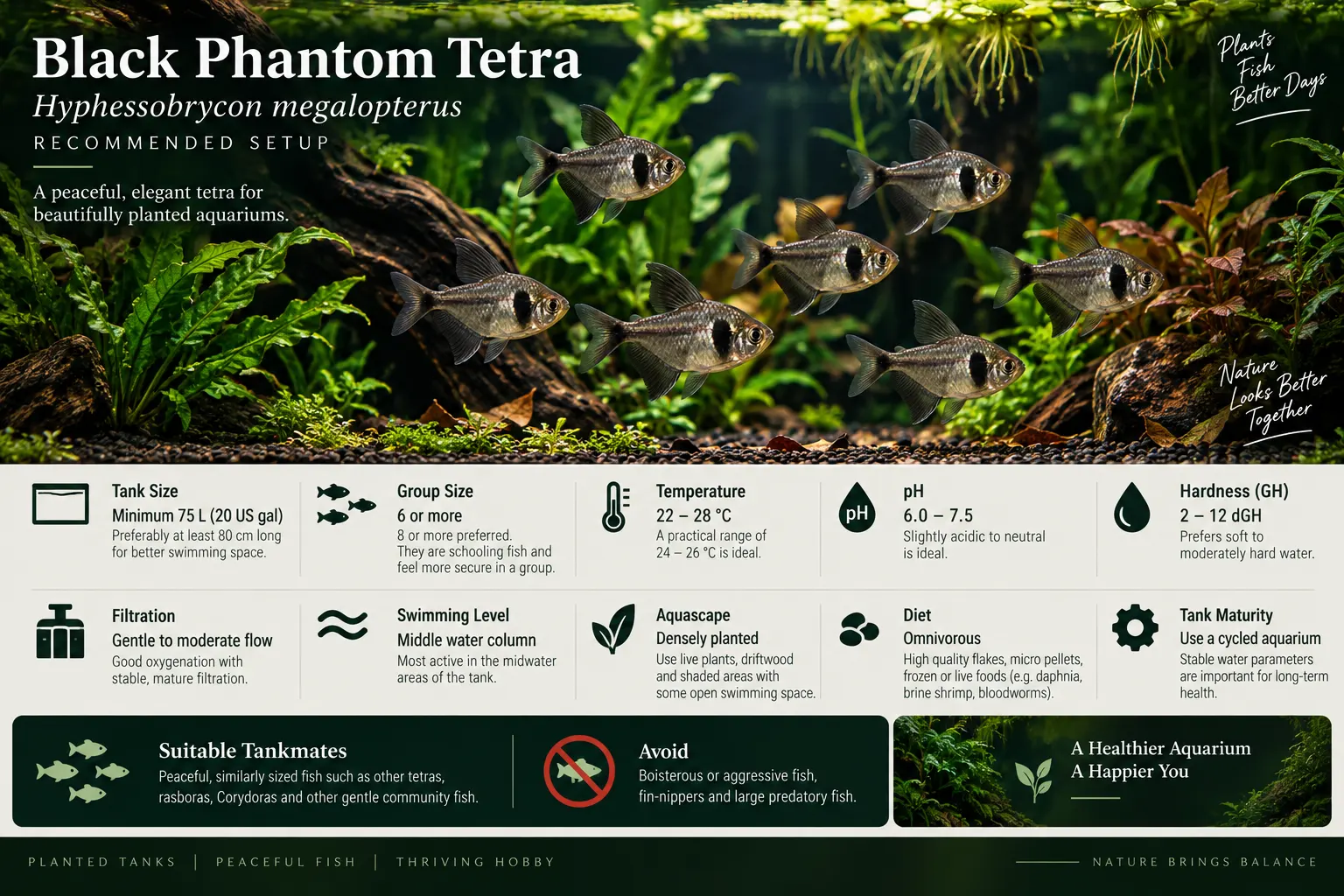
A 10-gallon (38 L) aquarium is a practical minimum for a small school, but a 20-gallon-long (75 L) aquarium is a much better choice for a group because it gives the fish a longer swimming footprint. Use a tight-fitting lid because small tetras can jump when startled.
How many black phantom tetras in a 5, 10 or 20 gallon tank?
Stock them as a school rather than as isolated individuals. A 5-gallon tank is not recommended for a proper school. A 10-gallon tank can house a small group of around six, while a 20-gallon-long aquarium is the preferred footprint for roughly eight to twelve, with additional compatible fish if filtration, swimming space and maintenance allow.
| 5 gal (19 L) | Not recommended for a proper school. A 10-gallon or larger aquarium gives better stability and swimming space. |
|---|---|
| 10 gal (38 L) | About 6 black phantom tetras — a practical minimum group in a mature, suitably filtered aquarium. |
| 20 gal long (75 L) | 8–12 black phantom tetras — a better footprint for natural schooling behaviour and a planted community. |
| 29 gal (110 L) | 10–15 black phantom tetras, with room for compatible peaceful tankmates. |
| 55 gal (208 L) | A large school of 15–25 or more can make a striking midwater feature alongside appropriately sized community fish. |
Water parameters
| Temperature | 23–28 °C (73–82 °F) |
|---|---|
| pH | 6.0–7.5 |
| Hardness (GH) | Soft to moderately hard water |
| Filtration turnover | Moderate circulation with good oxygenation and no excessive turbulence |
Use gentle to moderate flow, stable filtration and plenty of cover. Live plants, driftwood and floating plants can create shaded areas while leaving an open central swimming lane. Avoid sudden changes in temperature or water chemistry; stability is more important than chasing a particular “perfect” number.
Not sure how many litres your tank actually holds? Check it with the aquarium volume calculator.
What do black phantom tetras eat? Diet & feeding
Black phantom tetras are omnivores and readily accept quality flakes, fine granules and micro-pellets. Feed small portions once or twice daily and aim to give only what the group can consume quickly. Their small mouths make appropriately sized foods important.
For variety, offer frozen or live daphnia, brine shrimp, bloodworms or similar small foods periodically. A varied diet supports colour, growth and conditioning for breeding. Because they are active midwater feeders, slow-sinking foods work particularly well in a community aquarium.
Black phantom tetra tank mates & compatibility
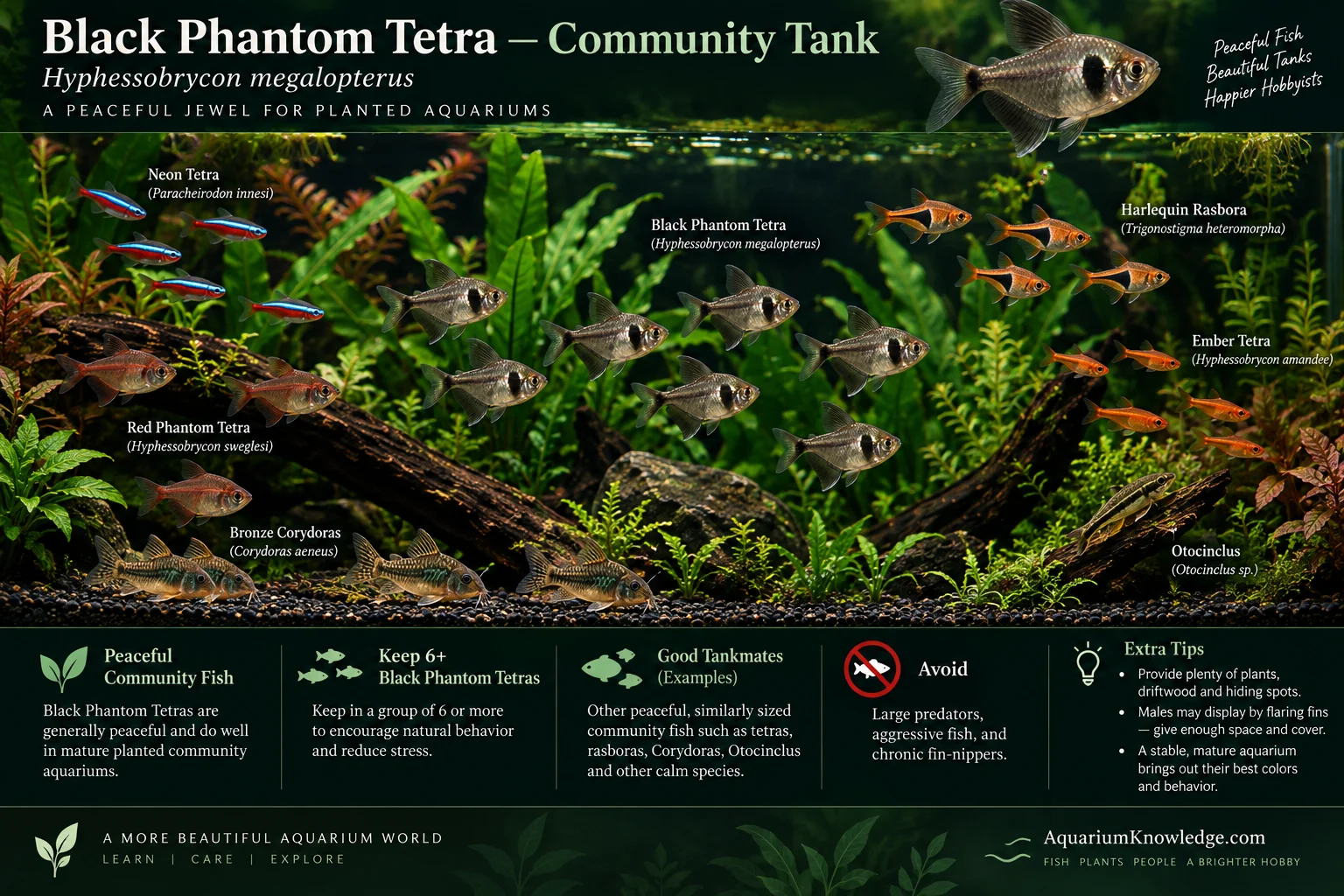
Black phantom tetras are peaceful community fish and should be kept in a school. A group of six is a reasonable minimum; larger groups usually show more confident and natural behaviour. Choose tankmates that are peaceful, appropriately sized and comfortable with similar tropical water conditions.
Are black phantom tetras aggressive? No. Brief chasing within the school is normal social behaviour. Persistent chasing, hiding, clamped fins or damaged fins usually indicate an unsuitable community, insufficient space or another stressor.
Good black phantom tetra tank mates
- Red phantom tetras and other peaceful similarly sized tetras
- Harlequin and other peaceful rasboras with overlapping water requirements
- Corydoras catfish suited to the same temperature range
- Kuhli loaches in mature, appropriately sized aquariums
- Small peaceful gouramis where the individual fish and tank size are suitable
- Other peaceful South American community fish that do not outcompete them for food
- Other black phantom tetras — keep the species in a proper school rather than singly
Avoid
- Large predatory fish that can swallow or seriously harass small tetras
- Aggressive or highly territorial cichlids
- Very boisterous fish that constantly chase or outcompete small tetras
- Fin-nipping species that prevent the tetras from displaying and schooling normally
How to breed black phantom tetras
Black phantom tetras are egg-scattering fish. They do not provide parental care, and adults may eat eggs if they remain accessible. Mature females are typically fuller-bodied than males, making sexing easier when the fish are viewed from above.
For a dedicated breeding attempt, use a separate shallow spawning aquarium with soft, clean water, subdued lighting and a mesh, spawning mop or fine-leaved plants that allow eggs to fall away from the adults. Condition the breeders with varied live or frozen foods before introducing them. Once spawning has occurred, remove the adults and keep the eggs protected in dim light. Raise the fry on appropriately tiny first foods, then progress to baby brine shrimp and other suitably sized foods as they grow.
Exact breeding parameters can vary between populations and breeding lines, so stable water quality and careful observation are more useful than making abrupt changes to chase a single target value.
Naming confusion & buyer’s notes
The black phantom tetra has fewer common-name problems than some aquarium fish, but it can be confused with red phantom tetras and other small Hyphessobrycon species. Always check the scientific name on a listing when accuracy matters.
Black phantom tetra
Hyphessobrycon megalopterus. A smoky dark-bodied tetra with contrasting fins and a pale shoulder patch. It is generally peaceful and social.
Red phantom tetra
Hyphessobrycon sweglesi. A closely related phantom tetra with a reddish body and similar peaceful schooling behaviour.
Former scientific name
Megalamphodus megalopterus. This is the former scientific name associated with the species and can still appear in older aquarium references.
Buying tip
Choose active fish with intact fins, clear eyes, normal swimming and good body condition. Mature males may show more extended fins and stronger dark coloration. Avoid tanks containing obviously sick or lethargic fish and quarantine new arrivals when practical.
Black phantom tetra FAQ
- How long do black phantom tetras live?
- Black phantom tetras commonly live around 5–6 years in a well-maintained aquarium, with some individuals potentially living longer. Stable water quality, good nutrition, adequate space and keeping them in a proper social group are important for long-term health.
- How big do black phantom tetras get?
- Adult black phantom tetras generally reach about 4–5 cm (1.6–2 in). Females are usually fuller-bodied, particularly when carrying eggs, while males tend to be slimmer and often have more extended fins.
- How many black phantom tetras should be kept together?
- Keep at least six together, with eight to twelve or more being preferable when the aquarium has enough swimming room. A larger group encourages confident schooling and allows males to display naturally without one fish receiving all the attention.
- How many black phantom tetras can live in a 10 or 20 gallon tank?
- A 10-gallon aquarium can work for a small group of around six if it is mature, well filtered and carefully maintained. A 20-gallon-long aquarium is a better choice and can comfortably accommodate around eight to twelve black phantom tetras with suitable peaceful tankmates.
- Are black phantom tetras aggressive?
- They are generally peaceful community fish. Males may chase and display to one another, especially when establishing a social hierarchy, but these displays are usually harmless. Persistent harassment is more likely when the group is too small or the aquarium contains incompatible fish.
- What do black phantom tetras eat?
- They are omnivores that readily accept quality tropical flakes, small granules and micro-pellets. Supplementing with frozen or live foods such as daphnia, brine shrimp and bloodworms provides variety and helps maintain colour and breeding condition.
- Do black phantom tetras need a heater?
- Yes, in most homes. They are tropical fish and do best with stable warm water. Use an adjustable aquarium heater when the room temperature does not reliably keep the aquarium within their preferred range.
- Can black phantom tetras live with bettas?
- It can work in some community aquariums, but it is not a guaranteed pairing. Bettas vary individually, while black phantom tetras are active schooling fish. A sufficiently spacious, planted tank and close observation are important if they are housed together.
- Are black phantom tetras the same as red phantom tetras?
- No. The black phantom tetra is Hyphessobrycon megalopterus, while the red phantom tetra is Hyphessobrycon sweglesi. They are closely related and have similar general care, but they are distinct species with different colour patterns.
- What is the former scientific name of the black phantom tetra?
- The species was formerly placed under the name Megalamphodus megalopterus. The currently accepted name used for the species is Hyphessobrycon megalopterus.