
Strawberry Rasbora
Boraras naevus
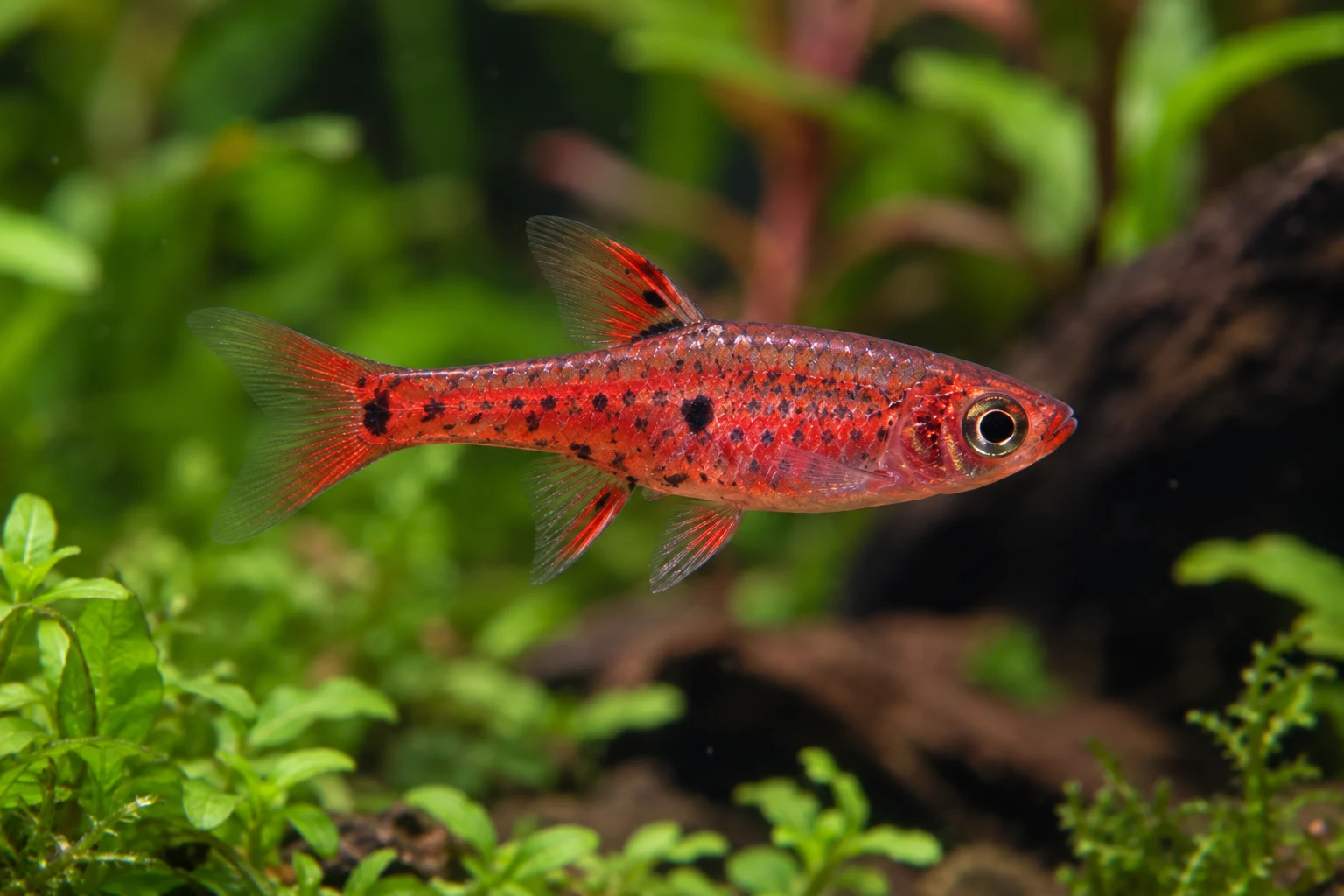
A tiny southern Thai schooling fish with a reddish body and dark markings — peaceful, social and well suited to planted nano aquariums.
Difficulty
Beginner
Min tank size
20 L / 5 gal
Temperament
Peaceful, active
Diet type
Omnivore, micropredator
Adult size
2–2.5 cm / 0.8–1 in
Lifespan
4–6 years
Water type
Freshwater
Strawberry Rasbora at a glance
| Scientific name | Boraras naevus |
|---|---|
| Former scientific name | None commonly established |
| Family | Danionidae (danios and rasboras) |
| Origin | Southern Thailand, particularly small freshwater habitats in the southern Thai peninsula |
| Adult size | 2–2.5 cm (0.8–1 in) |
| Tank size (min) | 20 L / 5 gal — 40 L / 10 gal or larger is better for a school |
| Temperature | 22–28 °C (72–82 °F) |
| pH range | 4.5–7.0 |
| Water hardness | Soft, ideally below 8 dGH |
| Diet | Omnivore — flakes, micro-pellets, live and frozen foods |
| Temperament | Peaceful, active schooling fish |
| Lifespan | 4–6 years |
| Care level | Beginner |
Overview
The Strawberry Rasbora (Boraras naevus) is a tiny member of the genus Boraras. Its reddish body and dark markings, combined with its peaceful schooling behaviour, make it an attractive choice for planted nano aquariums and carefully planned community tanks.
Native to southern Thailand, Strawberry Rasboras are associated with small, slow-moving freshwater environments. Their natural surroundings can include vegetation, leaf litter, roots and shaded areas, so a planted aquarium with cover is a good approximation.
In the aquarium, they do best in a mature planted tank with gentle circulation, shaded areas and enough open water for the group to move naturally. Keep them in a proper group; larger groups generally encourage more confident behaviour.
Strawberry Rasbora size & lifespan
How big do Strawberry Rasboras get?
Adult Strawberry Rasboras generally reach around 2–2.5 cm (0.8–1 inch) in length. Their tiny adult size makes them especially popular for carefully planned nano aquariums, although they still need stable water quality and a proper social group.
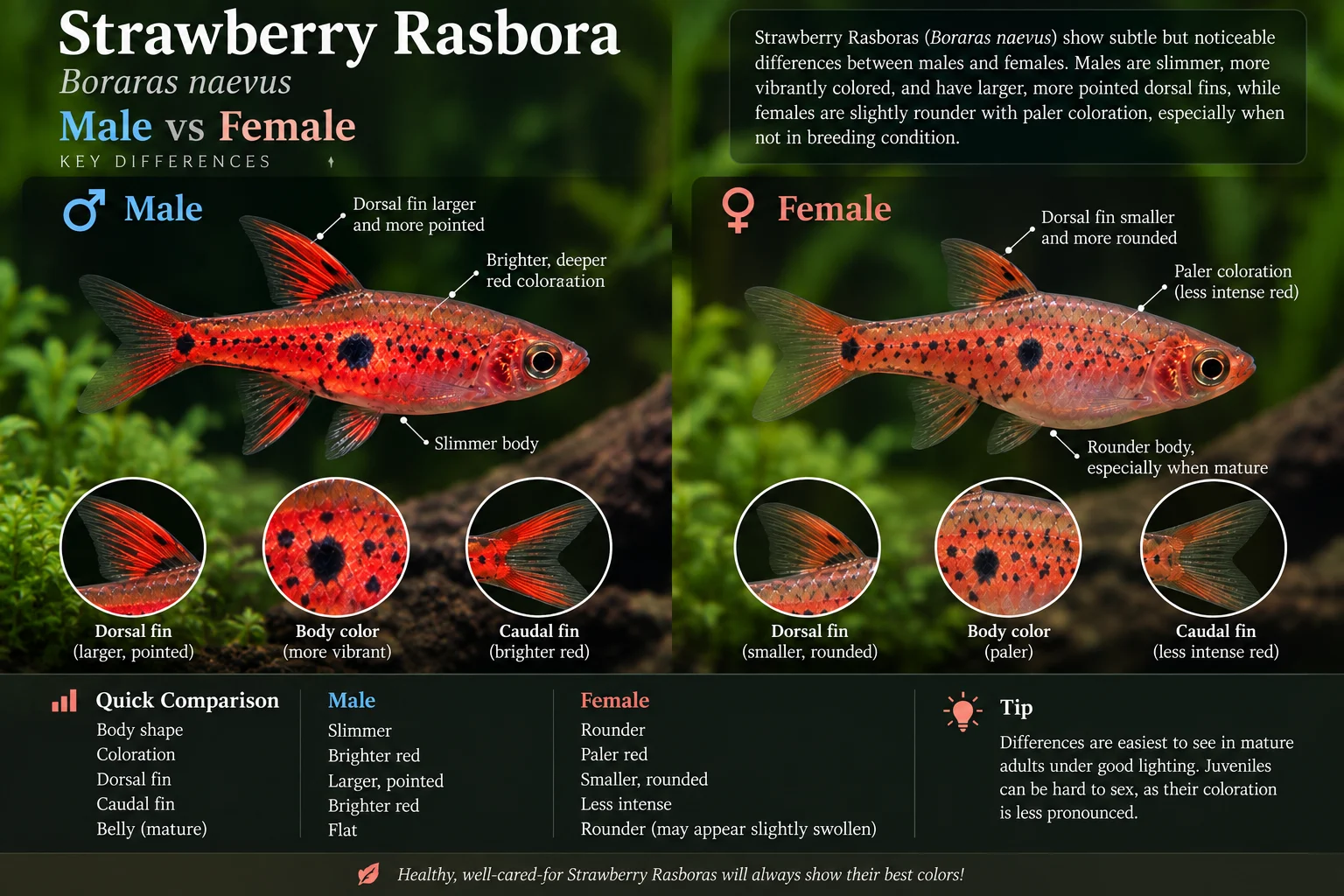
Females are generally fuller-bodied than males, particularly when mature and carrying eggs. Males tend to be slimmer and may show stronger colour and more noticeable display behaviour when competing for mates.
How long do Strawberry Rasboras live?
Strawberry Rasboras can live for several years in a well-maintained aquarium. Stable water quality, appropriate nutrition, low stress and a suitable social group all contribute to a longer lifespan.
Natural habitat & origin
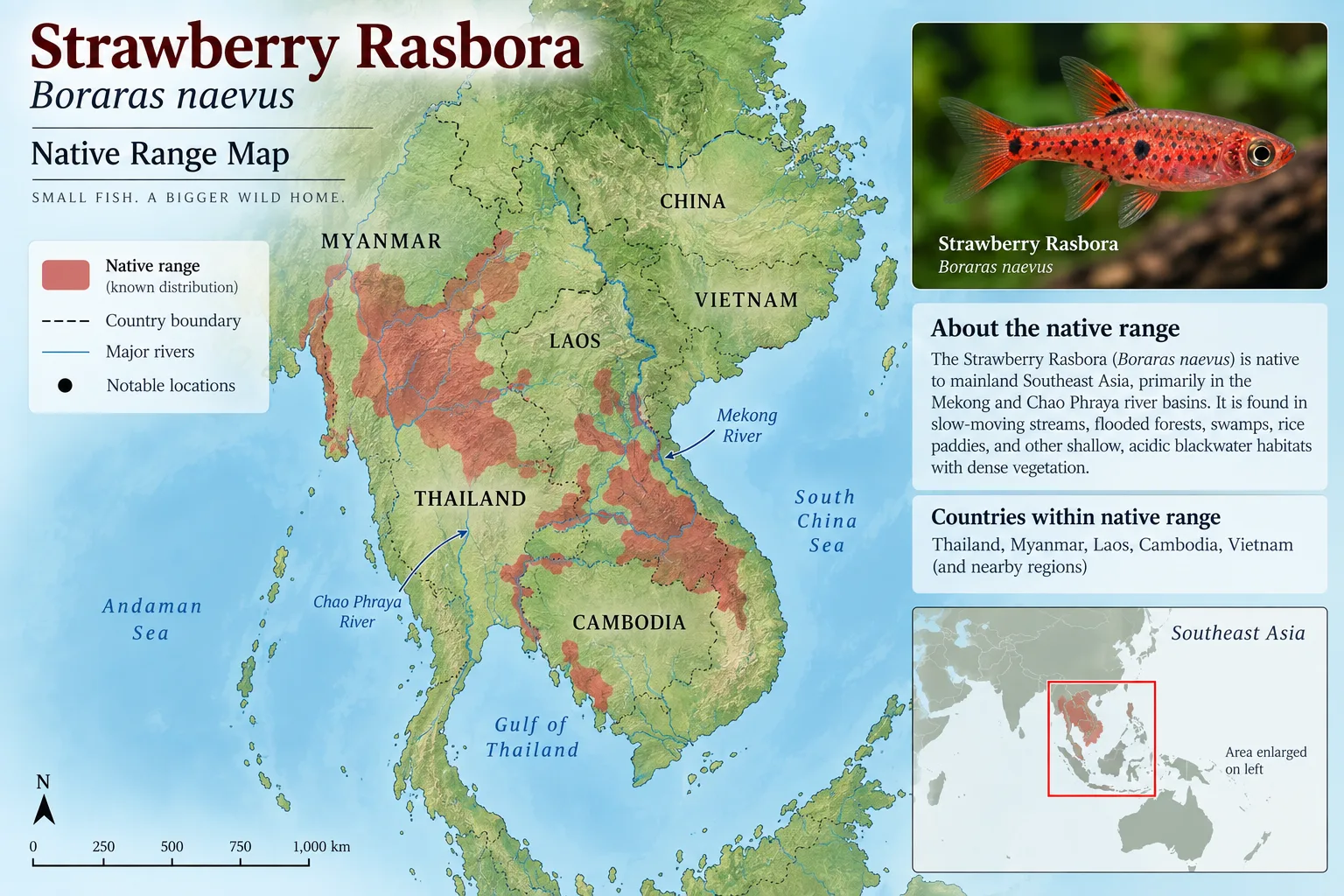
Boraras naevus is native to southern Thailand. It is associated with small freshwater habitats where vegetation, cover and relatively gentle water movement provide shelter for this tiny species.
Natural habitats can contain leaf litter, roots, branches and aquatic vegetation. Recreating these features with plants, wood and shaded areas can make captive fish feel more secure.
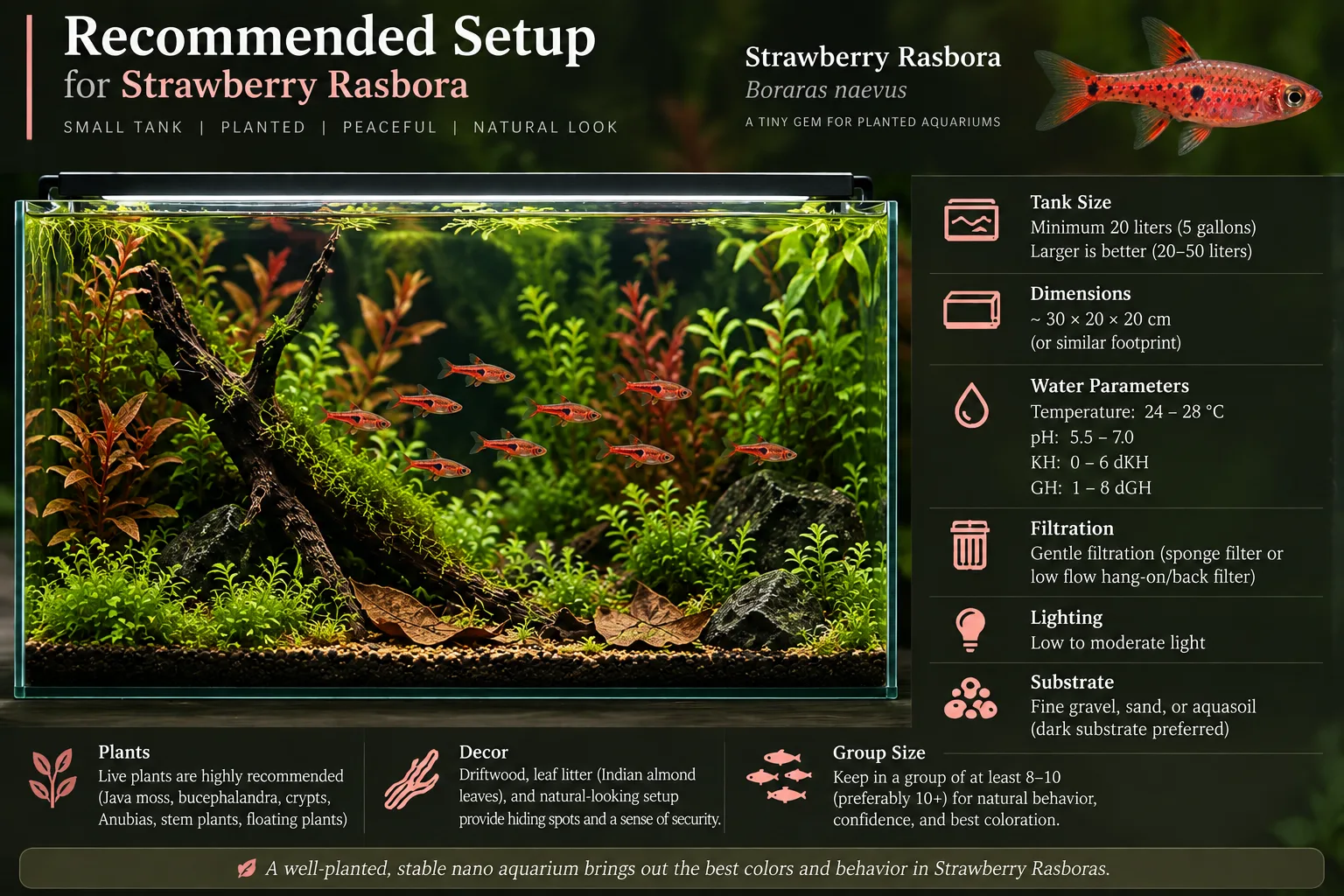
A planted aquarium with fine-leaved plants, moss, driftwood, shaded areas and gentle filtration can recreate many of the cover and low-flow features that help Strawberry Rasboras feel secure.
Strawberry Rasbora tank size & requirements
A 5-gallon (19 L) aquarium can work for a small group when it is mature, stable and appropriately filtered, but a 10-gallon (38 L) or larger aquarium is preferable because it offers more stable conditions and room for a larger group.
Use a secure lid because active rasboras can jump when startled. Provide an open swimming area through the middle of the aquarium while planting the rear and sides densely with plants. Driftwood, roots and floating plants can provide additional shade and cover.
How many Strawberry Rasboras in a 5, 10 or 20 gallon tank?
Stock Strawberry Rasboras as a school rather than as individual fish. A mature 5-gallon aquarium can work for a small group of Strawberry Rasboras, while a 10-gallon or larger aquarium is preferable for a more natural group and easier long-term stability.
| 5 gal (19 L) | Suitable for a small group in a mature, stable, species-focused or lightly stocked nano aquarium with gentle filtration and dense cover. |
|---|---|
| 10 gal (38 L) | Excellent size for a group of 8–12 Strawberry Rasboras, especially with plants, shaded areas and gentle circulation. |
| 15 gal (57 L) | Provides generous space for 10–15 Strawberry Rasboras and compatible peaceful nano fish. |
| 20 gal (75 L) | Ideal for a larger Strawberry Rasbora group with plants and carefully selected peaceful community fish. |
| 29 gal (110 L) | Allows a large, natural-looking school together with compatible peaceful community fish. |
Water parameters
| Temperature | 22–28 °C (72–82 °F) |
|---|---|
| pH | 4.5–7.0 |
| Hardness (GH) | Soft to moderately hard water, ideally below 10 dGH |
| Filtration turnover | Moderate circulation with good oxygenation |
Strawberry Rasboras appreciate good filtration and oxygenation but do not need extremely strong current. Moderate circulation with some calmer areas works well. Keep the aquarium biologically mature and perform regular partial water changes to maintain stable conditions.
Darker substrate, driftwood and dense plants can help enhance their natural colours. Cryptocoryne, Java fern, Anubias, Vallisneria and floating plants can all work well depending on the aquarium design.
Not sure how many litres your tank actually holds? Check it with the aquarium volume calculator.
What do Strawberry Rasboras eat? Diet & feeding
Strawberry Rasboras are tiny omnivorous micro-predators and need foods small enough for their mouths. Fine flakes, powdered foods and appropriately sized micro-pellets can form the staple diet, with frozen and live foods added for variety.
Good supplemental foods include baby brine shrimp, daphnia, cyclops and other appropriately sized frozen or live foods. Feeding a varied diet helps support growth, colour and breeding condition.
Feed small portions once or twice daily. Give only what the school can consume within a few minutes so uneaten food does not unnecessarily pollute the aquarium.
Strawberry Rasbora tank mates & compatibility
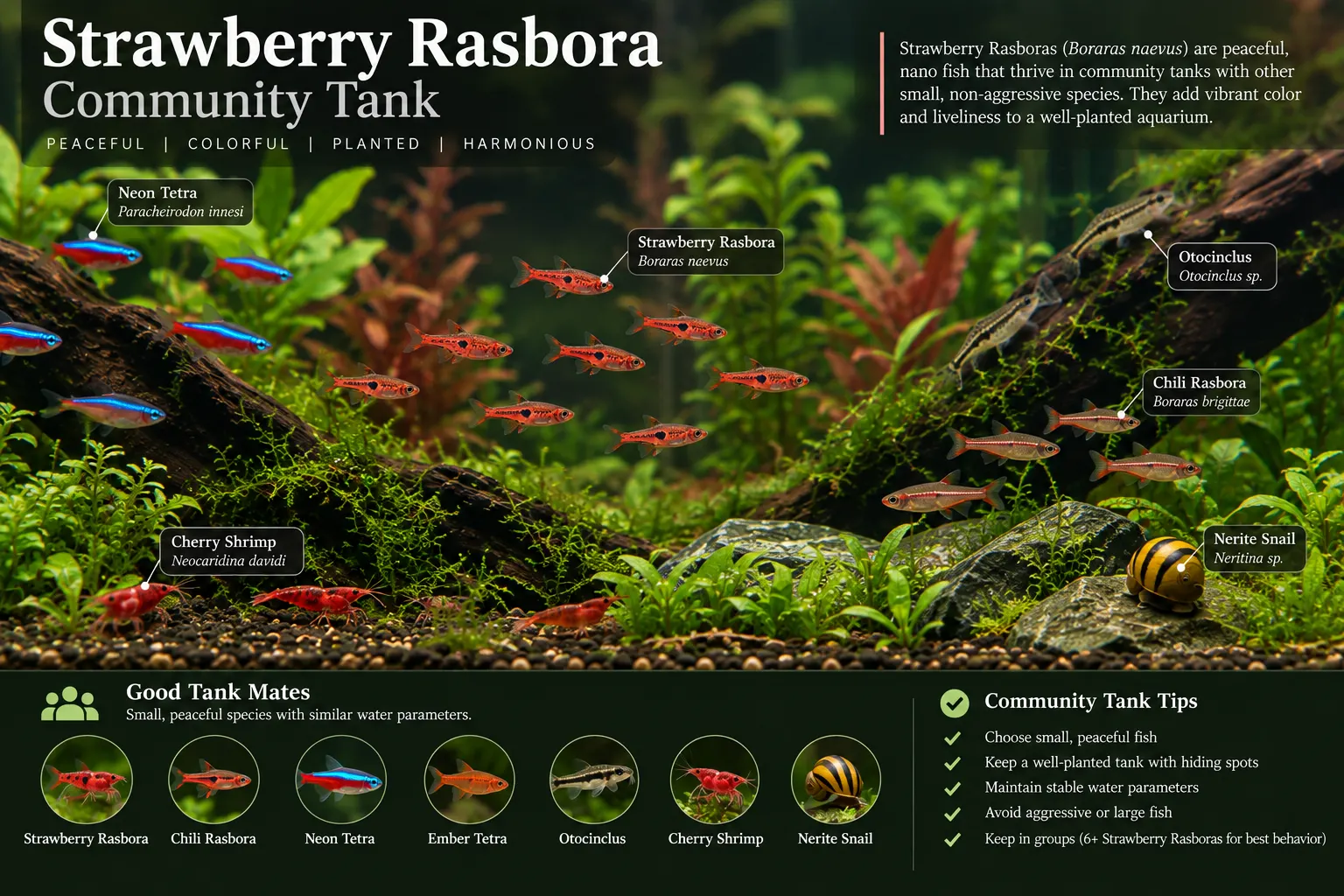
Strawberry Rasboras are peaceful community fish and can work well with other tiny, non-aggressive species that share similar water conditions and feeding requirements. The safest companions are peaceful fish that tolerate similar water temperatures and will not aggressively compete for food.
Keep at least six Strawberry Rasboras together, with eight to twelve or more preferred when aquarium size allows. A larger group spreads social interactions naturally and makes the fish more confident and active.
Good Strawberry Rasbora tank mates
- Other Strawberry Rasboras
- Espei rasboras
- Lambchop rasboras
- Chili rasboras and other peaceful Boraras species
- Peaceful small tetras
- Corydoras catfish suited to the same temperature range
- Kuhli loaches in established aquariums
- Otocinclus in mature planted tanks
- Peaceful dwarf gouramis where temperament and water conditions overlap
- Other similarly sized peaceful community fish
Avoid
- Large predatory fish
- Aggressive or territorial cichlids
- Very large catfish or bottom predators
- Fast, highly aggressive feeding competitors
- Fin-nipping species
- Fish requiring substantially different water parameters
How to breed Strawberry Rasboras
Strawberry Rasboras are egg-scattering fish that can spawn among fine-leaved plants, mosses and other vegetation. A dedicated breeding setup can improve egg and fry survival because adults may consume eggs or fry.
Females become noticeably fuller when carrying eggs, while males are generally slimmer. Conditioning the adults with high-quality live or frozen foods can encourage spawning.
For breeding, provide clean stable water, gentle filtration, dense fine-leaved vegetation or spawning media, and plenty of cover. Conditioning adults with appropriately sized live or frozen foods can help bring them into breeding condition.
Adult Strawberry Rasboras may eat eggs or fry, so removing the adults after spawning or using a protected breeding setup can improve survival. Newly hatched fry are extremely small and require appropriately sized first foods before progressing to larger foods such as baby brine shrimp.
Naming confusion & buyer’s notes
Strawberry Rasbora is a distinct species, Boraras naevus, rather than a colour form of Chili Rasbora. Because several tiny Boraras species are sold under overlapping trade names, checking the scientific name is the safest way to confirm what you are buying.
Other common names
It may be sold as Red Micro Rasbora or Petch Noi Rasbora. Trade names can vary between suppliers, so Boraras naevus is the most useful identifier.
Strawberry vs Chili Rasbora
Strawberry Rasbora (Boraras naevus) and Chili Rasbora (Boraras brigittae) are separate species. Their small size and red coloration can make them easy to confuse in shops.
Watch for the Dwarf Rasbora name
Older or informal trade labels such as “Boraras sp. micros” can create confusion with Dwarf Rasbora (Boraras micros). Verify the scientific name whenever possible.
Tiny fish need a proper group
Despite their small adult size, Strawberry Rasboras are social schooling fish. A larger group usually produces more confident and natural behaviour than keeping only one or two fish.
Buy by scientific name
If a seller uses only a trade name, ask for the scientific name before purchasing. This is particularly useful with tiny Boraras species, whose common names and historical labels can overlap.
Strawberry Rasbora FAQ
- How big do Strawberry Rasboras get?
- Strawberry Rasboras are tiny fish and generally reach around 2–2.5 cm (0.8–1 inch) as adults. Their small size makes them suitable for carefully planned nano aquariums.
- How many Strawberry Rasboras should be kept together?
- Keep Strawberry Rasboras in a group rather than as solitary fish. A group of at least six is a sensible starting point, while larger groups of eight to twelve or more usually show more confident social behaviour.
- Can Strawberry Rasboras live in a 5 gallon tank?
- Yes, a mature, stable 5-gallon aquarium can work for a small group when filtration, water quality and swimming space are appropriate. A larger aquarium is preferable because it provides more stable conditions and room for a larger group.
- Are Strawberry Rasboras good for beginners?
- They can be suitable for beginners who already understand cycling, stable water quality and nano-fish feeding. Their tiny size means they should not be treated as disposable or as a substitute for proper aquarium maintenance.
- Are Strawberry Rasboras aggressive?
- No. Strawberry Rasboras are peaceful schooling fish. Males may display or chase briefly, but serious aggression is unusual when the fish are kept in a suitable group and provided with adequate cover.
- What do Strawberry Rasboras eat?
- They are small omnivorous micro-predators that need appropriately sized foods. Use fine flakes, powdered foods or micro-pellets as staples and supplement with tiny frozen or live foods such as baby brine shrimp, daphnia and cyclops.
- What water parameters do Strawberry Rasboras need?
- A stable temperature around 22–28 °C (72–82 °F), mildly acidic to neutral water and soft to moderately hard conditions are appropriate. Stability and good water quality are more important than chasing an exact number.
- Can Strawberry Rasboras live with shrimp?
- They can generally be kept with adult dwarf shrimp in a mature planted aquarium. However, tiny shrimplets may be eaten, so dense moss, fine-leaved plants and other cover can improve juvenile survival.
- Are Strawberry Rasboras the same as Chili Rasboras?
- No. Strawberry Rasbora is Boraras naevus, while Chili Rasbora is Boraras brigittae. They are separate Boraras species and should not be treated as different colour forms of the same fish.
- What does Boraras sp. micros mean?
- “Boraras sp. micros” is a historical or informal trade label that can cause confusion with Dwarf Rasbora, Boraras micros. When buying Strawberry Rasboras, verify that the fish are identified as Boraras naevus.