
Harlequin Rasbora
Trigonostigma heteromorpha
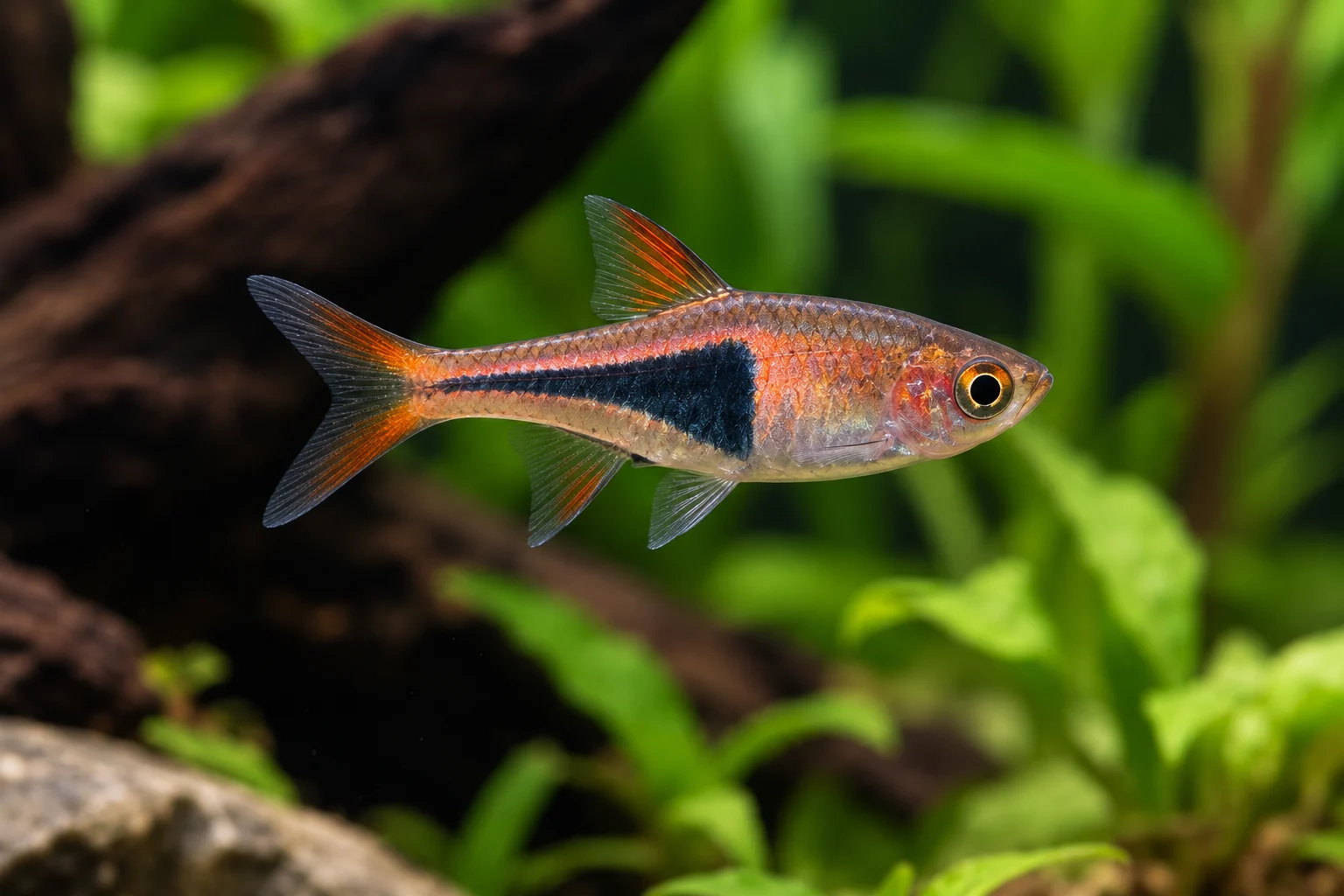
A classic Southeast Asian schooling fish with a copper-orange body and bold black wedge — peaceful, hardy and one of the best rasboras for a planted community aquarium.
Difficulty
Beginner
Min tank size
38 L / 10 gal
Temperament
Peaceful, active
Diet type
Omnivore
Adult size
4–5 cm / 1.5–2 in
Lifespan
5–8 years
Water type
Freshwater
Harlequin Rasbora at a glance
| Scientific name | Trigonostigma heteromorpha (Duncker, 1904) |
|---|---|
| Former scientific name | Rasbora heteromorpha |
| Family | Danionidae (danios and rasboras) |
| Origin | Thailand, Malaysia, Singapore and surrounding parts of Southeast Asia |
| Adult size | 4–5 cm (1.5–2 in) |
| Tank size (min) | 38 L / 10 gal — 60 L / 15 gal or larger is better for a school |
| Temperature | 22–28 °C (72–82 °F) |
| pH range | 5.0–7.5 |
| Water hardness | Soft to moderately hard, ideally below 12 dGH |
| Diet | Omnivore — flakes, micro-pellets, live and frozen foods |
| Temperament | Peaceful, active schooling fish |
| Lifespan | 5–8 years |
| Care level | Beginner |
Overview
The Harlequin Rasbora (Trigonostigma heteromorpha) is one of the most recognisable rasboras in the aquarium hobby. Its copper, pinkish-orange body and distinctive black triangular patch make it easy to identify, while its peaceful temperament and active schooling behaviour make it an excellent community fish.
Native to Southeast Asia, Harlequin Rasboras inhabit slow-moving streams, forest pools, peat swamps and other calm freshwater environments. They are commonly associated with soft, slightly acidic water and areas containing submerged roots, leaf litter and dense vegetation.
In the aquarium, they are happiest in a mature planted tank with open swimming space and plenty of cover. They are schooling fish, so a group of at least six is important, while larger groups of eight to twelve or more produce more natural and confident behaviour.
Harlequin Rasbora size & lifespan
How big do Harlequin Rasboras get?
Adult Harlequin Rasboras generally reach around 4–5 cm (1.5–2 inches) in length. They have a relatively deep-bodied shape compared with tiny Boraras rasboras, which gives them a substantial appearance despite their modest adult size.
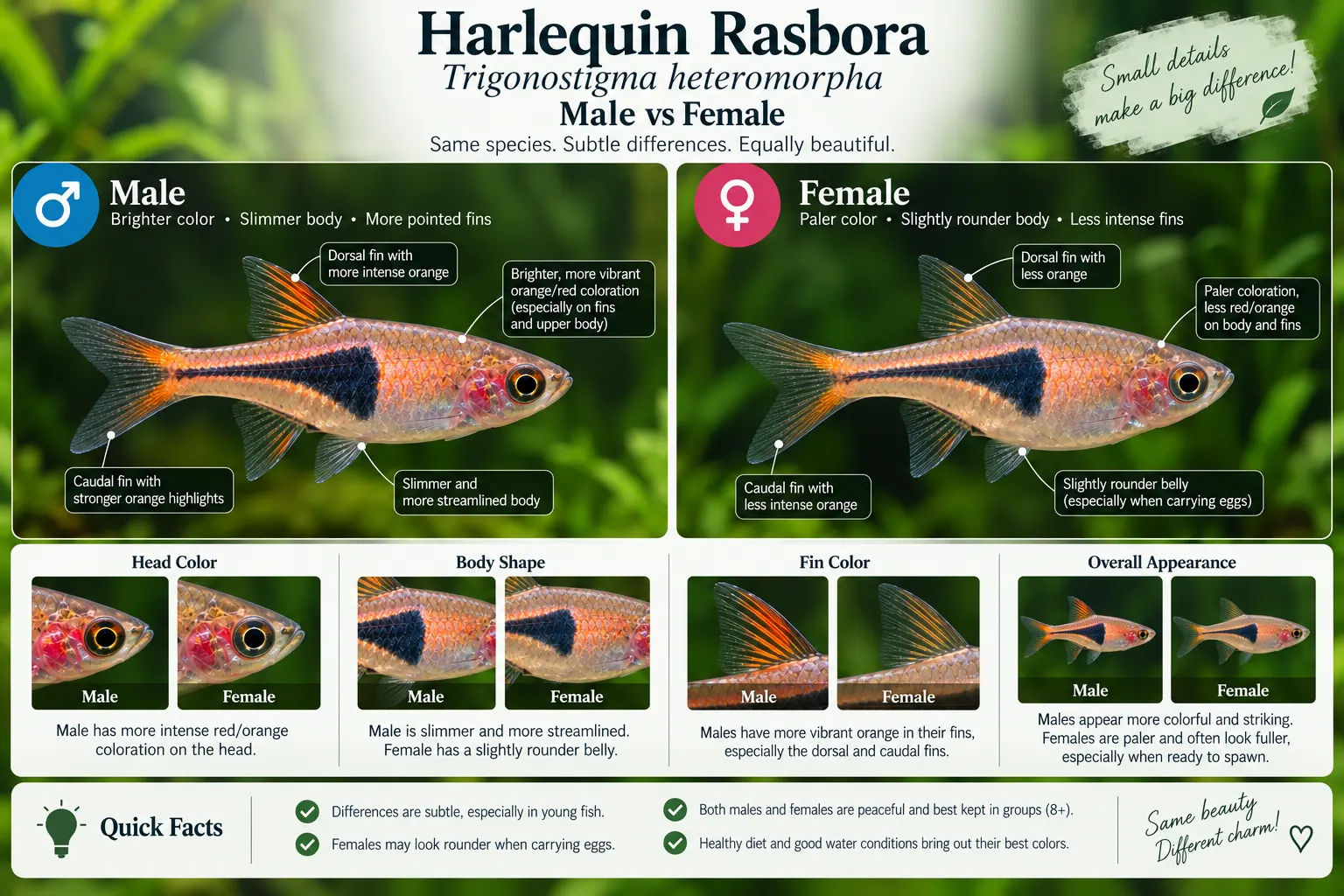
Females are usually slightly larger and fuller-bodied than males, particularly when mature and carrying eggs. Males tend to have a slimmer profile and can show stronger colour and more pronounced markings when displaying.
How long do Harlequin Rasboras live?
Harlequin Rasboras can live around 5–8 years in a well-maintained aquarium, with some individuals potentially living longer. Good water quality, varied nutrition, adequate swimming space and a stable social group all contribute to a long lifespan.
Natural habitat & origin
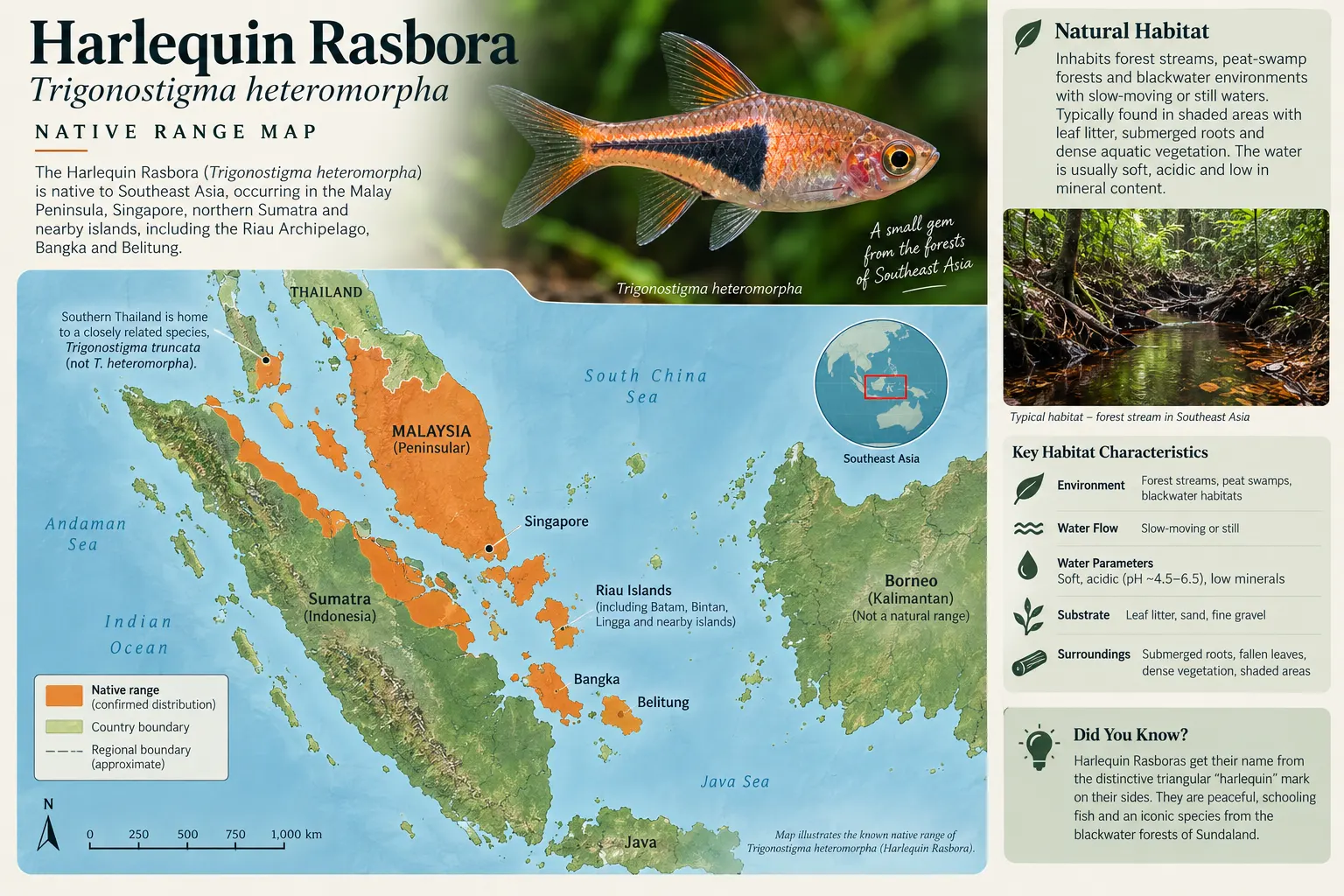
Trigonostigma heteromorpha is native to parts of Southeast Asia, including Thailand, Malaysia and Singapore. Wild populations are associated with slow-moving freshwater habitats such as forest streams, pools, swamps and peat-influenced waters.
These environments can contain substantial leaf litter, submerged branches, roots and aquatic vegetation. Water is often relatively soft and may become acidic where peat and decomposing organic matter influence the chemistry.
A planted aquarium with driftwood, shaded areas and moderate filtration recreates many of the environmental features that make Harlequin Rasboras feel secure in nature.
Harlequin Rasbora tank size & requirements
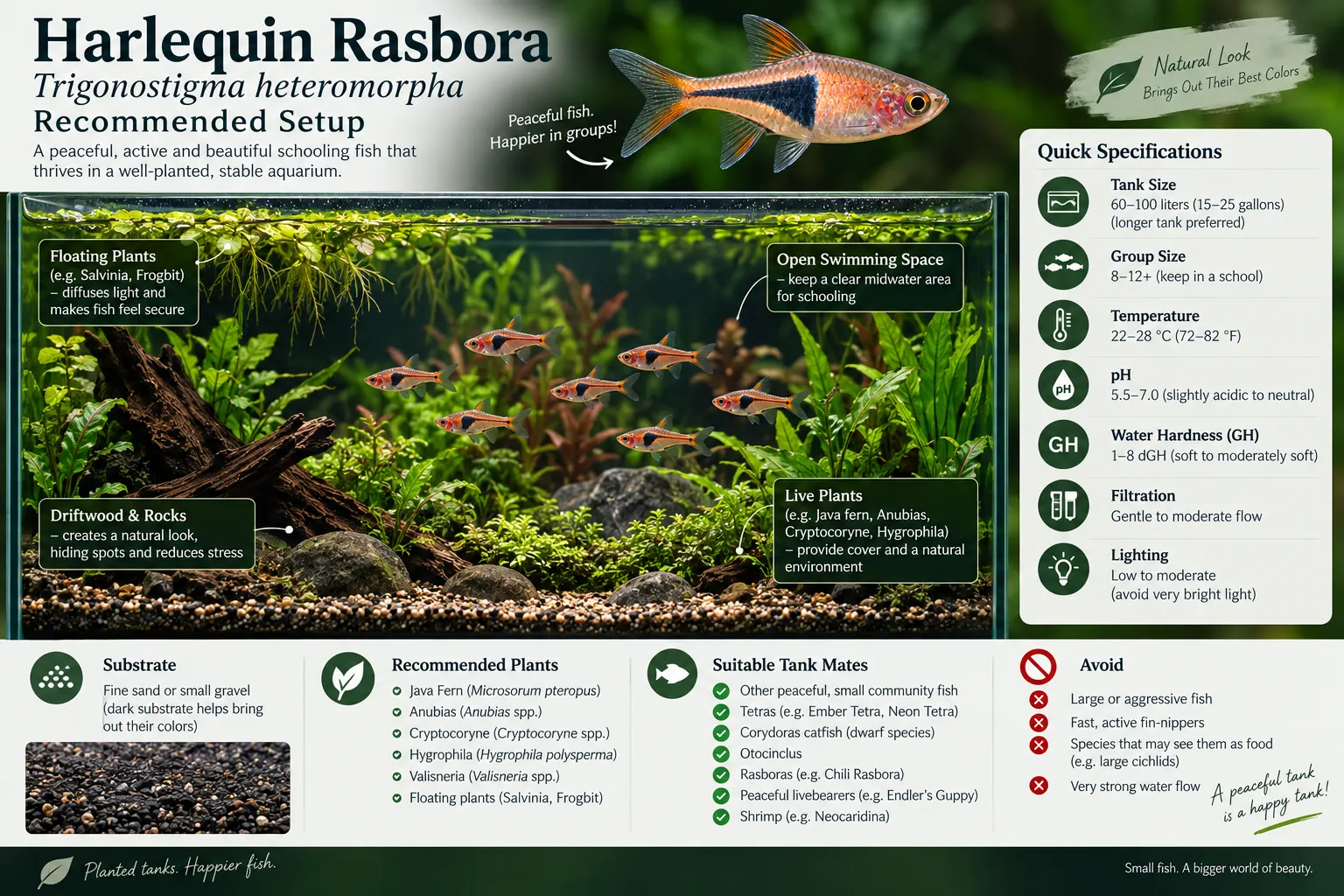
A 10-gallon (38 L) aquarium is a practical minimum for a small school, but a 15- or 20-gallon aquarium is preferable because Harlequin Rasboras are active schooling fish that benefit from horizontal swimming space.
Use a secure lid because active rasboras can jump when startled. Provide an open swimming area through the middle of the aquarium while planting the rear and sides densely with plants. Driftwood, roots and floating plants can provide additional shade and cover.
How many Harlequin Rasboras in a 5, 10 or 20 gallon tank?
Stock Harlequin Rasboras as a school rather than as individual fish. A 5-gallon aquarium is too restrictive for a comfortable long-term school. A mature 10-gallon aquarium can work for a small group, while a 15- or 20-gallon aquarium provides substantially better swimming space.
| 5 gal (19 L) | Not recommended for a proper school. The aquarium is too small for comfortable long-term swimming space and stable community stocking. |
|---|---|
| 10 gal (38 L) | A small school of 6–8 Harlequin Rasboras can be kept in a mature, appropriately filtered aquarium. |
| 15 gal (57 L) | Excellent size for 8–10 Harlequin Rasboras with dense planting and open swimming space. |
| 20 gal (75 L) | Ideal for 10–15 Harlequin Rasboras or a larger school in a peaceful community aquarium. |
| 29 gal (110 L) | Allows a large, natural-looking school together with compatible peaceful community fish. |
Water parameters
| Temperature | 22–28 °C (72–82 °F) |
|---|---|
| pH | 5.0–7.5 |
| Hardness (GH) | Soft to moderately hard water, ideally below 12 dGH |
| Filtration turnover | Moderate circulation with good oxygenation |
Harlequin Rasboras appreciate good filtration and oxygenation but do not need extremely strong current. Moderate circulation with some calmer areas works well. Keep the aquarium biologically mature and perform regular partial water changes to maintain stable conditions.
Darker substrate, driftwood and dense plants can help enhance their natural colours. Cryptocoryne, Java fern, Anubias, Vallisneria and floating plants can all work well depending on the aquarium design.
Not sure how many litres your tank actually holds? Check it with the aquarium volume calculator.
What do Harlequin Rasboras eat? Diet & feeding
Harlequin Rasboras are omnivorous and readily accept a wide variety of aquarium foods. A quality small flake or micro-pellet can form the daily staple, while frozen and live foods provide useful variety.
Good supplemental foods include daphnia, brine shrimp, cyclops and appropriately sized bloodworms. Feeding a varied diet helps support growth, colour and breeding condition.
Feed small portions once or twice daily. Give only what the school can consume within a few minutes so uneaten food does not unnecessarily pollute the aquarium.
Harlequin Rasbora tank mates & compatibility
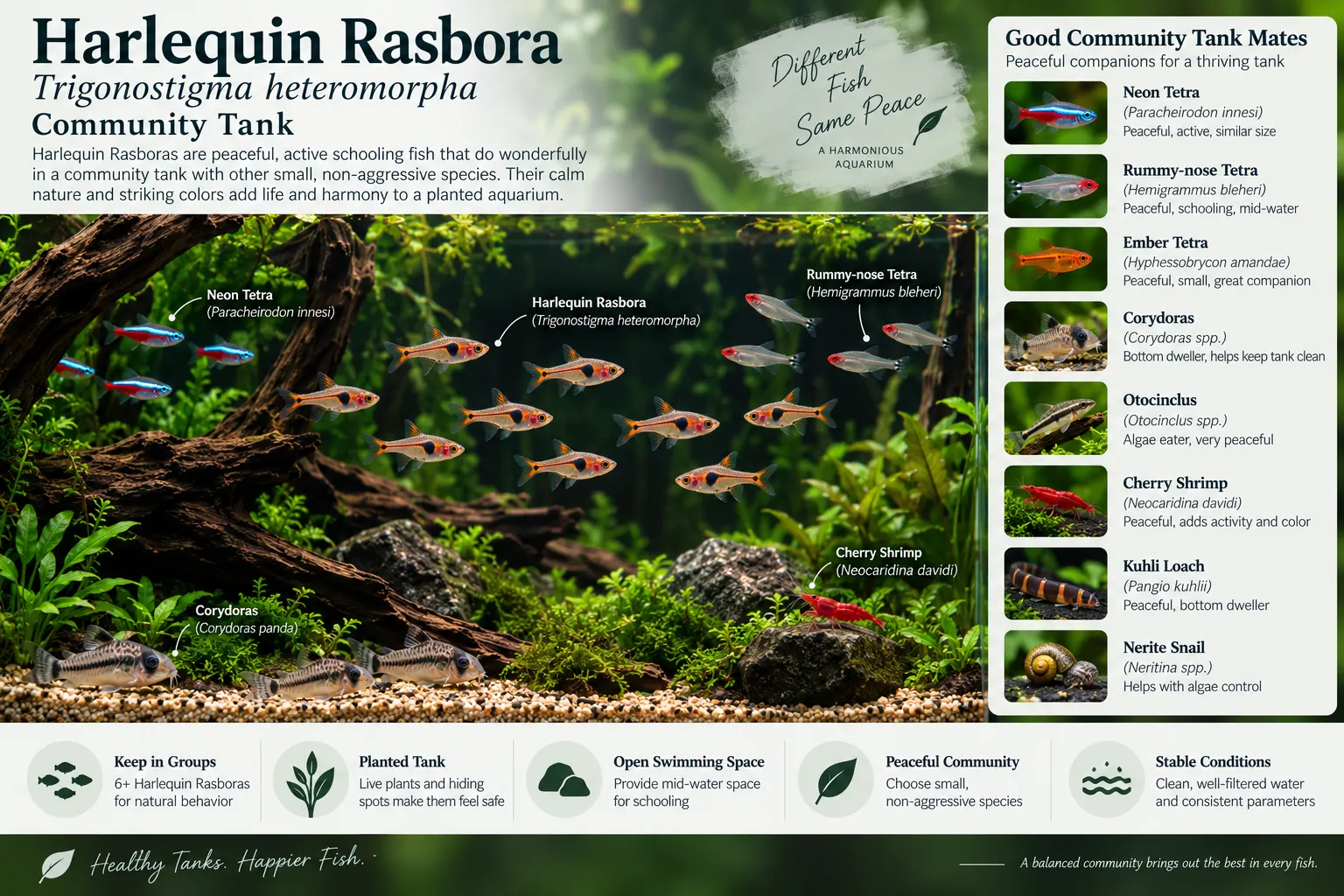
Harlequin Rasboras are peaceful community fish and work well with many similarly sized species. The safest companions are peaceful fish that tolerate similar water temperatures and will not aggressively compete for food.
Keep at least six Harlequin Rasboras together, with eight to twelve or more preferred. A larger group spreads social interactions naturally and makes the fish more confident and active.
Good Harlequin Rasbora tank mates
- Other Harlequin Rasboras
- Espei rasboras
- Lambchop rasboras
- Chili rasboras and other peaceful Boraras species
- Peaceful small tetras
- Corydoras catfish suited to the same temperature range
- Kuhli loaches in established aquariums
- Otocinclus in mature planted tanks
- Peaceful dwarf gouramis where temperament and water conditions overlap
- Other similarly sized peaceful community fish
Avoid
- Large predatory fish
- Aggressive or territorial cichlids
- Very large catfish or bottom predators
- Fast, highly aggressive feeding competitors
- Fin-nipping species
- Fish requiring substantially different water parameters
How to breed Harlequin Rasboras
Harlequin Rasboras are egg-laying fish and can be bred in a dedicated aquarium. Unlike many egg-scattering rasboras, they are known for attaching eggs to the underside of broad plant leaves during spawning.
Females become noticeably fuller when carrying eggs, while males are generally slimmer. Conditioning the adults with high-quality live or frozen foods can encourage spawning.
For breeding, provide clean, soft water, gentle filtration and broad-leaved plants such as Cryptocoryne. Spawning commonly occurs among vegetation, with the pair turning beneath a leaf while eggs are attached to its underside.
Adult Harlequin Rasboras may eat eggs, so removing the adults or protecting the spawning area improves fry survival. Newly hatched fry are extremely small and require appropriately sized first foods before progressing to larger foods such as baby brine shrimp.
Naming confusion & buyer’s notes
Harlequin Rasboras are sometimes confused with other species in the genus Trigonostigma. These fish share a similar body shape and general colour palette, but they are separate species. Checking the scientific name is the safest way to confirm what you are buying.
Former scientific name
Harlequin Rasbora was historically known asRasbora heteromorpha. It is now classified asTrigonostigma heteromorpha.
Harlequin vs Espei Rasbora
Espei Rasbora (Trigonostigma espei) is a closely related species that is generally slimmer and more strongly orange in appearance. The two can be confused in aquarium stores.
Harlequin vs Lambchop Rasbora
Lambchop Rasbora is another closely relatedTrigonostigma species. The shape and extent of the dark body marking can help distinguish it from the classic Harlequin pattern.
Look for the black wedge
The most recognisable feature of the Harlequin Rasbora is the large dark triangular or wedge-shaped marking extending toward the caudal region. The surrounding body is typically copper, pinkish-orange or reddish.
Buy a school, not individual fish
Harlequin Rasboras are social schooling fish. Purchasing a proper group rather than one or two individuals produces more natural behaviour and usually results in more confident, active fish.
Harlequin Rasbora FAQ
- How long do Harlequin Rasboras live?
- Harlequin Rasboras commonly live around 5–8 years in well-maintained aquariums. Stable water quality, good nutrition, a proper school and low stress are the most important factors affecting their lifespan.
- How big do Harlequin Rasboras get?
- Adult Harlequin Rasboras usually reach around 4–5 cm (1.5–2 inches). Females are generally fuller-bodied, while males tend to be slightly slimmer and more streamlined.
- How many Harlequin Rasboras should be kept together?
- Keep at least six Harlequin Rasboras together, although eight to ten or more is better. A larger school encourages natural schooling behaviour and helps the fish feel secure.
- Can Harlequin Rasboras live in a 10 gallon tank?
- Yes. A mature 10-gallon aquarium can house a small school of around six to eight Harlequin Rasboras when filtration, swimming space and maintenance are appropriate. A 15- or 20-gallon aquarium provides considerably more room and is preferable for larger groups.
- Are Harlequin Rasboras good for beginners?
- Yes. Harlequin Rasboras are hardy, peaceful and adaptable compared with many delicate nano fish. They are a good beginner schooling species when kept in a properly cycled aquarium with stable water conditions.
- Are Harlequin Rasboras aggressive?
- No. Harlequin Rasboras are peaceful community fish. Males may occasionally chase or display to each other, but this is normal social behaviour rather than serious aggression. They are generally safe with other peaceful fish of similar size.
- What do Harlequin Rasboras eat?
- Harlequin Rasboras are omnivores and readily accept quality flakes, micro-pellets and small granules. Supplementing their staple food with frozen or live foods such as daphnia, brine shrimp and bloodworms helps provide variety and condition breeding adults.
- Do Harlequin Rasboras need a heater?
- A heater is recommended when the aquarium does not naturally remain within their preferred temperature range of about 22–28 °C (72–82 °F). Stable temperature is more important than constantly adjusting the temperature.
- Can Harlequin Rasboras live with shrimp?
- Adult shrimp are generally compatible with Harlequin Rasboras, especially in a planted aquarium. However, very small shrimp shrimplets may occasionally be eaten, so dense moss and plant cover can improve survival.
- Why are my Harlequin Rasboras hiding?
- Hiding can be caused by a very small school, insufficient vegetation, bright lighting, poor water quality or intimidating tankmates. Increasing the group size and adding plants, wood and shaded areas usually makes them more confident.
- Are Harlequin Rasboras the same as Lambchop Rasboras?
- No. Harlequin Rasbora is Trigonostigma heteromorpha, while Lambchop Rasbora is generally Trigonostigma espei. They are closely related species and can look similar, but they are not the same fish.