
Chili Rasbora
Boraras brigittae
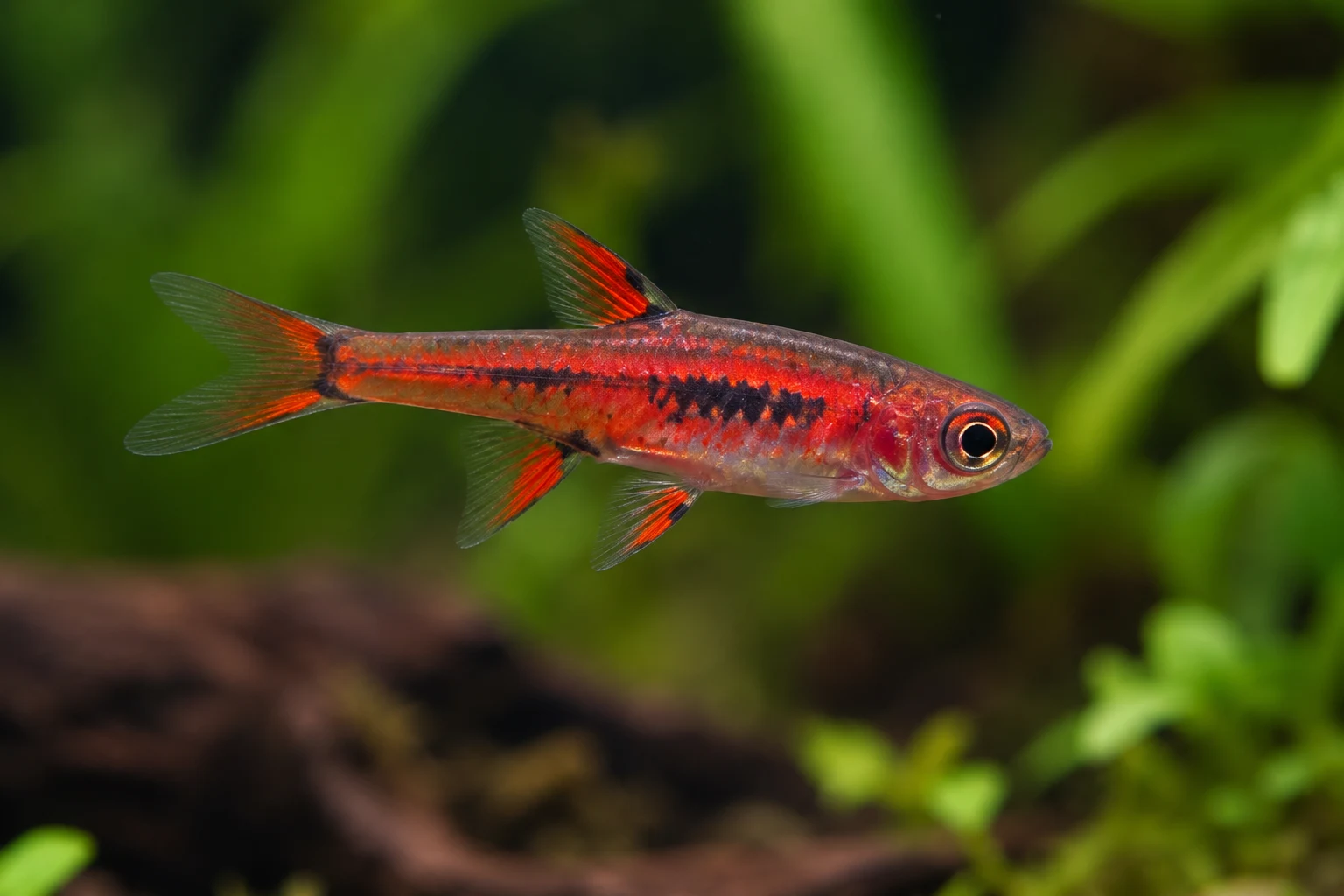
A tiny, jewel-red schooling fish from the blackwater habitats of Borneo — peaceful, colourful and one of the most popular species for heavily planted nano aquariums.
Difficulty
Intermediate
Min tank size
38 L / 10 gal
Temperament
Peaceful, shy
Diet type
Micro-predator
Adult size
1.5–2 cm / 0.6–0.8 in
Lifespan
4–8 years
Water type
Freshwater
Chili Rasbora at a glance
| Scientific name | Boraras brigittae (Vogt, 1978) |
|---|---|
| Family | Danionidae (danios and rasboras) |
| Origin | Borneo, Indonesia |
| Adult size | 1.5–2 cm (0.6–0.8 in) |
| Tank size (min) | 38 L / 10 gal — larger is easier to keep stable |
| Temperature | 22–28 °C (72–82 °F) |
| pH range | 4.0–7.0 |
| Water hardness | Very soft to soft, ideally below 10 dGH |
| Diet | Tiny live, frozen and dry foods |
| Temperament | Peaceful, shy shoaling fish |
| Lifespan | 4–8 years |
| Care level | Intermediate |
Overview
The Chili Rasbora (Boraras brigittae) is one of the smallest and most colourful freshwater aquarium fish in the hobby. Adults barely reach 2 cm in length, but healthy males can display an intense ruby-red body marked with a dark horizontal stripe. Their tiny size, peaceful nature and striking colour have made them a favourite for planted nano aquariums.
Native to Borneo, Chili Rasboras naturally occur in warm, soft, acidic blackwater environments surrounded by dense vegetation. In the aquarium they appreciate similar conditions: gentle filtration, stable water, plenty of plants and a calm environment. Although small, they should not be treated as disposable nano fish or kept in tiny, unstable containers.
Their most important requirement is security. A large school in a densely planted aquarium produces confident behaviour and much better coloration. When kept alone or with large, active tankmates, Chili Rasboras often hide and may remain pale.
Chili Rasbora size & lifespan
How big do Chili Rasboras get?
Adult Chili Rasboras usually reach around 1.5–2 cm (0.6–0.8 inches). They are among the smallest commonly kept aquarium fish, with a slender body and relatively large eyes adapted for searching for tiny food particles in calm, vegetation-filled water.
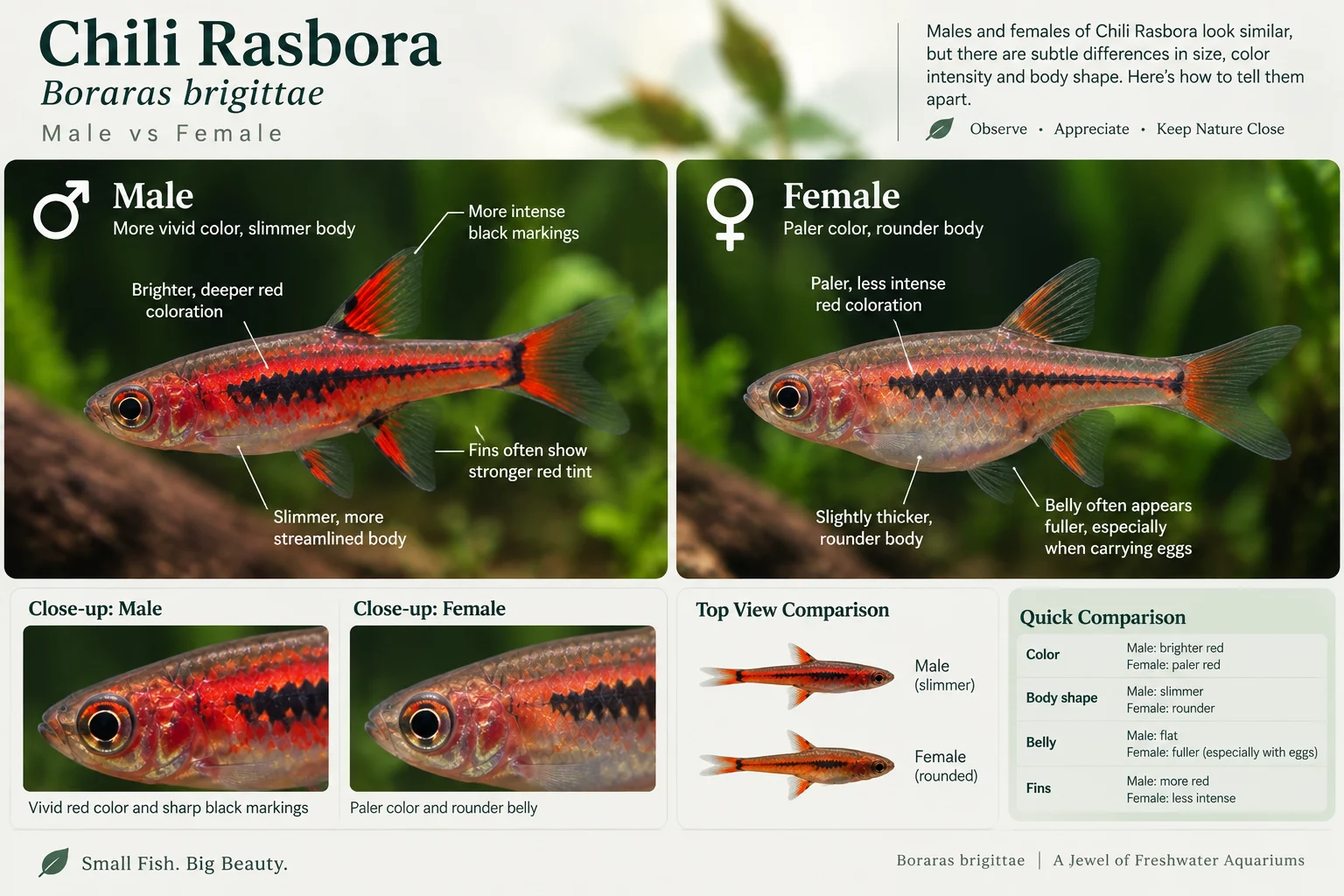
Males are usually slimmer and develop stronger red coloration, particularly when displaying to rival males. Females tend to have a slightly fuller abdomen and are often less intensely coloured.
How long do Chili Rasboras live?
Chili Rasboras commonly live around 4–8 years in good conditions. Their longevity depends heavily on stable water quality, a mature aquarium and consistent feeding. Sudden temperature changes, ammonia spikes and aggressive tankmates are much more dangerous to these tiny fish than their size might suggest.
Natural habitat & origin
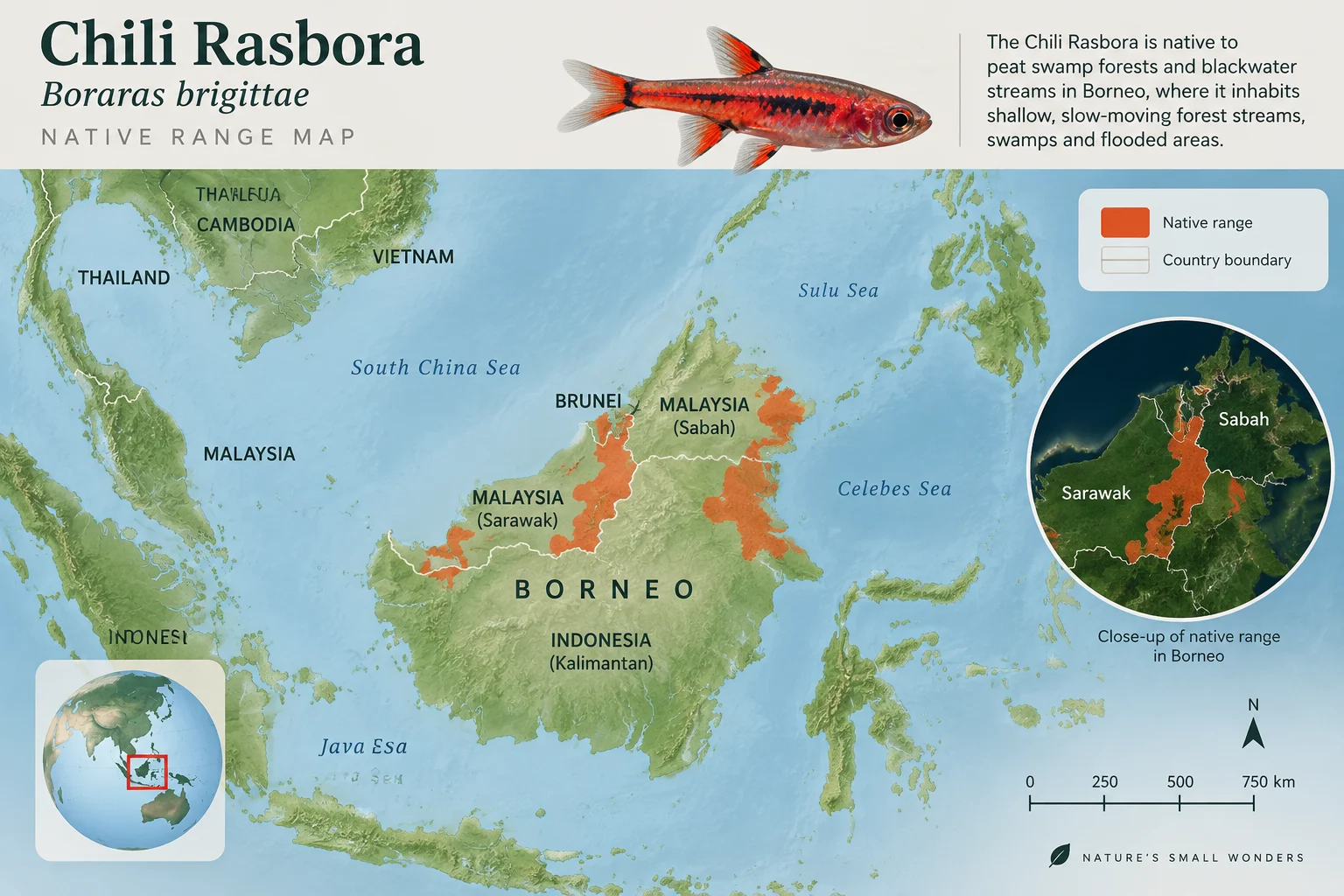
Boraras brigittae originates from Borneo in Southeast Asia. Wild populations are associated with shallow streams, swampy forest waters, peat swamps and other slow-moving habitats containing dense aquatic and marginal vegetation.
Many of these habitats contain naturally soft and acidic blackwater. Decaying leaves and organic material release tannins into the water, creating the tea-coloured appearance commonly associated with Southeast Asian peat swamps. The bottom is often covered with leaf litter, submerged roots and dense vegetation.
This natural environment explains why Chili Rasboras often look and behave best in planted aquariums with subdued lighting, floating plants, gentle water movement and plenty of visual cover.
Chili Rasbora tank size & requirements
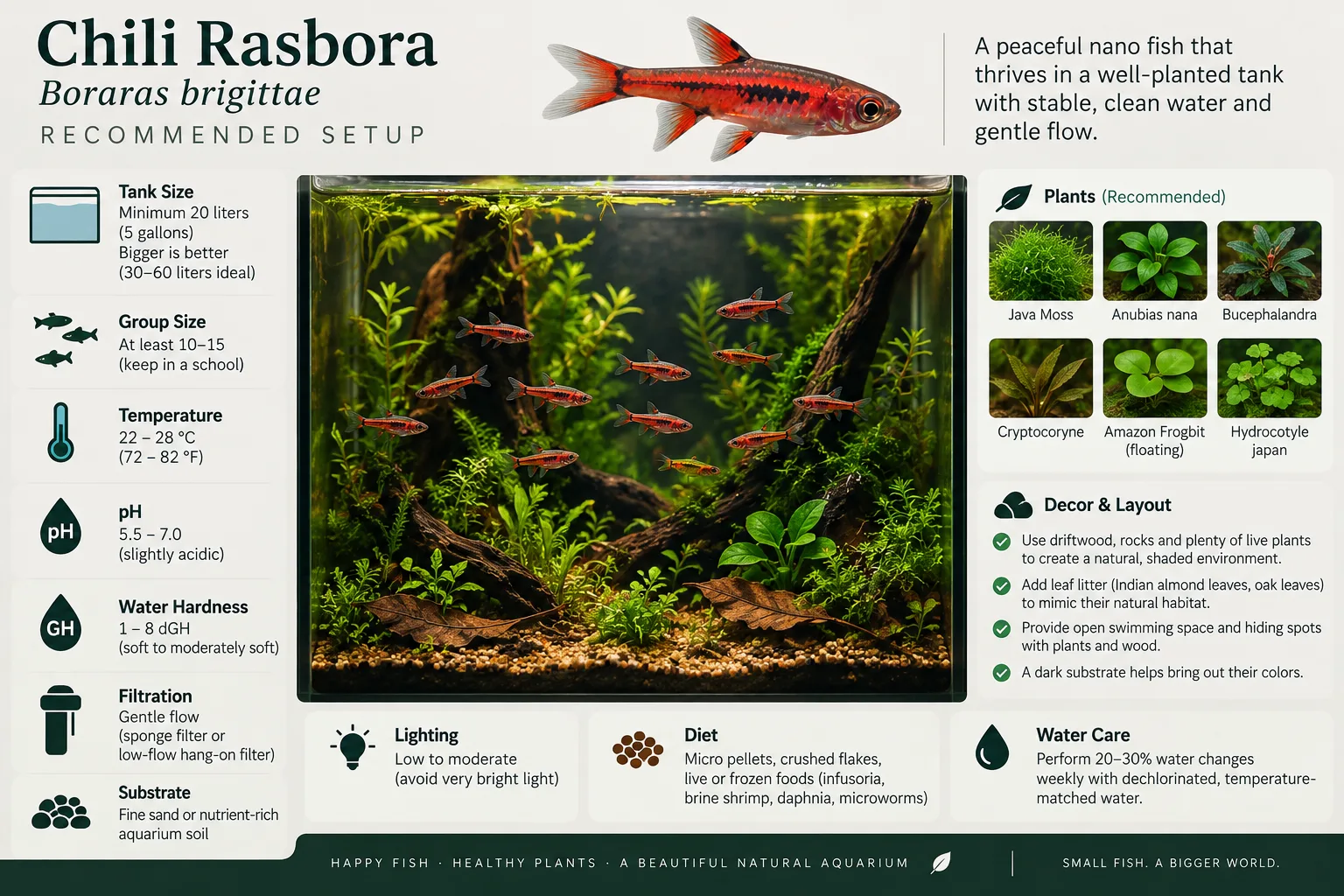
Despite their tiny adult size, Chili Rasboras benefit greatly from more aquarium space. A 10-gallon (38 L) aquarium is a practical minimum for a proper school, while larger tanks provide more stable water conditions and allow the fish to display more natural behaviour.
A heavily planted aquarium is ideal. Use fine-leaved plants, mosses, floating plants and other dense vegetation to create a secure environment. Open swimming areas should still be available, but the fish should always have nearby cover.
How many Chili Rasboras in a 5, 10 or 20 gallon tank?
Chili Rasboras should be stocked as a school rather than individually. A 5-gallon tank is difficult to keep stable and is best avoided for long-term care. A mature 10-gallon aquarium can comfortably house around 8–12 fish, while a 20-gallon aquarium can support a much larger school or a peaceful nano community.
| 5 gal (19 L) | Possible only as a carefully maintained species-only setup, but stability is limited. A larger aquarium is strongly recommended. |
|---|---|
| 10 gal (38 L) | A good minimum for 8–12 Chili Rasboras in a heavily planted aquarium. |
| 15 gal (57 L) | Excellent for a larger school of 12–20 fish with dense planting and stable water. |
| 20 gal (75 L) | Ideal for a large school or a carefully selected peaceful nano community. |
| 29 gal (110 L) | Allows a large natural-looking school with multiple compatible nano species. |
Water parameters
| Temperature | 22–28 °C (72–82 °F) |
|---|---|
| pH | 4.0–7.0 |
| Hardness (GH) | 0–10 dGH, preferably soft water |
| Filtration turnover | Gentle filtration with very low current |
Gentle filtration is important. Strong filter outlets can push these tiny fish around and prevent them from feeding comfortably. Sponge filters or filters with reduced flow work particularly well. A mature aquarium with stable biological filtration is strongly preferred over a newly established tank.
Dark substrate, driftwood, dried leaves and floating plants can help recreate their natural blackwater environment while making the red coloration of the fish stand out.
Not sure how many litres your tank actually holds? Check it with the aquarium volume calculator.
What do Chili Rasboras eat? Diet & feeding
Chili Rasboras are micro-predators that naturally feed on tiny invertebrates and zooplankton. Their mouths are extremely small, so food size is one of the most important parts of their care. Large flakes and pellets may simply be ignored because the fish cannot comfortably swallow them.
Suitable foods include crushed high-quality flakes, powdered fish food, micro pellets, baby brine shrimp, daphnia, cyclops and other tiny live or frozen foods. Live foods are particularly useful for conditioning breeding adults and encouraging strong coloration.
Feed small amounts once or twice daily and watch carefully to make sure every fish is eating. In community tanks, larger and faster fish may consume most of the food before Chili Rasboras get a chance.
Chili Rasbora tank mates & compatibility
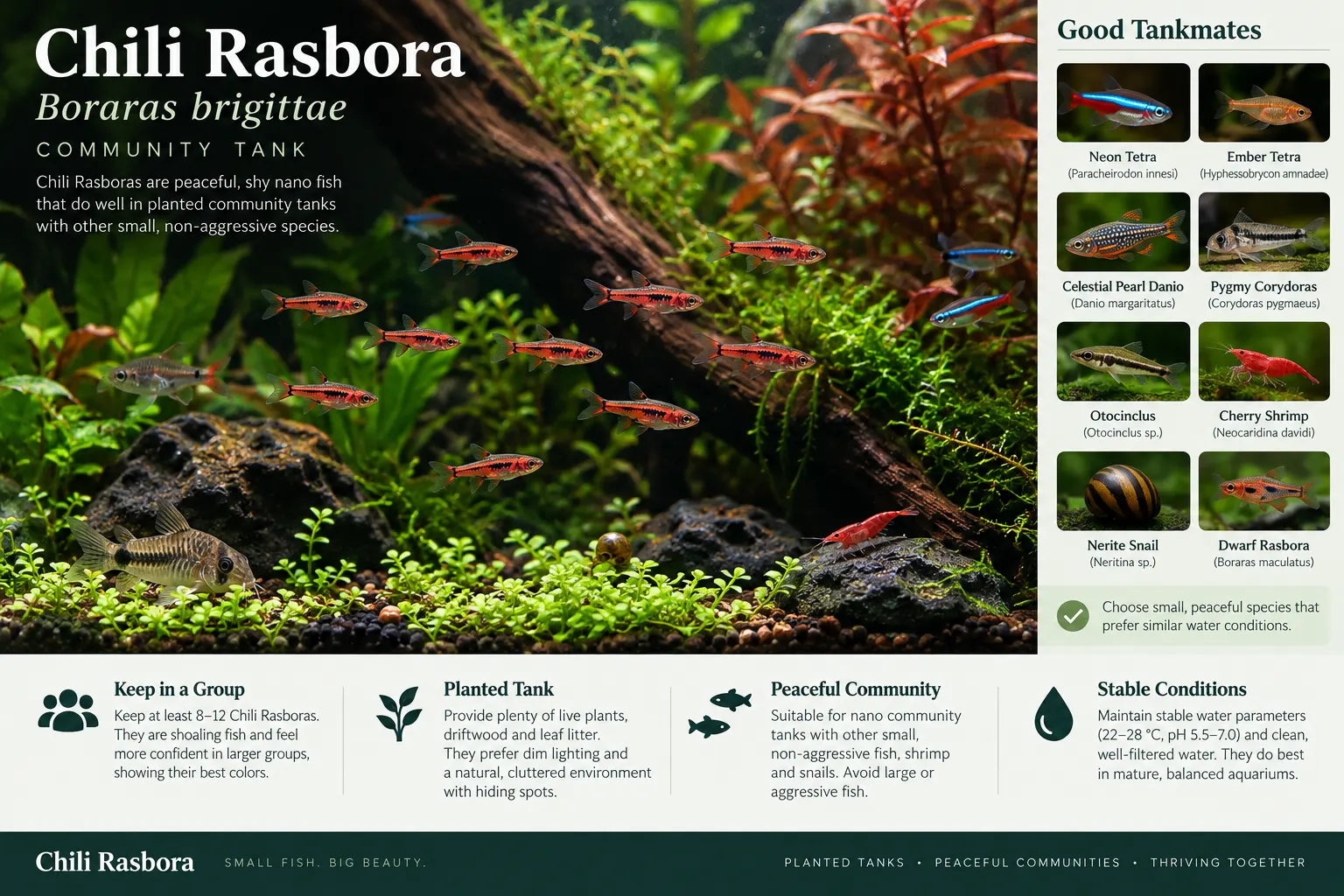
Chili Rasboras are extremely peaceful and should be kept with fish that will not intimidate, outcompete or eat them. Their tiny size makes compatibility more about the behaviour and size of their tankmates than aggression from the rasboras themselves.
Keep them in a school of at least eight to ten fish. Larger groups are usually more confident and will spend more time swimming in open areas. A group of 15 or more often creates a spectacular schooling effect in planted aquariums.
Good Chili Rasbora tank mates
- Other Boraras species with similar water requirements
- Phoenix rasboras
- Exclamation point rasboras
- Celestial pearl danios in suitable calm, planted aquariums
- Small peaceful Corydoras species such as pygmy corydoras
- Otocinclus in mature, established aquariums
- Small peaceful shrimp species
- Other tiny, non-aggressive nano fish with similar water preferences
Avoid
- Large or aggressive fish that may eat Chili Rasboras
- Fast, boisterous fish that outcompete them for food
- Large barbs and active danios
- Cichlids and predatory fish
- Fin-nipping species
- Fish requiring strong water current
How to breed Chili Rasboras
Chili Rasboras can breed in mature planted aquariums, although raising large numbers of fry requires a dedicated setup. They are egg scatterers and provide no parental care. Adults may eat eggs and fry, especially in open aquariums without dense vegetation.
Sexing adults is relatively straightforward once the fish mature. Males are generally slimmer and display stronger red coloration, while females tend to be slightly larger and rounder through the abdomen.
For intentional breeding, use a small mature aquarium with very soft, clean water, gentle filtration and dense moss or fine-leaved plants. Spawning often occurs among plants. After eggs are laid, adults should be removed if maximum fry survival is the goal.
The fry are extremely small and initially require microscopic foods such as infusoria and other suitable fry foods. As they grow, they can gradually move onto larger foods such as baby brine shrimp.
Naming confusion & buyer’s notes
Chili Rasboras are often confused with several closely related species in the genus Boraras. These fish are all tiny, colourful and commonly sold in the aquarium trade, but they are separate species.
Chili Rasbora vs Phoenix Rasbora
Chili Rasbora (Boraras brigittae) is commonly confused with the Phoenix Rasbora (Boraras merah). Both are tiny red fish, but their markings and coloration differ. Always check the scientific name when purchasing.
Exclamation Point Rasbora
The Exclamation Point Rasbora (Boraras urophthalmoides) is another small relative frequently confused with Chili Rasboras. Its body markings are different, but care requirements are broadly similar.
Not a large-school fish for big community tanks
Although Chili Rasboras are schooling fish, they should not automatically be mixed with every peaceful community species. Their tiny size means even non-aggressive medium-sized fish can intimidate them or consume their food.
Colour depends on environment
Store-bought Chili Rasboras may initially appear pale due to transport stress. Strong red coloration usually develops after they settle into a stable, planted aquarium with good nutrition and a proper social group.
Tiny fish does not mean tiny care requirements
Chili Rasboras are often marketed for very small nano tanks, but water stability matters more than minimum physical space. A larger mature aquarium is usually easier to maintain and provides a much better environment for a healthy school.
Chili Rasbora FAQ
- How long do Chili Rasboras live?
- Chili Rasboras can live around 4–8 years when kept in stable, mature aquariums with clean water, a varied diet and a proper social group. Their lifespan is strongly affected by water stability because these tiny fish do poorly in newly established or rapidly changing aquariums.
- How big do Chili Rasboras get?
- Adult Chili Rasboras usually reach around 1.5–2 cm (0.6–0.8 inches). Their extremely small size makes them popular for planted nano aquariums, although their tiny body does not mean they should be kept in unstable or poorly maintained small tanks.
- How many Chili Rasboras should be kept together?
- Keep at least eight to ten, but larger groups of 12–20 usually produce much more confident and natural behaviour. Chili Rasboras are shoaling fish and often become shy or remain hidden when kept in very small groups.
- Can Chili Rasboras live in a 5 gallon tank?
- A 5-gallon tank can physically house a small group, but it is not ideal because tiny water volumes are less stable. A mature, heavily planted 10-gallon aquarium is a much safer and easier long-term choice for a proper school.
- Are Chili Rasboras good for beginners?
- They are peaceful and small, but they are not as forgiving as hardy beginner fish such as zebra danios. Chili Rasboras prefer mature, stable aquariums with gentle filtration and consistent water conditions, so they are better suited to beginners who understand aquarium cycling and maintenance.
- Are Chili Rasboras aggressive?
- No. Chili Rasboras are extremely peaceful. Males may display to each other and briefly chase during social interactions, but they rarely cause harm. Their biggest problem is usually being intimidated by larger or more active tankmates.
- What do Chili Rasboras eat?
- Chili Rasboras need very small foods because of their tiny mouths. High-quality micro pellets, crushed flakes, baby brine shrimp, daphnia, cyclops and other tiny live or frozen foods work well. A varied diet helps maintain strong red coloration and healthy breeding behaviour.
- Do Chili Rasboras need a heater?
- Usually yes, unless the room naturally stays within their preferred temperature range of roughly 22–28 °C (72–82 °F). A heater is useful because stable temperature matters more than constantly fluctuating conditions.
- Can Chili Rasboras live with shrimp?
- Yes. Adult shrimp are generally safe with Chili Rasboras, and the fish are among the better nano fish for peaceful shrimp aquariums. However, very tiny shrimp babies may occasionally be eaten.
- Why are my Chili Rasboras pale?
- Pale coloration can result from stress, poor water conditions, transportation, insufficient cover, aggressive tankmates or being kept in too small a group. Males usually show their strongest red coloration when healthy, comfortable and competing naturally with other males.